Things that don't exist in Spain
(and how to find them, anyway... with the Spanish to ask for them)

There’s no ice in Spain.
Think there’s no ice in Spain? No decaf coffee? No peanut butter? No hair conditioner? Or…
If you believe all the “advice” you read in Camino groups, you’d think Spain is lacking most everyday essentials, apart from café con leche and tortilla.
But the truth is: these things DO exist—you just need to know what to ask for and where to look.
Pilgrims struggle to find basic items not because we don’t have those things in Spain but because:
- They don’t know what they are called in Spanish.
- They don’t know where to buy them.
- They ask in English… and get blank stares.
Like the person who was adamant that decaf coffee can’t be found ANYWHERE in Spain.
When I asked what they ordered, their response was “decaf”. In English.
That’s why they couldn’t find it! Because the people they asked didn’t understand English. Not because there’s no decaf.
⚠️ Spoiler alert: there’s decaf EVERYWHERE; you just need to know what to ask for.
Or like the other person who was in pain for almost 2 days because they thought all pharmacies were closed on Saturday evening and all day Sunday.
⚠️ Another spoiler alert: there’s always an open pharmacy, any time of the day or night, any day of the week.
Being in pain for 2 days because you heard that everything is closed on Sundays, including pharmacies, is unnecessary. It will slow you down and it’s potentially dangerous. Your condition could deteriorate.
Apps and phrasebooks teach you general vocabulary. They don’t focus on the needs of pilgrims. they don’t give you cultural insights or explain how things are organized in Spain.
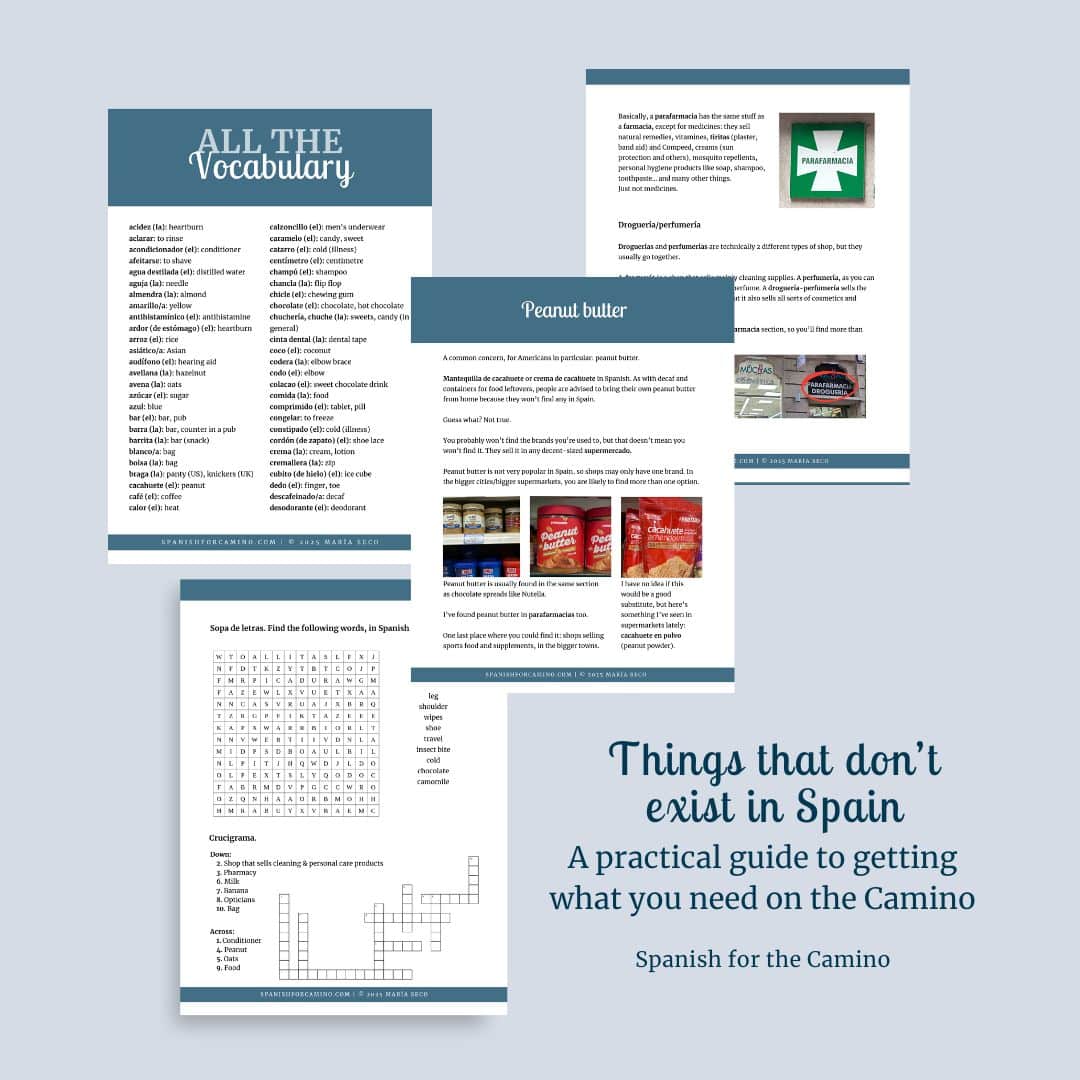
Things that don’t exist in Spain focuses on real-life situations pilgrims face. It gives you both the language tools and the cultural insights.
It covers 25 common items pilgrims often search for, along with their Spanish translation, where to find them and how to ask for them like a local.
It also includes bonus vocabulary, practical tips about Spanish shops and even exercises to reinforce what you learn.
THE BENEFITS
WHAT’S INSIDE
 Feel confident navigating pharmacies, cafés and other stores.
Save time and avoid stress by knowing where to go and what to say.
Handle emergencies like a blister or a lost item with calm and clarity.
Connect more easily with locals—even if your Spanish is basic.
62 pages full of practical advice.
25 items pilgrims often search for (plus extra related items in most chapters).
Exercises to practice what you learn (with answers).
Full Spanish-English glossary, with over 100 words.
Bonus vocabulary.
Practical tips about Spanish shops.
Get yours
ALSO INCLUDED

Audio companion, in case you prefer to listen. This audio companion includes all the vocabulary mentioned in the guide, so you know exactly how to pronounce everything.
Things that work differently in Spain: an extra guide explaining cultural aspects of Spain that might cause confusion, so you know exactly what to expect.
This guide includes new Spanish vocabulary not included in the main guide + audio with all the new words.
Hola, soy María
I’m a Spanish teacher who lives on the Camino Portugués.
When I’m not walking the Camino, I help other pilgrims learn the Spanish they need for their walk across Spain on the Camino de Santiago.
I believe that walking into a café, joining a local festival and chatting with people, understanding what’s going on, feeling connected… will help you enjoy a richer, more meaningful Camino.
That’s why I help you learn the Spanish language and culture you need to make the Camino a truly transforming experience.

Frequently Asked Questions
I don’t speak any Spanish—will this book still help me?
Yes! This ebook is made specifically for English speakers with little to no Spanish. It’s designed to help you ask for what you need using simple phrases, with clear explanations.
Can’t I just use Google Translate?
You could, but it’s not always reliable—especially for local shop names, product types, or when there’s no Wi-Fi. This guide gives you context, local terms, and confidence—without relying on tech that might fail you.
What if I don’t need all 25 items?
Totally fine! Even if you don’t need everything listed, the vocabulary and shop tips apply to lots of common situations on the Camino. Plus, related items are covered in each chapter, so you’ll still get plenty of value.
I’m leaving soon—will I have time to go through it?
Yes! It’s quick to read and easy to skim. You can focus on what matters most to you, and even practice with the exercises or glossary during your travels.
Because it’s all digital, you can have both the text and/or the audio on your phone while on the Camino. You can refer to it anytime.
Is this a physical book or a digital download?
Both guides are digital, in PDF format, so you can download them instantly and access them from your phone, tablet, or laptop—perfect for traveling light on the Camino. You could also print any pages you need.
You can also access the audios from your device and download them to use them offline.
Why does a simple ebook cost this much?
Great question! This isn’t just an ebook with a vocab list—it’s a carefully curated Camino-specific guide with practical language, cultural context, and bonus tools like exercises, a glossary and audio. It saves you time, stress, and potential mistakes on your journey—making it well worth the investment.
Back to check all the learning options.