Life as an expat in Spain

Life as an expat in Spain

Many pilgrims who walk the Camino de Santiago end up falling in love with the country and dream of starting a new life here. Some actually do. But as my guest in the podcast reminds us, moving to Spain 

In this episode of the Spanish for the Camino podcast, I speak with Jimena Ibarra, a Spanish teacher who helps expats in Spain. As an expat herself, she knows that moving to Spain means more than just speaking Spanish: it’s about understanding everyday language, culture, and the little things that make life here unique.

Jimena is originally from Mexico. Before settling in Spain, she lived in Germany, Ireland, and England. Despite being a native Spanish speaker, she was surprised by how challenging it was to adapt when she moved to Spain in 2013 with her husband and three young children.

After 12 years, Jimena now feels like a local, but she remembers well the difficulties of those first months. That’s why she helps others navigate the same experience through her work teaching practical, everyday Spanish for life in Spain.

Culture shock… even in Spanish!

One of Jimena’s biggest surprises was how different Spanish culture (and even the language) can be compared to what she was used to.

She laughs about one of her first grocery trips in Spain: her Irish husband asked her to buy cookies. After 30 minutes walking up and down the supermarket, searching, she couldn’t find any… until she realised they were in the breakfast section! “Who eats cookies for breakfast?” she thought. It was her first taste of cultural shock in Spain.

She also discovered that some everyday words in Mexican Spanish don’t have the same meaning (or aren’t used at all) in Spain. And although she speaks fluent Spanish, she had to learn expressions like ir a la compra (“go grocery shopping”) instead of using ir de compras for everything (ir de compras means to go shopping for clothes, shoes, etc. in Spain).

Jimena noticed another big difference: the Spanish way of speaking. “In Spain, people speak more directly, and sometimes more loudly,” she says. “At first, I thought everyone was angry!”
In Latin America, the tone tends to be softer, and people rarely say “no” so directly. Over time, she learned that people were not angry at her and that this isn’t rudeness: it’s just a cultural difference.

Tips for anyone planning to move to Spain

Jimena shared some valuable advice for anyone thinking about making the move:

  • Keep an open mind. Every country has its own way of doing things. Spain works like Spain—not like Germany, the U.S., or Mexico.

  • Be patient with bureaucracy. It’s usually slow. We even have a saying for it: Las cosas de palacio van despacio (literally, palace business moves slowly).

  • Learn basic Spanish. Even if you’re not fluent, learning the essentials helps you become independent and enjoy your new life without relying on others to translate everything.

As Jimena says, “At first you need help, but eventually you have to take that step toward independence. That’s when you really start enjoying life here.”

Despite the challenges, Jimena wouldn’t change her decision. “We are here to stay,” she says. “Spain is home now.”
Her message is clear: come prepared, be patient, and embrace the differences, because life in Spain can be wonderful.

You can find Jimena online on her website or on YouTube.

Want more?

Make sure you don’t miss any posts or announcements by subscribing for free here. You’ll receive the transcripts + vocabulary guides + interactive exercises of episodes 1-5 of the Spanish for the Camino podcast. And… you’ll get access to exclusive content too.
A walk through Castilla y León

A walk through Castilla y León

The Camino Francés crosses most of Spain from east to west, and goes through 4 different regions. The biggest (and one of Spain’s biggest too) is Castilla y León.

My guest on the podcast today is Sara Castro, a Spanish teacher and host of the podcast Spagnolo a 360 gradi. Although she lives in Italy and mainly teaches Italian students, Sara is originally from Castilla y León, which is crossed by several other Camino de Santiago routes too.

We talk about the Meseta, that long, flat stretch of the Camino Francés between Burgos and León. Sara explains why this part of the Camino can be tough, with its extreme weather and seemingly endless landscape, but also deeply rewarding for those seeking a more introspective journey.

Of course, we also talk about food. The hard weather  we mentioned earlier influences Castilla y León’s cuisine: you’ll find lots of hearty dishes like sopa de ajo (garlic soup), lechazo asado (roast lamb) or lentils and chickpeas stews. The Ribera del Duero wine is produced in this area too.

Valladolid, Sara’s town, hosts a national pinchos and tapas competition.  You have to pay for those, but right on the Camino, in León, you get a free tapa with your drink. 

More on tapas and pinchos here.

Sara also invites us to discover the region’s rich cultural and historical heritage: the cathedrals, castles and other monuments as well as centuries of history: El Cid, Christopher Columbus, kings and queens like Isabel de Castilla and Felipe II, Cervantes… 

If you’re planning your Camino or simply want to learn more about this part of Spain, this episode will give you plenty of reasons to slow down, explore, and enjoy every step through Castilla y León.

More about Sara and her work: https://www.saracastro.net/

Her podcast, Spagnolo a 360 gradi (don’t let the name fool you, the podcast is all in Spanish!): https://open.spotify.com/show/7vjXdkLC5TLYvqXHMGle4B?si=fd6275b07c52464d

And here is when she invited me to her podcast.

Want more?

Make sure you don’t miss any posts or announcements by subscribing for free here. You’ll receive the transcripts + vocabulary guides + interactive exercises of episodes 1-5 of the Spanish for the Camino podcast. And… you’ll get access to exclusive content too.
Santiago in the Canaries

Santiago in the Canaries

Santiago in the Canary Islands? Yes, really!

There are over 140 places named after Santiago all over the world. A few of them are located on the Canary Islands, so this week on the podcast I welcom back Marina Rodríguez, who you might remember from episode 25, when she told us all about the Camino de Gran Canaria.

We talk about places in the Canary Islands that are named Santiago... and something else that connects Galicia and the Canary Islands.

Playa de Santiago

The first place Marina tells me about is Playa de Santiago on the small island of La Gomera:  a quiet fishing village with black sand beaches, tucked at the mouth of the Barranco de Santiago. It started out as a fishing spot, then grew into a hub for canning fish, exporting tomatoes and bananas, and welcoming ships. Today, it’s still authentic and peaceful—definitely not the kind of place overrun by tourists.

Santiago en Tenerife

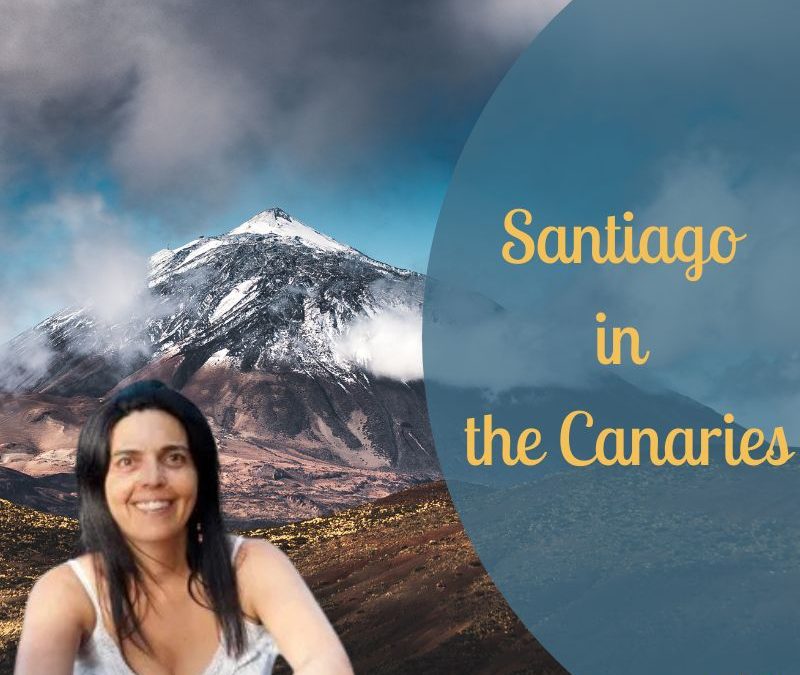
Then we jumped over to Tenerife to explore Santiago del Teide. This mountain village sits near Spain’s highest peak, Mount Teide, which is actually a volcano. It’s not the only volcano in the area. The nearby  Chinyero last erupted in 1909.

Fun fact: the town was once just “Santiago,” but constant postal mix-ups with Playa de Santiago in La Gomera (letters ending up on the wrong island!) forced the locals to rename it Santiago del Teide. That solved the problem, and the name stuck. Nearby you’ll also find Puerto de Santiago and the dramatic cliffs of Los Gigantes, plus whale and dolphin watching.

More links between the Canaries and Galicia

Of course, since Marina is from the Canaries, we couldn’t resist diving into local culture and language. We discovered more interesting links between Canary Spanish and Galician, like similar vocabulary. c

And we talked about the Canarian version of Galicia’s furanchos: guachinches (in Tenerife) or bochinches (in Gran Canaria). These started as homes where families sold their extra wine alongside homemade food. Today, they’ve evolved into more conventional restaurants serving traditional dishes, though the most authentic ones still only open in winter, when the new wine is ready.

Marina shared two theories about the name guachinche. One is that it comes from buche (sip) > bochincheguachinche.

The other? A popular legend that it comes from locals teasing English visitors with “I’m watching you” as they drank! And that became bochinche /guachinche. No one knows for sure and there’s no evidence that that’s the real origin of the word, but it’s a great story.

If you’re curious about language, culture, and hidden corners of the Canary Islands linked to Santiago, this episode is for you. And if you want to learn more from Marina, check out her website Lengua Babel.


I started this series on places named after Santiago a few weeks ago with an episode on Santiago de Chile. You read/listen here.

Want more?

Make sure you don’t miss any posts or announcements by subscribing for free here. You’ll receive the transcripts + vocabulary guides + interactive exercises of episodes 1-5 of the Spanish for the Camino podcast. And… you’ll get access to exclusive content too.
When the Camino calls

When the Camino calls

Brand-new season of the Spanish for the Camino podcast.

I couldn’t think of a better way to do it than with a guest with ample Camino experience.

Meet Rebecca Weston: originally from the U.S., now living in Villaviciosa, Asturias, right on the Camino del Norte. Rebecca has walked many routes over the years and even helps others plan their own pilgrimages.

Discovering the Camino

In our chat, Rebecca shared how she first discovered the Camino back in 2000 through a book by actress Shirley MacLaine. That piqued her interest but she didn’t actually walk until 2012.

Back then, she had no idea there were other routes or even that you could continue to Finisterre, so for her first pilgrimage she walked the Camino Francés all the way from Saint-Jean-Pied-de-Port to Santiago. 

Things have changed a lot since 2012. Rebecca described how the Camino Francés has become much busier, with more albergues, cafés, and international pilgrims every year. That’s one reason she now prefers the quieter routes, like the Camino Inglés and especially the Camino de Invierno, where she once met only a handful of fellow pilgrims over two weeks.

Feeling nervous about walking the Camino?

When I asked Rebecca what advice she’d give to someone considering the Camino but feeling nervous, her answer was simple: if the Camino is calling you, listen to that feeling and go for it. Don’t overthink it. And instead of drowning in online information, try to talk to someone who’s walked it in real life over a coffee or even on a video call.

Rebecca herself felt called to walk the Camino all those years ago. At the time, she didn’t know why. She just knew she had to walk. So she did. And the rest is history, as they say.

Do you need Spanish on the Camino?

We also talked about language. Rebecca didn’t speak Spanish at all on her first Camino. She knew French, and that was helpful. But when she decided to go back to the Camino she started learning a few key phrases, to help her with basic daily interactions like finding a bed. That was enough for her to notice a huge difference in how people responded to her.

One of her favorite memories is from an albergue where the hospitalera was thrilled that Rebecca tried to speak Spanish and helped translate for other pilgrims who couldn’t speak a word of Spanish. Thanks to that, she and her father were treated to coffee before setting out very early the next morning, before coffee was normally available, something that probably wouldn’t have happened otherwise.

By 2021, she began studying seriously, and now, after four and a half years living in Spain, she can give her first interview entirely in Spanish! 

To wrap up, Rebecca reminded us that there’s no single “right way” to do the Camino. Each pilgrim’s journey is unique, and that’s the beauty of it.

If you’d like to connect with Rebecca, you can find her at thecaminocalls.com where she shares resources and interviews about the Camino.

Want more?

Make sure you don’t miss any posts or announcements by subscribing for free here. You’ll receive the transcripts + vocabulary guides + interactive exercises of episodes 1-5 of the Spanish for the Camino podcast. And… you’ll get access to exclusive content too.
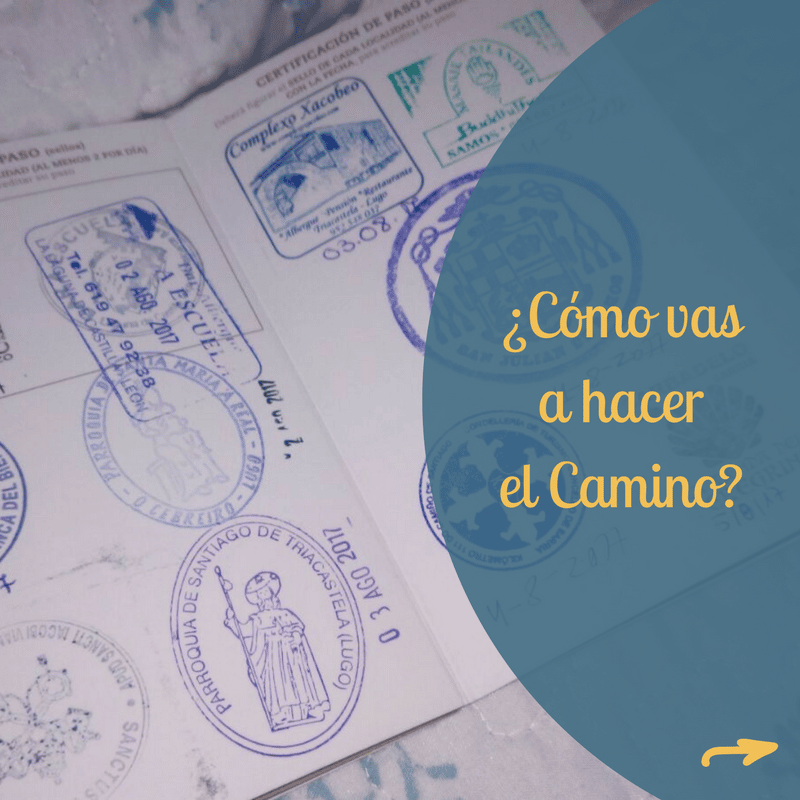
¿Cómo vas a hacer el Camino?

¿Cómo vas a hacer el Camino?

Updated May 2025

How will you do the Camino?

Once you decide you want to go on the Camino, you need to start making other decisions.

The first one:

¿Cómo vas a hacer el Camino? (How are you going to do the Camino?)


Before we go on, let me remind you what I said in the intro post about travel vocabulary guides: I don’t like them because they don’t tell how to pronounce the words. And I don’t want to be like them, so keep reading till the end of this post if you want to learn how to pronounce the Camino vocabulary you’ll find in this article.


Going back to the question “how will you do the Camino?”, most people do it a pie (on foot, walking). But that’s not the only way that is allowed if you want to get a Compostela when you reach Santiago.

According to the pilgrim’s office website, you can also do it en bici (cycling), a caballo (on horseback) or you could even sail part of it and walk from the port where you disembark. 


What is a Compostela and how to get it

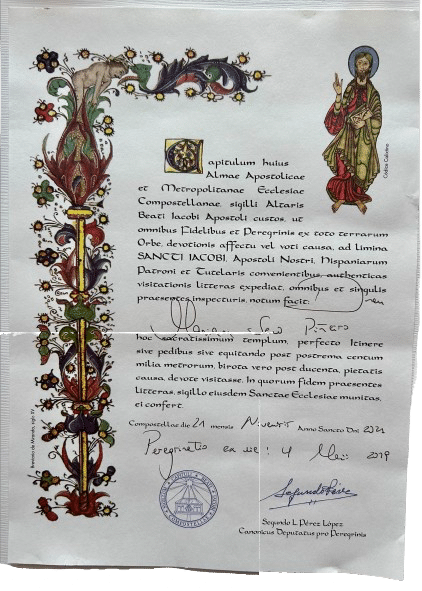
Compostela certificate

A Compostela is a certificate issued by the Santiago cathedral saying that you have completed the pilgrimage to the tomb of St. James on one of the recognized routes.

At the end of 2024, the cathedral announced changes to the requirements to get a Compostela. 

You’ll find all the info on their website, but here’s a summary:


(Get this episode’s transcript for free here)

According to the pilgrim’s office website, in order to obtain a Compostela, you must walk “at least 100 continuous kilometers on the same route to Santiago recognized by the International Pilgrim’s Reception Office system. The final stage must include at least, the last one leading into Santiago’s Cathedral”.

“If a pilgrim has already started a route on foot outside Spain along one of the routes recognized by the International Pilgrim’s Reception Office system, the required distance in Spain shall be no less than 70 kilometers”.

There has been some speculation about the meaning of the “last stage”, and whether that last stage must have a specific distance, but it doesn’t seem to be so.

So, you could walk 100 continuous km anywhere along the Camino Francés, or Portugués, or any other route, and  then take a train or bus to the outskirts of Santiago (the airport on the Camino Francés or Milladoiro on the Portugués, for instance) and walk those last couple of kilometres into Santiago.

Same distance applies if you’re horse riding, but if you decide to do the Camino on a bike, then you must cycle at least 200 km in order to qualify for a Compostela. For sailors, the required distance is 100 nautical miles.


The credencial

You’ll need proof that you’ve done all of that.

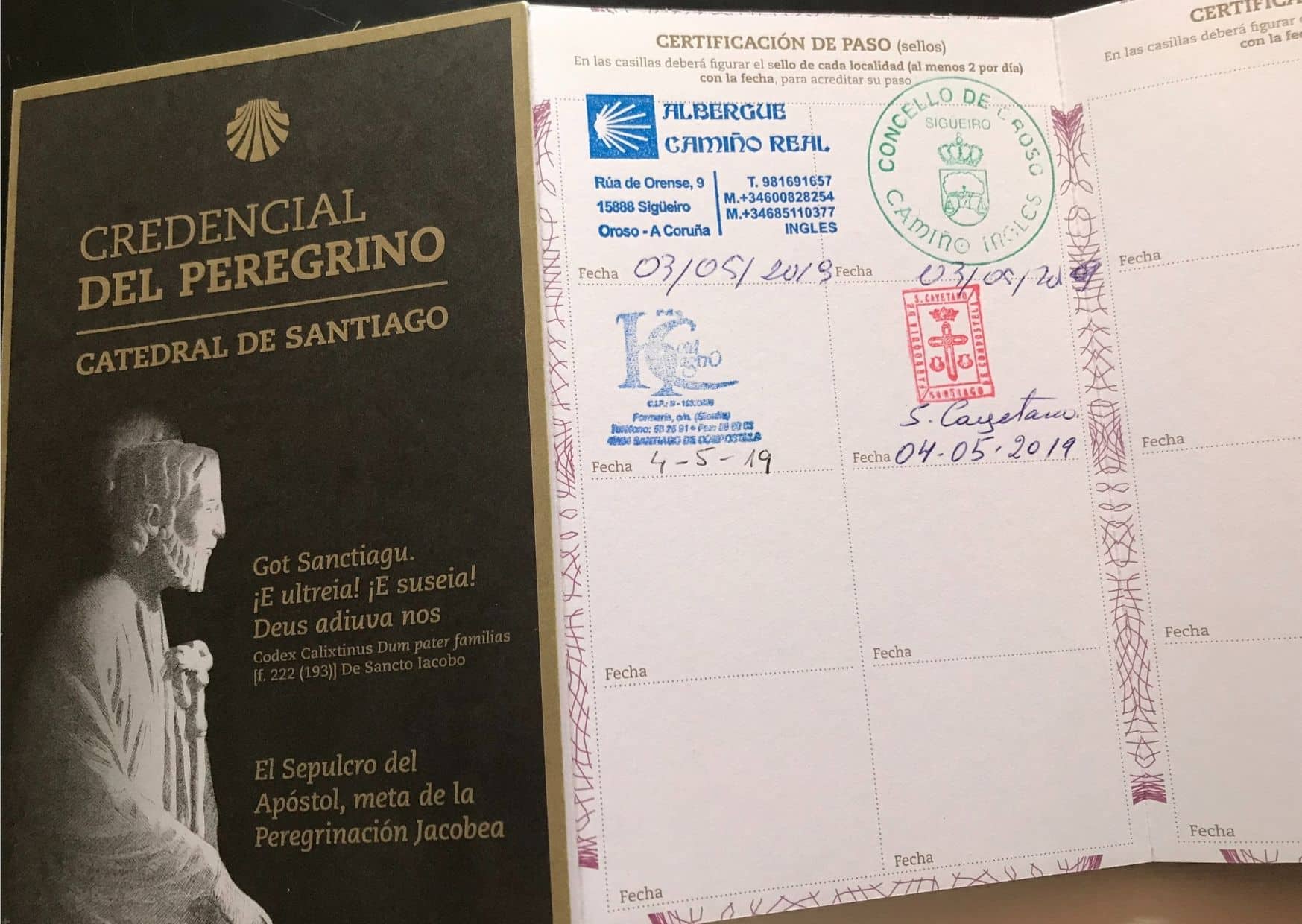
That’s what the credencial is for. A credencial is like a Camino passport, that’s why many people refer to it as the pilgrim’s passport. You’ll need to get sellos (stamps) on it along the way.

You can get stamps from many places such as bars and cafés, accommodations, churches, town halls or post offices.

You’ll also need a credencial if you’re planning to stay in pilgrim-only hostels, to show that you’re on the way to Santiago.

Listen to this episode of Beginners Spanish for the Camino podcast about the word credencial.


Escucha “4. Credencial” en Spreaker.


Pilgrims passport and stamps


Have you decided already? ¿Cómo vas a hacer el Camino?

Write your answer, in Spanish, in the comments: Voy a hacer el Camino…

Basic Spanish Camino vocabulary

Want more?

Make sure you don’t miss any posts or announcements by subscribing for free here. You’ll receive a free Spanish vocabulary guide with your first Spanish words + cultural tips. And… you’ll get access to exclusive content too.
 

¡Buen Camino!

Things that don’t exist in Spain

Things that don’t exist in Spain

If you’ve never been to Spain and believe everything you read online (especially in Camino groups) you might end up filling your backpack to the brim. Why? Because apparently, according to some of those posts, Spain doesn’t have anything.

But is that really true? Can you not find ice, peanut butter, electrolytes or even flip flops in Spain?

It’s normal to have lots of questions before traveling to a new country, especially if it’s your first time.

I remember my own first trip to the UK when I was about 15 or 16. I went with a school group and stayed with host families. Some of the questions we got from them were… interesting.

Things like: “Do you have washing machines in Spain?”
And years later, when I moved to Ireland, I heard more of the same. A Spanish friend mentioned her dad was an engineer, and people were genuinely surprised: “Wait, there are engineers in Spain?”
This was from people who had actually been to Spain, and seen our roads, airports, infrastructure…

So, yes, some stereotypes are hard to shake.

And when I scroll through Camino forums, I see similar assumptions.
People ask if they need water purification tablets. Or vaccines. Fortunately, these are not the most frequently asked questions, but they come up every now and them. 
In case there are any doubts, let me clear that up right now: No, you don’t need water purification tablets to walk the Camino in Spain. You don’t need any vaccines to get into the country either.

So, over the last few months, I’ve been compiling a list of the questions I see most often in forums and groups. Some are understandable, others a bit surprising. But what truly baffles me are some of the answers.

Take decaf coffee, for example.

Someone asked if it was available in Spain.
A few people quickly replied there’s no decaf in Spain.

One person even said they had just walked the Camino and hadn’t found decaf anywhere. I was curious, so I asked what they had asked for. Their answer was “decaf”, in English.

Well, that explains it.

Of course they couldn’t find it. No one understood what they were asking for. That doesn’t mean it doesn’t exist!


Someone else asked if it was acceptable to take leftovers home from a restaurant.

The response?
“No, that’s not something people do in Spain. They won’t understand if you ask for a doggy bag.”

Well, if you say “doggy bag” in English in a Spanish restaurant, no, they probably won’t understand.

And if you try Google Translate and ask for “una bolsa para el perro”, they might hand you a bag of scraps for your pet—as they did with another poor pilgrim!

But does that mean you can’t take your leftovers home?
Not at all. It’s actually perfectly normal to do so in Spain. But you need to ask in proper Spanish.

(Get this episodes’s transcript for free here)

So, I compiled a list and ended up with 25+ items that people often worry they won’t be able to find in Spain.

Then, I went to supermarkets, pharmacies, sports stores… and even those catch-all chinos (discount stores run by Chinese families). All the typical places you’d go shopping in Spain. Just to confirm that everything on my list could be easily found.

And guess what?
I found everything. I had to search a bit harder for one of the items… but I found that one eventually, just not in the first shop I checked.

Here’s the thing: sometimes it’s not about what’s available, but how you ask for it and where you’re looking.

For example, in the UK or Ireland, you can often buy over the counter medicine like painkillers or cold remedies at a supermarket.

But in Spain? Nope. You won’t find those in the supermarket.

That doesn’t mean they’re not available. You just need to go to a pharmacy.

I’ve turned all this info into a super practical guide called: Things That Don’t Exist in Spain
(Spoiler: They do exist).

Inside, you’ll find:

  • A list of 25+ commonly asked items

  • Where to find them

  • What to say in Spanish so people understand you

  • Cultural tips, like how to find a pharmacy open 24/7—even on Sundays and holidays

  • Photos to prove it all!

Inside pages of the ebook Things that don't exist in Spain

Want more?

Make sure you don’t miss any posts or announcements by subscribing for free here. You’ll receive the transcripts + vocabulary guides + interactive exercises of episodes 1-5 of the Spanish for the Camino podcast. And… you’ll get access to exclusive content too.