Galician language on the Camino

Galician language on the Camino

Updated February 2026.

Imagine you are on the Camino Francés… or on the Camino del Norte, or the Primitivo or even on the Vía de la Plata. It doesn’t really matter.


The thing is, you are walking across Spain. Maybe you’ve prepared before your trip and learned a bit of Spanish. Or you’ve been picking up a few words along the way. And then you enter Galicia and you get the impression that people sound different.


What’s worse: things start getting confusing. Now you see Fisterra… later you see Finisterre… Are they different places? Is it the same place?

Don’t worry! You’re not going crazy. You’re encountering Galician, or galego, a language you’ll hear and see during the last 100 km of any Camino.

A brief history of Galician

Spain has not always been Spain as we know it today. A few centuries ago, it consisted of several smaller kingdoms, including the Kingdom of Galicia, which covered modern day Galicia, the north of  Portugal as well as part of Asturias and León.


Latin was the dominant language in the Iberian Peninsula, but over time, it evolved differently across regions, giving rise to several languages. Some of them have survived until our days and they are co-official, together with Spanish, in their respective territories.


Such is the case of gallego (Galician), or galego in the Galician language. And that’s what you are hearing!


  • The first written documents in gallego date back to the 12th century. During the Middle Ages, gallego was the language of poetry in all of Spain.


  • Gallego and portugués were initially the same language, but by the 14th century, that language had already split into the two separate languages we have today. This means that gallego and portugués have a lot in common. So, knowing a bit of gallego will help you in Portugal too!


  • Galician was banished from public life in the 15th century, and it remained so until the 19th century. During this period, the upper classes spoke Spanish, while Galician remained the language of the lower classes. Add to this the fact that Galicia became impoverished during this time and many had to emigrate. In many cases, these people were ridiculed and made fun of because of their language.


  • In the 18th century, a group of intellectuals started becoming interested in the Galician language. One of them was Padre Sarmiento, whose pilgrimage to Santiago inspired the Variante Espiritual route.


  • One of the first and most popular authors to write in galego was Rosalía de Castro, who lived in Padrón, on the Camino Portugués.


Why town names can be confusing

As I just mentioned, during the 15th to 19th centuries, Galician was marginalized. Upper classes spoke Spanish.

Many names of towns (and family names too) were changed to make them sound more Spanish, more upper class. More recently, during Franco’s dictatorship, Galician was banned again.


All of this contributed to create the belief, that many still hold today, that Galician is an inferior language, that if you want to do well in life, you must speak Spanish and not Galician.

As a result of all of this, even today, you’ll see some towns with two versions of their name: the official Galician version and the older Spanish-sounding version.

To use an exampled I’ve mentioned before, Fisterra is the official name of the town where many end their Camino, but you’re likely to see Finisterre too.


Not every town has 2 names, but there are several well-known Camino towns where this happens. Wikipedia, for instance, tends to favour the Spanish name. Certain apps will only display the Spanish name too.


Muxía is an example of this. The Spanish-sounding version is becoming less and less common, but you may still see Mugía in places. Melide may sometimes appear as Mellid and Tui is still frequently spelled as Tuy (no change of pronunciation in this case).

    Common Galician words you’ll see on the Camino

    The use of galego varies across the region, so how much of it you see or hear will depend on where you are. Rest assured. Everyone can and will speak Spanish. But it’s nice and can be helpful at times to be familiar with some common words you’re likely to see often.

    Rúa (calle in Spanish): street

    Praza (plaza in Spanish): square

    Igrexa (iglesia in Spanish): church

    Mosteiro (monasterio in Spanish): monastery

    Concello (ayuntamiento in Spanish): town council

    Castelo (castillo in Spanish)

    We Galicians like to add the diminutive -iño/-iña to almost any word! It adds proximity, familiarity and even affection. So grazas (thank you) becomes graciñas and ata logo (see you later) becomes ata loguiño!
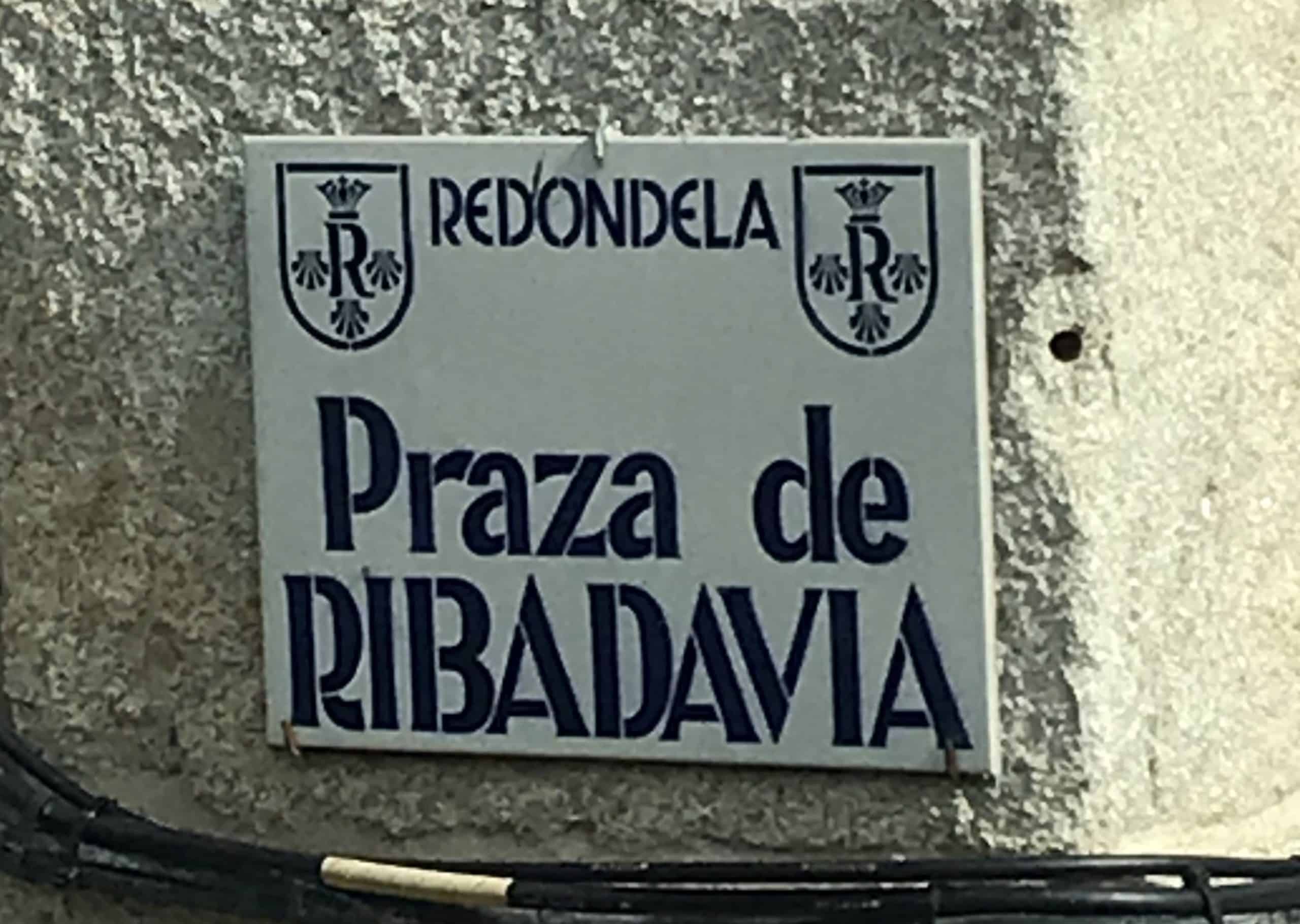
    Galician language
    Calle Peregrina Pontevedra


    Today’s Camino vocabulary

    For the pronunciation of Muxía, check the post about Muxía.

    For the pronunciation of Tui, check Camino Portugués.

    For the pronunciation of calle, iglesia and monasterio, check Camino Inglés: de Ferrol a Neda.

    For the pronunciation of plaza, check Santiago de Compostela.

    For the pronunciation of Fisterra and castillo, check Finisterre.

    Want more?

    Make sure you don’t miss any posts or announcements by subscribing for free here. You’ll receive a free Spanish vocabulary guide with your first Spanish words + cultural tips. And… you’ll get access to exclusive content too.

    You will come across Basque as you walk through País Vasco and Navarra. Oihana teaches us some basic words in this post.


    ¡Buen Camino!

    (or Bo Camiño, as we say in Galicia)

    Game of the goose

    Game of the goose

    Have you heard of the Game of the Goose?

    The Game of the Goose is a board game I used to play as a child… and now play again with my kids.

    And how is this relevant to the Camino, you may ask?

    In this guest post, Vickie Kelty tells us about the benefits of introducing board or card games on our Caminos. Games can also be a way to keep the Camino feeling alive while you can’t travel. And, of course, they’re a fun way to practice and improve your Spanish.

    But apart from all of that, which is valid for any game, really, there’s more.

    The Game of the Goose or La Oca, as we call it in Spanish, is an ancient game. It’s origins are not totally clear, but one theory links it to the Camino de Santiago. According to it, this game was created by the Templars in the 12th century; and it was not a game originally, but  an encrypted map of the Camino.


    Who are the Templars?

    But who are these Templars and why would they create an encrypted map of the Camino?

    There are many myths and legends around the Templars, so I won’t go into detail but the Knights Templar (or simply Templars, or Templarios in Spanish) were a Catholic military order founded in the early 12th century. They were active for around 200 years, until they were suppressed by Pope Clement V. The Templars were closely tied to the Crusades and one of their duties was to protect pilgrims going to Jerusalem.

    To cut a long story short, the order grew rapidly and extended to several countries, including what we today know as Spain.

    In Spain, they took part in the Reconquista (reconquest). Many of the territories being reconquered were located along the Camino, so the Templars contributed to the safety of pilgrims going to Santiago de Compostela too.

    Different sources differ about the extent of the Templars’ presence and influence on the Camino (there were other orders too and things sometimes get blurry). But we do know  for sure there’s a Templar castle in Ponferrada.

    Castillo templario de Ponferrada

    Templars’ castle in Ponferrada

    Why a goose? 

    Geese were considered sacred animals from ancient times and they would alert you in case of intruders. Also, only the nobility was allowed to raise geese so, if pilgrims saw a flock of geese they knew they were near a noble household, possibly a safe place.

    A lot has been written about the goose references along the Camino. That seems to support the links between the Camino and the game of the goose. We can find examples of these references in the names of many places, such as Montes de Oca, Puerto de Oca, Castrojeriz (which means city of geese) or Manjarín (meaning man of geese). Other references would be builders marks in the shape of a goose leg, found on churches; and even the cross in Puente La Reina’s church of the Crucifix (also in the shape of a goose leg).  

    The Game of the Goose

    But going back to the game, La Oca would be an encrypted map of the Camino. In those times, most people couldn’t  read, so each casilla* (square) had pictures. The symbols on each casilla would make reference to signs that had been placed along the Camino. Pilgrims would be told what each picture represented. On casilla 6, for instance, you’ll find un puente (a bridge), which allegedly represents Puente La Reina.

    The casillas with ocas (geese) on them would represent safe places. Not everybody uses the exact same rules; there are some variations. But this one doesn’t change: if you fall on a goose, you advance to the next one and roll your dice again, saying “de oca a oca y tiro porque me toca”, which roughly translates as “from goose to goose and I roll the dice because it’s my turn”… Sorry, it doesn’t rhyme in English!

    There’s a second bridge on casilla 12. If you fall on either of the bridges, you move to the other one and roll your dice again saying “de puente a puente y tiro porque me lleva la corriente” (from bridge to bridge and I roll the dice because the flow carries me).


      How many places on the Camino Francés can you recognise?

      There are also other special casillas like:   

      • El pozo (well). The well symbolises depression. If you fall here, you miss a turn and you can only get out with the help of another player.  
      • El laberinto (labyrinth). This symbolises getting lost, which was quite easy during the Middle Ages, since paths were not clearly marked as they are today (and of course, GPS was not a thing either). If you fall here, you go back to casilla 30.  
      • La cárcel (jail) y la posada (inn). Both places represent the necessary rest you need in order to complete your pilgrimage. If you get into jail, you miss 3 turns but you only miss one of you stay at the inn.  
      • La muerte (death). It doesn’t have to represent literal, physical death, although death does happen sometimes on the Camino (and I’m sure it was much more common in medieval times). The Camino is a life-changing experience for many, so death could also be a metaphor for new beginnings.    
      • Los dados (dice). They represent luck, which can be good or bad. There are 2 casillas with dados on them: numbers 26 and 53. There are rule variations for these; the one I’ve always used is this: if you fall on one of them, you have to move to the other one, which means sometimes you’ll be moving forward and sometimes you’ll be going backwards. 


      Game of the goose pozo

      El pozo

      Game of the goose laberinto

      El laberinto

      Game of the goose muerte

      La muerte

      Game images used with permission from www.ideasperegrinas.es

      So, will you give La Oca a go?


      Today’s Spanish words and phrases

      De puente a puente y tiro porque me lleva la corriente

      *Casilla means square in the context of board games. Other meanings of the English word square are expressed by different Spanish words.


      Want more?

      Make sure you don’t miss any posts or announcements by subscribing for free here. You’ll receive a free Spanish vocabulary guide with your first Spanish words + cultural tips. And… you’ll get access to exclusive content too.


      ¡Buen Camino!

      Games and the Camino

      Games and the Camino

      Have you ever played any games on the Camino? Have you even considered it?

      I had a lovely evening on the Camino Inglés last year, playing cards. It was fun, but it was also an opportunity to bond and, of course, to learn about Spanish culture and language.

      So, if you hadn’t thought about it, please think again and keep reading.

      In this guest post, Vickie Kelty tells us about the benefits of games and how you can incorporate them in your Camino… and in your life after the Camino.

      Over to Vickie!Flecha azul


      I know you have a lot of things to pack for the Camino and you want to keep it as light as possible, but I have one request: please don’t forget to pack a game (juego).

      Now, obviously you aren’t going to put a big board game like Clue or Monopoly in your backpack! I’ll bet a deck of cards (baraja), some dice (dados), or a tiny travel size game would fit though, wouldn’t it?


      First, why you’ll wish you brought a game on the Camino

      1. Relaxation! After a long day walking the Camino playing a game is just one way to chill out and start getting to know other pilgrims. Read about what it’s like walking with strangers in this post
      2. You can play them anywhere! It isn’t necessary to wait for a table to play a round of cards, just sit right down on the ground and play.
      3. No time limit. You decide how long to play, so don’t worry about time. It’s not necessary to keep score or finish the entire game. Sometimes just one hand of cards is a nice way to unwind after a long day of walking or travel.
      4. Forget language barriers. Playing a game is a great way to take the Spanish you know and the English or other language the other person knows and use it to play a game together. Be prepared for laughter and fun to ensue! 


      What Spanish games can I learn before I do the Camino?

      Keep in mind, the games I’m about to mention are suggested based only on my own personal experiences living in Spain and in the U.S. So, please take that into account if there’s a game mentioned that you’ve never heard of or isn’t popular where you’re from.

      I also invite you to research any games you don’t know, perhaps they’ll become your next favorite game!

      Let’s start with board games. 

      Games and the Camino Parchís
      If you know the game Sorry!, which I grew up playing in Nebraska, then Parchís will look familiar to you. I found a cool magnetic travel size version called Ludo (this game goes by many names!) at a dollar store and I often bring it with me on vacation. In fact, it proved entertaining while on a road trip with my parents one summer, even though my mom always beat me.

      Perhaps you’ve heard of this next game too, The Game of the Goose or La Oca. This one I hadn’t played before coming to Spain and I can’t wait to play it with my family the next time they visit. Even though I don’t have the travel size version I did see one available online. It’s like a game I grew up playing called Chutes and Ladders in that you never know if you’re going to land on a good or bad square next!

      Games and the Camino La Oca

      By the way, both of these board games have special Camino versions available – though perhaps not in the travel size – and they could make for nice souvenirs! So even if you don’t play them on the Camino you can play them when you get home and share your experience with others.


      Although board games are nice, nothing beats a good old-fashioned card game.

      While there are many popular Spanish card games, I suggest checking out Brisca, which can be played in pairs, and another game called Chinchón, which is similar to Rummy.

      It might also be fun to buy a Spanish deck of cards to play with! Another nice souvenir – and this one will easily fit in your backpack.

      Obviously, there are many more Spanish card and board games, but these are the ones I’ve played the most and found easiest to learn.


      If you’re like me, you want to share your culture too!

      Think about some easy games you can share with other pilgrims. I’ll share two of my examples. A couple easy to teach card games that I played growing up are now my favorite games to teach others when I travel. They’re Old Maid and Go Fish.

      Although I have special cards (cartas) for them, I don’t travel with those. I just carry a standard 52-card deck that I can play both games with. A little secret for Old Maid, I simply leave one joker in the deck and call that the Old Maid. (I know some people will remove three Queens so there’s only one Queen. Do what works for you).

      Another card game I’m obsessed with is UNO! I’ve been delighted to find out that it was recognized by most of my Spanish friends when I’ve brought it out to play. Although I was surprised to find out that their rules are slightly different than the ones we played with in my family. Sometimes we play with my rules, sometimes with theirs. It’s fun to change it up!

      Honestly, for me, UNO is one of the best games to travel with because the rules are easy to follow (even if they differ slightly from country to country) and the vocabulary you need to play is quite basic. Besides, when you don’t know the words gestures go a long way! 

      By the way, if you don’t want to play cards, even carrying five dice and playing a version of Yahtzee can easily be done. The game options are endless!


      Just remember, whatever game you choose to bring, it’s worth it for the memories you’ll make.

      What game will you bring on the Camino?


      Today’s Spanish words


      Vicky Kelty

      Vickie Kelty is an English speaking skills teacher originally from Nebraska, USA. She specializes in using games to help English language learners speak with ease and enjoyment. You can find her at vickiekelty.com or follow her @vickiekelty on IG where she posts regularly.


      Want more?

      Make sure you don’t miss any posts or announcements by subscribing for free here. You’ll receive a free Spanish vocabulary guide with your first Spanish words + cultural tips. And… you’ll get access to exclusive content too.


      ¡Buen Camino!

      Topics you should avoid

      Topics you should avoid

      Topics you should avoid |

      You’ve been dreaming for ages about walking the Camino. You’ve planned,  packed, trained… and you’re finally in Spain. Of course, you want to make the most of this amazing experience and hope that the time spent in Spain will go as smoothly as possible.


      That can include a wide range of things, such as your flights not being delayed, not suffering any injuries or ampollas (blisters) and making meaningful connections with both fellow peregrinos and locals.


      Some of these things are beyond your control, so we’ll not discuss them now. Others, however, you have power over.


      It’s surprising how different things can be in another country, even one that is in theory close to ours: you say or do something that is perfectly OK in your homeland, and all of a sudden you can sense the mood changing. For the worse.


      So, what should you do?

      In order to minimise potential problems or awkward situations with Spaniards, there are certain behaviours and topics you’d better avoid.


      Don’t criticise

      As mentioned in this previous post, avoid criticising our customs; whether it’s mealtimes, siesta, bullfighting or something else. We may privately agree with you. But the fact that you, a foreigner, just came into our country and “have the nerve” to tell us how we should be doing things will not be welcome.


      I mean, you wouldn’t like it if we went to your country and told you how to run it, would you?


      Topics you should avoid

      You should tread carefully if discussing política (politics) and religión (religion). In fact, my advice would be to stay away from those 2 as much as possible.


      Politics is maybe an obvious subject to avoid. People can be very passionate about their political ideas and things can easily get heated when we don’t agree.


      And I’m not just talking about current affair issues like the latest election results or the independence of Cataluña (Catalonia). Other “older” topics like the Spanish Civil War can also be very touchy and nobody will appreciate you, a foreigner, sharing your thoughts about it and “coming to teach us lessons”. That’s how most Spaniards would see it and that’s also one of the most polite replies you will get. So, stay away from it.


      Oh! And please don’t even suggest that the Catalan, Basque and Galician languages are dialects, especially if you are talking to someone from one of those regions! They ARE languages and, in fact, they are co-official with Spanish in their respective territories. It really upsets many of us when you call them dialects.


      Religion, on the other hand, is considered a private matter in Spain. You don’t ask someone you just met about their religious beliefs or practices. Of course, some walk the Camino for religious reasons, but some others don’t. So, unless they bring it up, I would also stay away from it. You’re just going to make people uncomfortable if you ask.


      Bursting stereotypes

      While I’m on this topic, I’d like to clarify some common misconceptions people tend to have about Spain and religion.

      • First of all, Spain has no official religion. After Franco’s dictatorship, Catholicism was abolished as the country’s official religion. Our current Constitution, adopted in 1978, establishes the right to religious freedom.


      • Secondly, Spain is not a deeply Catholic country, at least not in the way many foreigners think it is. According to the latest surveys, 2 thirds of Spaniards consider themselves Catholic, but only 22% of them attend church on a regular basis. Almost 30% of Spaniards identify as atheist, agnostic or non-believers.


      You should avoid this, too

      Before we finish for today, let me give you one final tip:


      Please, don’t tell us we have a lisp because of some king or another a few centuries ago!


      It’s not true; actually, it’s quite a ludicrous theory and all it shows is that you don’t know what a lisp is.


      A lisp is a speech disorder characterised by  the inability to correctly pronounce the S sounds. People with a lisp typically pronounce S sounds as TH.


      In Spain, there is a difference in pronunciation (and meaning) between the words seta (mushroom) and zeta (the letter z), or cocer (to boil) and coser (to sew), just to mention a couple of examples. Just the same way that an English speaker pronounces sink & think differently. So, if we have a lisp, I guess you do, too!

      You’ve been warned. Now you know what topics you should avoid, so it’s up to you to stay out of trouble.


      Today’s Spanish words

      Want more?

      Make sure you don’t miss any posts or announcements by subscribing for free here. You’ll receive a free Spanish vocabulary guide with your first Spanish words + cultural tips. And… you’ll get access to exclusive content too.


      ¡Buen Camino!

      5 things you need to know about Spain

      5 things you need to know about Spain

      When you travel to a foreign country it’s easy to make mistakes because we don’t know how things work over there. It’s easy to assume that everybody does things the same way we do and this can lead to difficult or embarrassing situations.

      So, what are the things you need to know about Spain? There are more, but let’s start with these 5:

      1. It’s not siesta time!

      I read a lot of comments about siesta in Camino forums: 

      “Everything was closed because it was siesta time” 

      “There were no people on the streets because it was siesta time” 

      It’s almost like anything unfamiliar you experience gets blamed on the siesta. Sorry to burst your stereotypes but… siesta is not really a thing in Spain. At least not the way you think it is. If you go to a shop at 3:00 or 4:00pm and it’s closed it is not because it’s siesta time. It’s because it’s lunch time. 

      Yes. Lunch time. But that’s way more than the usual one hour lunch break, you may say. Well, lunch in Spain is the main meal of the day, quite often a 3-course meal. So, one hour is not enough. Also, traditionally, people would go home for lunch. Not everybody can do that these days, especially in the bigger cities, but many people still do. For more details about eating times, go to nº2.

      And if you go for a walk around town at 6:00 or 7:00pm in the summertime and the place is deserted, it’s not siesta time. People could be either at the beach or pool or simply at home, staying away from el calor (the heat).

      We don’t put our pyjamas on, get into bed and sleep for 2 or 3 hours in the middle of the day, as many foreigners seem to think. Most of us don’t even take siestas at all. Those who do, it’s mostly a 10-15 minute nap on the sofa. So, por favor, if you find shops closed or streets empty, don’t blame it on the siesta. 

      2. Don’t criticise our meal times. Try to adapt to them instead.

      As I already mentioned, lunch is the main meal of the day, quite often a 3-course meal. It is usually served between 1:30 and 3:30 or 4:00pm.

      You’ll have trouble finding dinner  before 8:30pm. 

      The picture shows average kitchen hours, although they may very from place to place.

      Instead of complaining because dinner is too late, why don’t you try the Spanish way? Have lunch when you get to your destination for the day; shower, rest and and then you can have something light for dinner, like a drink and a tapa or two.

      3. Avoid criticising Spanish customs, even those that we, Spaniards, criticise. 

      This is like family: you may complain about them but when an outsider criticises them, you feel compelled to defend them. Same thing here: I may disagree with that particular custom but if you, an outsider, criticise it, I may feel forced to defend it. How would you feel if we went to your country and started criticising what you do?

      “Why do you not have a proper 3-course meal for lunch?”

      “Oh, so you don’t eat tortilla de patatas? That’s weird!”

      “Shops close at 6:00pm? Ridiculous!”

      Not nice, right? For me, one of the beauties of travelling is to get to see and experience different things, eat different foods… Embrace the difference and enjoy it!


      4. Manners, please!

      Don’t go over the top with your gracias and por favor. I’m not suggesting you shouldn’t use those words, but we don’t use them half as much as in other cultures. Once or twice per conversation is fine. More than that is too much and you’re going to make the other person uncomfortable. This doesn’t mean we’re rude or don’t have manners. We just express it in different ways.

      5. Yes, I’m greeting you.

      We might not say please and thank you as much as you do, but we probably greet each other more, even total strangers: you go into a shop, you greet the shop assistant; go into a doctor’s waiting room, you greet the people who are already there; get into a lift with strangers, you greet them.

      A simple hola is fine or, depending on the time of the day, you can also add buenos días (in the morning, until lunch time -Spanish lunch time), buenas tardes (in the evening) or buenas noches (later in the evening, from 9:00pm roughly).


      These are just 5 basic things you need to know before you travel to Spain. There are more, especially around food, but they would make this post too long and we’ll leave them for another occasion. If, on the other hand, you would like to know whether it’s OK or not to tip and how much is appropriate, you can check this post.


      Today’s Spanish words

      Want more?

      Make sure you don’t miss any posts or announcements by subscribing for free here. You’ll receive a free Spanish vocabulary guide with your first Spanish words + cultural tips. And… you’ll get access to exclusive content too.


      ¡Buen Camino!

      Tipping etiquette on the Camino

      Tipping etiquette on the Camino

      Updated February 2026


      What is the tipping etiquette on the Camino, and in Spain in general?

      I see this question come up regularly in Camino-related forums. The answers given can vary a lot depending on people’s personal experiences. Some will tell you they got strange looks when they tipped while some others felt their tip was welcome and appreciated.

      I’ve even read one or two stories about bar owners chasing people in order to return their tip!


      So, should you tip or not?

      One of the stereotypes about Galicians is that we answer questions with another question, we don’t give straight answers and so you never know whether we’re coming or going. So, as the good Galician that I am, my answer to “should you tip or not?” is… it depends.

      But before we go into details, do you know how do you say tip in Spanish? The word we’re looking for here is propina. BUT! Propina means tip in this context only. If you’re talking about the tip of your tongue or a piece of advice, just to name some other tips, there are different words in Spanish for those. We’ll leave those for another day.

      And now, let me elaborate on that “it depends”. First of all, a couple of general things you should know about propinas in Spain:

      • Tips are not mandatory. Bar/restaurant staff are paid a living wage; they don’t depend on tips to survive. A tip is usually a way to show that you were very pleased with the food and/or service.


      • All tips go into a common pot. At the end of the week or month, this money is split between all staff. So your tip does not go straight to your server.


      • Using a credit card to pay? You can’t add a tip. In theory, you could ask them to increase the amount you have to pay to reflect the tip you want to leave. But chances are that money will go to the owner of the establishment, not your server. So, use your card to pay la cuenta (the bill) and then leave the tip in cash… if you’re planning to leave a tip at all.

      After the pandemic, some establishments starting offering the option of adding a tip when you’re paying by card. But this is not widely available.


      There’s no tipping in Europe.

      I read this a lot, but it’s not true.

      First of all, Europa is a diverse continent and every country has different customs. In this post, I’ll try to clarify the tipping etiquette in Spain. I’m Spanish and I live in Spain, so that’s what I know best. I can’t guarantee that this will work for Francia (France), Portugal or any other European country.

      So, what’s the tipping etiquette on the Camino (and in Spain in general)?

      Looking for the podcast transcripts? Click here to find them.


      Tipping in bars and cafés

      No tipping is the norm in bars and cafés. What we sometimes do is just round up to the next euro. Let’s say you stop for a second desayuno (breakfast) of café con leche and tortilla, and you must pay a total of €3.80. You can pay 4 euros and not collect your change of 20 céntimos (cent).

      And that’s if you feel you must leave a tip. As I said before, it is not mandatory and it’s not generally expected (unless maybe you are in a very touristy area full of foreigners who regularly tip).


      Tipping in restaurants

      As a general rule, the more informal the place is, the less common tips are. So propinas would be more expected in high-end restaurants, but not so much in basic establishments serving menú del peregrino. It’s also more common to leave a tip if you’re part of a large group.

      How much should you tip? You can just leave the change or, if that’s too little, around 5% of your bill. And that’s if you’re happy with the food and service.


      Tipping in taxis

      Again, propinas are not expected. But if your driver was very nice and extra helpful you can round up to the next euro or leave a €1 tip.


      Today’s Spanish vocabulary for the Camino


      ¡Buen Camino!