

Updated February 2026
If you’re walking the Camino de Santiago, you probably have many questions about food along the Camino. After all, la comida (food) is a central part of the pilgrimage experience… and life in general! In this blog post, you’ll find the information you need about meals, snacks, and eating like a local while walking the Camino.
Is food easily available along the Camino?
YES, food is widely available along the Camino. You will be walking through towns and villages with shops, cafés, bars, restaurants…
So, no need to carry a big load, just some light snacks and water (agua). You can bring a refillable bottle.
Tap water is generally safe, and fountains along the route make it easy to stay hydrated. Look for signs saying “no potable”, which mean the water isn’t safe.
Meals on the Camino
Breakfast (desayuno)
Spaniards, in most cases, don’t take breakfast too seriously. Many just drink a cup of coffee before leaving their homes. That’s why it’s common for people to go down to their nearest bar or café during their break, for a mid-morning café con leche and pincho.
Lunch (la comida)
La comida is the most important meal of the day in Spain, usually served late compared to other countries.
Don’t expect restaurants to start serving lunch before 1:30pm. Restaurant kitchens usually close at around 3.30-4.00 pm, and they won’t reopen until dinner time. Keep this in mind when planning your mealtimes.
Bars may offer tapas and pinchos, but if you’re looking for a full meal you normally have a couple of options:
- La carta (menu). This option tends to be more expensive, but it gives you the freedom to choose exactly what you want.
- El menú del día. Generally a more economical option. The price is set and you get at least 2 or 3 choices for each course.
Dinner (Cena)
It is usually a light meal. 10:00pm is a perfectly acceptable (and normal) time to have dinner. It’s not common for restaurants to start serving dinner before 8:30pm.
Some albergues provide dinner, but not all. Some have a kitchen, which means you could cook your own meals. Just be aware that the equipment in some of the kitchens may not be adequate. Check before you buy any groceries.
El menú del día
It’s an affordable, set-price menu including at least a primero (starter) and a segundo (main course). Each course offers at least 2–3 choices.
Some menús del día include postre (dessert), as well as drink. Sometimes the drink is not included.
Many restaurants along the Camino also offer a menú peregrino (pilgrim menu), similar to the menú del día. It tends to be a bit cheaper than the menú del día… but the options are more limited, too.
The primeros usually include vegetables, soups, eggs and/or pasta.
Some places may offer a vegetarian option among their segundos, but you’re more likely to find one among the primeros. So, if you’re a vegetarian and you still want to avail of the menú del día, you can ask to have 2 primeros, instead of a primero and a segundo. That’s an acceptable practice and most places will be happy to oblige.
For more vegan/vegeterian tips, check Soy vegano.
- If you don’t want dessert, you could ask for coffee instead. Again, most places wouldn’t have a problem with that.
- What is frowned upon and not allowed in many places is to share a menú del día between 2 people.
- In some places, they have a plato del día (just 1 course instead of 2).
- Restaurants normally offer menú del día for lunch. It’s very unusual to find menú del día for dinner.
- Some restaurants only offer menú del día Monday to Friday. Some also offer it on Saturdays and Sundays, but it’s usually a bit more expensive than on weekdays.
Menú del día was introduced by law in the 60’s. Back then it was called menú turístico and, as the name suggests, it was created to cater for all the tourists that started visiting Spain in those days. The government set the prices and what the menu should include. It should be served as fast as possible and it should also try to promote typical Spanish dishes among the tourists.
Things have changed since, and restaurantes don’t have to offer a menú del día, although many do. Needless to say, prices are not set by the government either and they can vary a lot from one place to another.
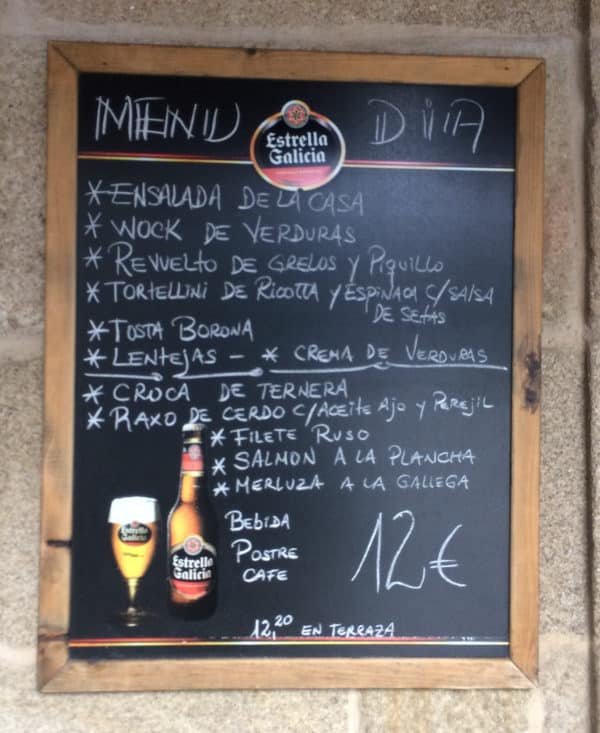
The picture shows a real menú del día from a restaurant along the Camino Portugués.
In this menu, you can see the first and second courses separated by a line. So you have 7 primeros and 5 segundos to choose from. The price was €12.00 (a couple of years ago. €12.20 if you sit outside) and it also includes a bebida (drink), postre (dessert) and café (coffee).
In case you’re curious, the reason why mealtimes are so late in Spain is that we are living in the wrong time zone (this article explains it in more detail).
Today’s Spanish Camino vocabulary
Menú del día
Desayuno
Comida
Cena
Carta
Menú peregrino
Primero
Segundo
Postre
Want more?
Make sure you don’t miss any posts or announcements by subscribing for free here. You’ll receive a free Camino food guide. And… you’ll get access to exclusive content too.

