You may remember today’s podcast guest. If you listened to episode 60, you already met her. That time she came with her dad, Toni, a true Camino geek. This time, it was just Sandra and myself, since there were a couple of things I wanted to discuss with her.
We talked for so long that I split our conversation into 2 podcast episodes. You can read (or listen) both here.
Skip to part 2, about what the Camino has taught Sandra.
Is Spain really that conservative?
One of the reasons I wanted to talk to Sandra is because I see the some questions come up on a regular basis in Camino Facebook groups and forums. Questions like:
-
Will people judge me for my tattoos? Should I cover them?
-
Should I remove my piercings?
-
Is it safe to do the Camino if I’m LGTB?
There’s this idea that Spain is ultra-Catholic, ultra-conservative, and very judgmental. I’m glad to announce that Spain is not stuck in the 50’s. That image doesn’t really match today’s Spain.
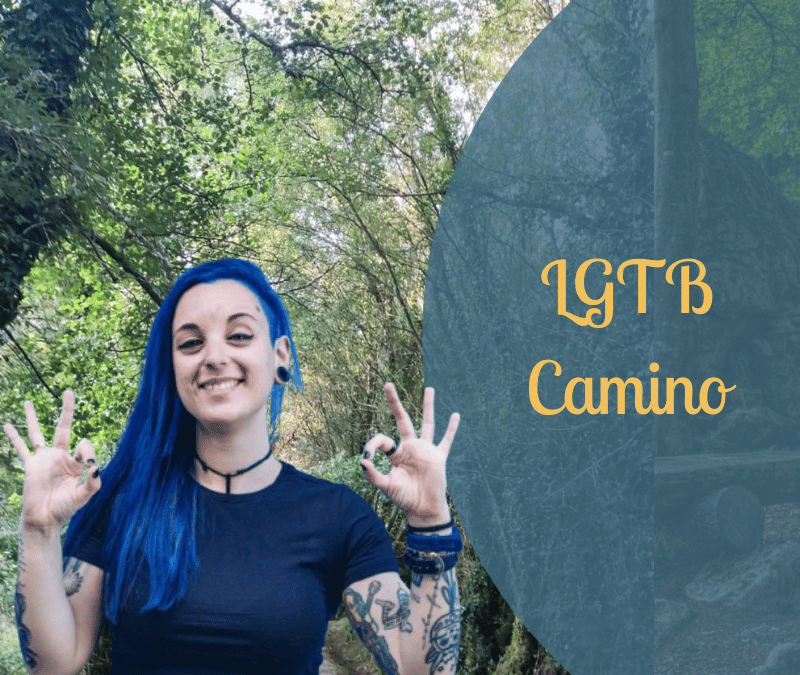
Sandra is the perfect person to talk about this because… well, you can’t miss her. She has bright blue hair, shaved on both sides, full tattoo sleeves, piercings, and a very alternative style. In other words: if tattoos or “looking different” were a problem in Spain, she’d know.
Tattoos, piercings, and standing out on the Camino
So, to answer the first 2 questions, about tattoos and piercings, short answer is no, you don’t need to cover anything.
Sandra’s experience is very clear: in Spain, she feels free to look how she wants and be who she is. She’s done the Camino without hiding her tattoos or removing her piercings and it’s never been an issue.
In fact, quite the opposite. Her tattoos has been conversation starters more than once.
And there’s also a very practical point: if you’re doing the Camino in summer, covering up tattoos just means suffering more heat. You’re walking for hours. It’s a physical activity. Comfort matters more than appearances.
Bottom line: be yourself. Spain in 2025 is full of people with tattoos, piercings, dyed hair… not having any is almost the exception now.
Doing the Camino as an LGTB person
The second big topic we talked about was doing the Camino as part of the LGTB community.
Sandra speaks from personal experience as a lesbian, and her view is refreshingly honest and grounded.
Spain, especially compared to many other countries, is generally LGTB-friendly. Big cities like Madrid, Barcelona, and Valencia are very open, but even outside cities, on the Camino itself, problems are rare.
A key point she made:
You’re not walking around announcing your sexual orientation, and nobody is going to ask you about it either.
On the Camino, people connect naturally. You walk together, talk, share meals. If you’re open, you tend to meet open people. Sandra even reconnected with a gay pilgrim she’d met years before, simply through that shared sense of community.
Interestingly, Sandra said something that really stuck with me:
If she worries about doing the Camino alone, it’s more because she’s a woman than because she’s a lesbian. That says a lot.
Villages, cities, and real life
Yes, the Camino goes through small villages, and yes, people there can be more traditional. But “traditional” doesn’t mean hostile.
Even if someone has more conservative ideas, that doesn’t mean they’ll confront you, insult you or make your life difficult.
And as Sandra put it very bluntly (and very truthfully):
your money doesn’t have a sexual orientation.
In albergues, bars, hotels, and restaurants, you’re a pilgrim. Full stop.
The Camino as a moving community
One of the nicest ideas from the episode is Sandra’s description of the Camino as a “nomadic village”. A community that moves together, day by day. You keep seeing the same faces, forming connections naturally.
If you go with an open mindset, you’ll find people you vibe with. The rest? You simply don’t connect. And that’s fine too.
So… should you worry?
Sandra’s message is very clear:
-
Don’t hide who you are.
-
Don’t change yourself to make others comfortable.
-
Come, walk, enjoy the Camino, and live the experience fully.
Spain today is not the Spain many people imagine. It’s more diverse, more open, and more “live and let live” than its reputation suggests.
And with that, we wrapped up part one of the conversation.
In the next episode, we’ll talk about something completely different… but you’ll have to wait a little longer for that.
The Camino as a mirror of life
In the second part of our conversation, Sandra shared what the Camino means to her beyond walking, stages, and destinations. For her, the Camino is full of parallels with life.
These are her key takeaways:
The backpack you carry (and the one you don’t need)
One of the strongest images Sandra talks about is the backpack.
Sandra compares your backpack’s literal weight with the emotional weight you carry around in your life.
You can’t expect someone else to carry it for you… but you shouldn’t overload it either. Just like on the Camino, carrying more than you can handle only makes everything harder. Some things aren’t your responsibility. Some things aren’t yours to carry. Learning to let go of that extra weight is part of the journey.
Both on the Camino and off it.
It’s not just about arriving in Santiago
Yes, arriving in Santiago is emotional. Seeing the cathedral and reaching your goal feels amazing.
But the Camino teaches you something else: the point isn’t just the destination.
The landscapes, the food, the small towns, the conversations, the moments you don’t plan. That’s the main experience. The meaning is in what happens along the way, especially when things aren’t easy.
Doing something difficult (and being proud of yourself)
Sandra talks about something many pilgrims feel but don’t always say out loud:
when something is a bit hard — but still achievable — it feels better in the end.
When you reach your goal, you don’t just think “I did it.” You think: I’m proud of myself.
And that feeling stays with you.
The Camino as a nomadic village
Sandra describes the Camino as a kind of moving village, a community that forms and dissolves as you walk.
You meet people. You share moments. Sometimes you never see them again.
And that teaches you something important: how to be present, and how to let go.
Enjoy the conversation you’re having now, the landscape you’re seeing now, the meal you’re eating now.
Without needing to know what comes next.
Walking alone, silence, and listening to yourself
For Sandra, the Camino isn’t religious — it’s therapeutic.
Walking alone, being with your thoughts, can be peaceful… or uncomfortable. Sometimes both. But being uncomfortable doesn’t mean it’s wrong. Often, it means it’s necessary.
And if you’re going to face your thoughts, doing it surrounded by nature, good food, and a decent tortilla de Betanzos doesn’t hurt either.
So,
Enjoy what you’re doing.
Even when it’s hard.
Even if you don’t finish.
Be proud of what you try.
Be present.
And yes — enjoy the food.
Those, according to Sandra, are the Camino’s biggest lessons.
Find out more about Sandra’s work on her website.
Want more?
Make sure you don’t miss any posts or announcements by subscribing for free here. You’ll receive the transcripts + vocabulary guides + interactive exercises of episodes 1-5 of the Spanish for the Camino podcast. And… you’ll get access to exclusive content too.

