

Updated February 2026.
Imagine you are on the Camino Francés… or on the Camino del Norte, or the Primitivo or even on the Vía de la Plata. It doesn’t really matter.
The thing is, you are walking across Spain. Maybe you’ve prepared before your trip and learned a bit of Spanish. Or you’ve been picking up a few words along the way. And then you enter Galicia and you get the impression that people sound different.
What’s worse: things start getting confusing. Now you see Fisterra… later you see Finisterre… Are they different places? Is it the same place?
Don’t worry! You’re not going crazy. You’re encountering Galician, or galego, a language you’ll hear and see during the last 100 km of any Camino.
A brief history of Galician
Spain has not always been Spain as we know it today. A few centuries ago, it consisted of several smaller kingdoms, including the Kingdom of Galicia, which covered modern day Galicia, the north of Portugal as well as part of Asturias and León.
Latin was the dominant language in the Iberian Peninsula, but over time, it evolved differently across regions, giving rise to several languages. Some of them have survived until our days and they are co-official, together with Spanish, in their respective territories.
Such is the case of gallego (Galician), or galego in the Galician language. And that’s what you are hearing!
- The first written documents in gallego date back to the 12th century. During the Middle Ages, gallego was the language of poetry in all of Spain.
- Gallego and portugués were initially the same language, but by the 14th century, that language had already split into the two separate languages we have today. This means that gallego and portugués have a lot in common. So, knowing a bit of gallego will help you in Portugal too!
- Galician was banished from public life in the 15th century, and it remained so until the 19th century. During this period, the upper classes spoke Spanish, while Galician remained the language of the lower classes. Add to this the fact that Galicia became impoverished during this time and many had to emigrate. In many cases, these people were ridiculed and made fun of because of their language.
- In the 18th century, a group of intellectuals started becoming interested in the Galician language. One of them was Padre Sarmiento, whose pilgrimage to Santiago inspired the Variante Espiritual route.
- One of the first and most popular authors to write in galego was Rosalía de Castro, who lived in Padrón, on the Camino Portugués.
Why town names can be confusing
As I just mentioned, during the 15th to 19th centuries, Galician was marginalized. Upper classes spoke Spanish.
Many names of towns (and family names too) were changed to make them sound more Spanish, more upper class. More recently, during Franco’s dictatorship, Galician was banned again.
All of this contributed to create the belief, that many still hold today, that Galician is an inferior language, that if you want to do well in life, you must speak Spanish and not Galician.
As a result of all of this, even today, you’ll see some towns with two versions of their name: the official Galician version and the older Spanish-sounding version.
To use an exampled I’ve mentioned before, Fisterra is the official name of the town where many end their Camino, but you’re likely to see Finisterre too.
Not every town has 2 names, but there are several well-known Camino towns where this happens. Wikipedia, for instance, tends to favour the Spanish name. Certain apps will only display the Spanish name too.
Muxía is an example of this. The Spanish-sounding version is becoming less and less common, but you may still see Mugía in places. Melide may sometimes appear as Mellid and Tui is still frequently spelled as Tuy (no change of pronunciation in this case).
Common Galician words you’ll see on the Camino
The use of galego varies across the region, so how much of it you see or hear will depend on where you are. Rest assured. Everyone can and will speak Spanish. But it’s nice and can be helpful at times to be familiar with some common words you’re likely to see often.
Rúa (calle in Spanish): street
Praza (plaza in Spanish): square
Igrexa (iglesia in Spanish): church
Mosteiro (monasterio in Spanish): monastery
Concello (ayuntamiento in Spanish): town council
Castelo (castillo in Spanish)
We Galicians like to add the diminutive -iño/-iña to almost any word! It adds proximity, familiarity and even affection. So grazas (thank you) becomes graciñas and ata logo (see you later) becomes ata loguiño!
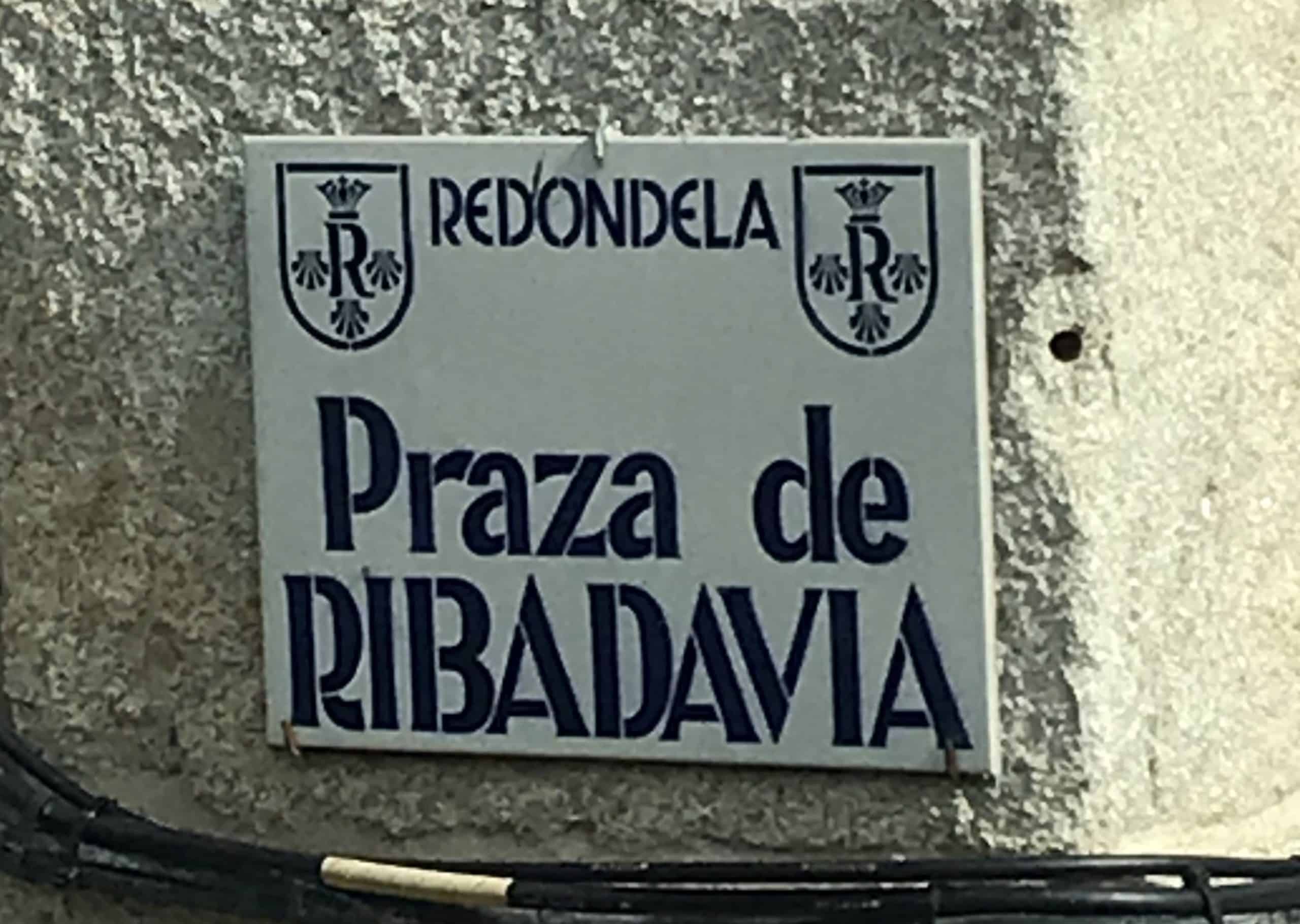

Today’s Camino vocabulary
For the pronunciation of Muxía, check the post about Muxía.
For the pronunciation of Tui, check Camino Portugués.
For the pronunciation of calle, iglesia and monasterio, check Camino Inglés: de Ferrol a Neda.
For the pronunciation of plaza, check Santiago de Compostela.
For the pronunciation of Fisterra and castillo, check Finisterre.
Galego
Bo Camiño
Ata logo
Grazas
Melide
Rúa
Praza
Igrexa
Mosteiro
Concello
Want more?
Make sure you don’t miss any posts or announcements by subscribing for free here. You’ll receive a free Spanish vocabulary guide with your first Spanish words + cultural tips. And… you’ll get access to exclusive content too.
You will come across Basque as you walk through País Vasco and Navarra. Oihana teaches us some basic words in this post.
¡Buen Camino!
(or Bo Camiño, as we say in Galicia)

