
Your packing advice

Your packing advice

We are still packing our mochilas! First we packed a few general items, then it was the turn of la ropa and last week was about other items. As I mentioned before, for this week’s post I asked experienced pilgrims for their advice. I wanted to know about the best and worst items they packed. So, today, it’s your packing advice.

The answers were many and varied, with some items proving quite popular and some others more personal.


Let’s start with the best items to pack

The most popular item, by far, among the ladies is a pareo (sarong), as it serves multiple purposes (in fact, I think I could write a whole post just about it!):

  • it serves as a sábana (sheet)
  • or as a toalla (towel)
  • you can wear it as a falda (skirt)
  • or as a vestido (dress), for instance, when you are washing the rest of your clothes.
  • you can tuck it around your litera for privacy
  • you can use it as a pillowcase or as a pillow
  • it’s an extra layer on cold mornings
  • it can be used as sun protection too

Last week I listed imperdibles (safety pins) and they were mentioned as essential by many pilgrims. Tapones para los oídos are quite popular among experienced pilgrims too.

When it comes to calzado (shoes), things get more personal. Some people swear by their sandalias, whereas others prefer shoes. However, most people agree on  merino wool calcetines (socks). In fact, any light merino clothing appears to be very popular, from ropa interior to camisetas: they dry quickly and don’t get stinky!

Your feet are very important and need a lot of care while doing the Camino de Santiago. Vaselina is a very popular option when it comes to footcare, although different people use different products: chamois cream, footcream… And, believe it or not, a tennis ball is a great thing to pack! You can use it to massage your feet and other areas.

Last week I recommended taking a móvil (mobile phone) which, among other uses, can also serve as a camera. The problem is that, if you are like me and tend to take loads of pictures, you will run out of memory in no time.

Tina-Marie had the perfect solution: a 256GB USB memory stick for your móvil. In Tina-Marie’s words “it was easy to move the photos and videos over thus freeing up the phone; it weighed next to nothing and fit in my pocket”.


What should you not pack

What people regretted the most was packing too much stuff. I love Beth’s piece of advice:

Don’t take anything on the Camino you aren’t willing to leave behind to lighten your load. I left toiletries and clothing at every albergue for the first 10 nights. I walked with people who carried way too much weight but were unwilling to ditch their items. Not being attached allowed me the freedom to let go, lighten my burden, and walk free!

Most people said they packed too many clothes (ropa). Take two outfits only, plus maybe one other thing that you can wear while you do laundry or to go out in the towns you are visiting.

Navaja suiza (Swiss Army knife) was another item that many people packed and then didn’t use. And it’s heavy!

A few people took a guía (guidebook) and then didn’t use it, but some others did use their guidebooks, so just think about it: do you think you will use it? Or can you manage without it?

When in doubt, follow Alder’s advice:

No “just in case” stuff. You can buy what you need in Spain.


Today’s Spanish words

For the pronunciation of ropa and calzado, check the post about your backpack.

For the pronunciation of calcetines, sandalias, camisetas and ropa interior, check this post about clothes.

For the pronunciation of tapones, imperdibles and móvil, check this post about other things to pack.

¡Buen Camino!

Want more?

Make sure you don’t miss any posts or announcements by subscribing for free here. You’ll receive a free Spanish vocabulary guide with your first Spanish words + cultural tips. And… you’ll get access to exclusive content too.
¿Qué llevas en la mochila?

¿Qué llevas en la mochila?

¿Qué llevas en la mochila? |

A few weeks ago I asked you this question:

¿Qué llevas en la mochila?

or

What are you going to take in your backpack?


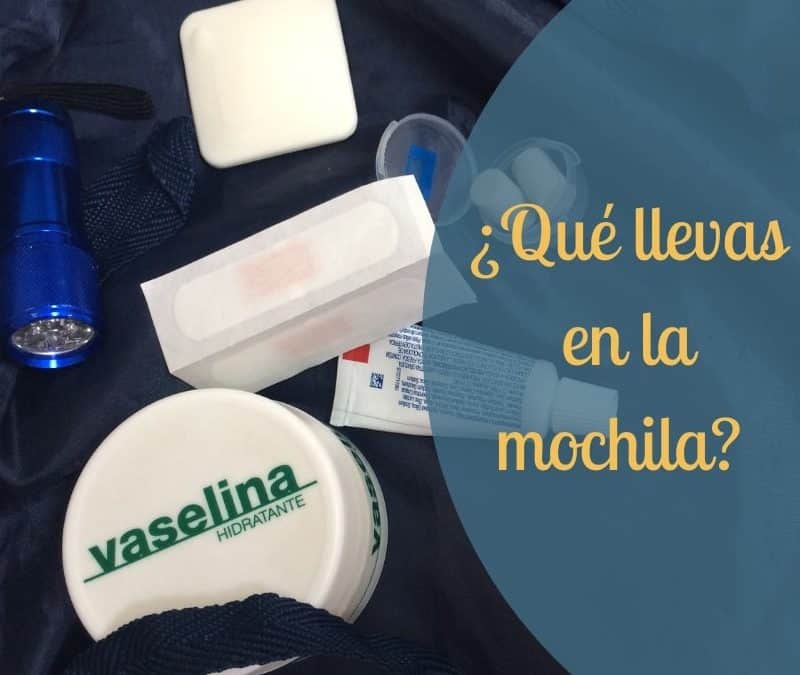
In that post  I wrote about general items that you will need during your Camino de Santiago. Then, last week I concentrated on la ropa (clothes). But you need some other things as well. I will write a post soon about healthcare stuff you may need. So, today I’m going to tell you about other items you should bring in your mochila.


  • Some people use them, some others don’t but they can be useful going up and down hills. They provide extra support and stability and they also reduce the effort, therefore helping you keep your joints and ligaments in good shape. I’m talking about bastones (trekking poles). Look for something light and foldable.


que llevas en la mochila
  • Tapones (para los oídos) or earplugs. Don’t leave them behind if you are planning to stay in albergues. You never know if the person in the next litera is a snorer… or how early some fellow pilgrims will get out of bed and start making noise!


  • Linterna (torchlight). It will be useful if you are planning to start walking before sunrise. If you are using it inside your albergue dorm, please be thoughtful of the people who are still sleeping. Nobody likes light flashing in their eyes at 5 am! A headlamp is probably the most convenient type to use, as your hands will be free to do whatever you need to do.


  • Imperdibles (safety pins). They can have several uses, one of them being to “hang” your wet clothes from your mochila and let them dry while you walk.


  • Móvil y cargador (mobile phone and charger). A mobile phone is great to have in case you need to call for help in an emergency. You can use it as a GPS. And you can also use it to take pictures (it saves you the weight of the camera). But make sure it doesn’t distract you too much from the scenery and your surroundings. You could be missing great things


And that’s it for today! For next week I’m hoping to get some help from experienced pilgrims. I’d love to get their recommendations. So, if you are reading this and you have already done the Camino, I’d love to hear from you.


What’s the best item you packed? And the worst?

Today’s Spanish words

Want more?

Make sure you don’t miss any posts or announcements by subscribing for free here. You’ll receive a free Spanish vocabulary guide with your first Spanish words + cultural tips. And… you’ll get access to exclusive content too.


¡Buen Camino!

La ropa

La ropa

In a previous post I discussed the things that you should pack in your mochila or backpack (you can read it here). On that occasion I only mentioned a few general items like ropa (clothes), calzado (shoes) or toiletries and promised to elaborate on the topic. So, this week it’s the turn of la ropa (clothes).

So, what ropa should you take? As I said before, you shouldn’t pack too many items, unless you are planning to have your bag transported from one place to the next one: you will have to carry the weight, remember? And you can always do a bit of washing at the end of your walking day.

Again, what ropa you take will differ slightly depending on the route you have chosen and the time of the year when you are doing the Camino de Santiago, but there are still some general recommendations you should follow!

Two outfits are enough: The one you are wearing and another one for when you wash the first one. It might be a good idea to get technical clothing, made of improved fabrics that stay warmer, dry quicker, block the sun…


La ropa

  • Camisetas (T-shirts). Dos (2) or tres (3) camisetas is enough, both short and long sleeve (this will also depend on what time of the year you are doing your Camino).


  • Pantalones (trousers). A couple of them. It might be a good idea to get one of those with a zip, that will convert into shorts when needed. Make sure they are comfortable and not itchy.


  • Calcetines (socks). Probably one of the most important clothes decision you will take: just think that you are going to walk for many hours every day, so you need to take good care of your feet.  Some people like to wear two pairs, some others wear one pair and change it half way through their daily walk… you should do what works for you. Just remember how important your feet are and make sure they stay dry.


  • Ropa interior (underwear). Again, two or three pairs is OK.


  • Chubasquero (rain jacket). Some people prefer to take a poncho that will cover themselves and their bag, some others prefer a waterproof jacket… there are many options, but some sort of raingear is advisable, especially if you are not doing the Camino in the summer (and even in the summer you can get wet days in the north of Spain).


  • Calzado (shoes): again, your choice will depend your route and the time of the year, but whether you choose trekking boots or shoes, make sure they are not new! If you need to buy a new pair of shoes, you should start wearing them at least three months before you start your Camino.


  • Apart from your walking shoes, you should also pack a pair of sandalias or chanclas (sandals, flip flops) to give your feet a rest after the walk. Chanclas are also very important to get into la ducha in albergues.


If you already have experience doing the Camino de Santiago, I would love to hear your advice on things to pack, clothes and otherwise. What were the most useful things you took along? Did you get rid of anything along the way because it was not necessary and it only added weight to your backpack? I’d love to hear your stories! You can comment here or go to our Facebook group and leave a comment there.


Today’s Spanish words

washing your clothes on the Camino


For the pronunciation of ducha, check albergues.


Want more?

Make sure you don’t miss any posts or announcements by subscribing for free here. You’ll receive a free Spanish vocabulary guide with your first Spanish words + cultural tips. And… you’ll get access to exclusive content too.

¡Buen Camino!

Where did you stay?

Where did you stay?

Where did you stay?


In the past few weeks I wrote about the different types of accommodation where you can stay along the Camino (¿Dónde vas a dormir?, El albergue and ¿Dónde vas a dormir? (II)). And for this post I wanted to get the stories of people who have already done the Camino about places where they stayed. So I asked the question: where did you stay?


Which Camino?


Although we talk about the Camino de Santiago or the Way of Saint James as if there is just one Camino, the truth is that there are many routes leading to Santiago. There’s the very popular Camino francés, but you could also decide to do the Camino primitivo, Camino del norte, Camino inglés or Camino portugués, to mention just a few.


Let’s just look at the Camino portugués today. As the name suggests, it goes from Portugal to Santiago de Compostela. If you start your pilgrimage from the Portuguese capital, Lisbon (Lisboa in Spanish), you will have to cover a distance of around 600 km. If you walk 25 km per day on average, you will need 25 days to complete it.


Many people start from Porto; in that case, you will need around diez (10) days to walk the 240 km to Santiago. If you don’t have so much time, you can do the Spanish section of this Camino, from Tui. It’s 119 km (enough to get a compostela) and you can do it in cinco (5) or seis (6) days.


In Padrón


All the places these pilgrims tell us about are along the Camino portugués. Scott Prunty has a recommendation for you:

You must visit the monastery (monasterio) in Padrón before pushing on to Santiago. It was the highlight of my walk. We were given a tour by the friars that still study there. Then we were joined by local villagers for a beautiful mass (misa) together.

After a communal dinner (cena) with other pilgrims, we slept in the original cells that friars have lived in for centuries. The whole experience just made a connection to the Camino spirit.


According to the information in the following link, http://www.alberguescaminosantiago.com/albergues-camino-portugues/hospital-de-peregrinos-san-antonio-de-herbon-herbon-la-coruna/ there are 30 beds in this albergue. You cannot book in advance and you must produce your stamped credencial if you wish to spend the night. Apart from la cena that Scott mentioned, you can also have your desayuno (breakfast) here. They take donativo (voluntary donation).


Two places on the coast


Vera Wallström would like to recommend two places:

Pazo Pías in Ramallosa was a great place to sleep at! Single room (habitación individual).

And Camping Mougás, after Mougás. They have a saltwater swimming pool (piscina) with a view, lovely after walking 30km!


In this link you can find pictures and more information about Pazo Pías: http://pazopias.org/contenidos/peregrino 

Vera’s picture of the pool.

In Porriño

And Tess Bouds had a nice experience at the albergue municipal in Porriño:

It is clean & quiet, even though it’s right next to a very large road. I forgot my glasses when I left and had to visit the policía, who called the cleaning lady. Twenty minutes later, I had them and was off. FYI amazing kitchen which you can use if you carry pots, plates, & utensils.

Do you have an “accommodation story” that you would like to share? Just leave a comment!


Basic Spanish Camino vocabulary

Want more?

Make sure you don’t miss any posts or announcements by subscribing for free here. You’ll receive a free Spanish vocabulary guide with your first Spanish words + cultural tips. And… you’ll get access to exclusive content too.


¡Buen Camino!

¿Dónde vas a dormir? (II)

¿Dónde vas a dormir? (II)

¿Dónde vas a dormir? |

A couple of weeks ago, I wrote about the main types of accommodation where you can stay while doing the Camino de Santiago. And last week’s post was all about albergues.

Today, I’ll tell you about two more types of accommodation that you can find along the Camino de Santiago, plus I’ll give you a few words and phrases you will need when arranging a place to stay.


¿Dónde vas a dormir? 

  • Casas rurales are privately owned properties, usually old farmhouses or manors that have been refurbished. They are a relatively new type of accommodation. As the name suggests, they are located in rural settings. This means that they won’t always be available, especially if you are around bigger towns. You can just book one habitación (room), but if you are travelling with a group, you should know that many casas rurales give you the option of renting the whole house. 


  • Paradores. Chain of luxury hotels, managed by a state-run company. They are usually located in historic buildings such as castles or convents. In Santiago, for instance, you have the Hostal dos Reis Católicos, right beside the cathedral. It was built in the 16th century as a hospital that cared for the pilgrims arriving in Santiago de Compostela.


The choice is all yours and, as I said before, you don’t have to stay in the same type of accommodation every night. Just be aware of all the possibilities available and decide which one is the best fit for you, based on your personal circumstances.


Useful Spanish phrases

If you have booked your accommodation in advance, you can just show up and say Tengo una reserva (I have a reservation). If you haven’t, it can happen sometimes that you get to your destination after having walked for many hours and you find a sign at the albergue saying completo (full, no vacancies). Oh, no! you have to start looking for another place for the night.

A very useful question in this situation (and many others) is ¿Tiene…? (Do you have…?). You can then finish the question accordingly. Since we are talking about accommodation, you can just say ¿Tiene una habitación (individual/doble)? (Do you have a single/double room?). In the case of double rooms, you might ask for one with una cama (one bed) or dos camas (two beds).

And don’t forget to ask about el baño! ¿Con baño? (en suite), ¿Con baño compartido? (with shared bathroom).

So,

donde vas a dormir


¿En un albergue (público o privado), en un hostal, en una pensión, en un hotel, en una casa rural o en un Parador?

(For the pronunciation of albergue, hostal, pensión and hotel, please go to this previous post).

If you have done the Camino already and you have any accommodation-related story that you would like to share, I’d love to hear about it.


¡Buen Camino!

Want more?

Make sure you don’t miss any posts or announcements by subscribing for free here. You’ll receive a free Spanish vocabulary guide with your first Spanish words + cultural tips. And… you’ll get access to exclusive content too.