¡Feliz Navidad!

¡Feliz Navidad!

What is Christmas like on the Camino? Can you walk during Christmas time?

The winter months are typically a quieter period on the Camino de Santiago. There are few pilgrims walking and many albergues are closed. However, some people prefer to walk around this time of the year. For them, and for those who would like to know how we celebrate la Navidad (Christmas) in Spain, I wrote this post. ¡Feliz Navidad!

First of all, you should be aware that there are a few festivos (public holidays). Shops will be closed those days; you should keep it in mind, in case you need to buy something. I’ll list the important dates and explain a bit about them:


In December

  • 22 de diciembre – La lotería de Navidad (Christmas lottery) also known as “el gordo” (the fat one!). This is the unofficial start of Christmas celebrations. Almost everyone in Spain plays this lottery and it’s a huge event: TV, radio, people on the street… all you’ll hear about is lotería!


  • 24 de diciembre – Nochebuena (Christmas Eve; literally “the good night”). It’s not festivo, although shops will close earlier than usual in the evening. This is because families get together for a big, special dinner. Traditionally, this is the time to be with family, at home, so make sure you plan your dinner ahead: expect everything, including restaurants, to be closed from 7.00pm.


  • 25 de diciembre – Navidad (Christmas Day). It’s festivo and everything will be closed. Family will gather again, for lunch on this occasion. Both Nochebuena and Navidad are days spent mostly with family, at home. People don’t go out much, although things are changing a bit. Again, you’ll need to plan ahead what you’re going to eat throughout the day, as it will be hard to find anything open.


We don’t have just one typical Christmas dish for these days. What people eat for Nochebuena and Navidad differs a lot from one region to another. But we have sweets in common: it doesn’t matter where you are, you can expect to find turrón (almond nougat), mazapán (marzipan) and polvorón (some sort of crumbly shortbread), the three main Christmas treats.

Turrón

Mazapanes

Polvorones

  • 28 de diciembre – día de los Inocentes. It’s the Spanish version of April Fools’ Day. So watch out for pranks and funny news. Otherwise, a regular day.


New Year’s Eve

  • 31 de diciembre – Nochevieja (New Year’s Eve; literally, “the old night”). Similarly to Nochebuena, this is not festivo, but shops will close early again. There’s another big, special dinner. But Nochevieja is more about partying and celebrating. It’s common for people to go out for dinner, with family or friends and then party into the next day.


At midnight, you can go to the town main square and eat 12 uvas (grapes), one with each campanada (stroke) of the clock. You can also do this at home, as all TV channels will show a clock striking 12 (traditionally, they show Puerta del Sol in Madrid). If you manage it, you will have good luck in the new year.


Another widespread tradition to bring you luck in the new year is to wear red underwear. That’s why you will see a lot of it displayed in shops for a couple of weeks before the New Year.


The New Year

  • 1 de enero – día de Año Nuevo (New year). If you went out partying after your uvas, chances are you won’t go to sleep until the morning (9.00am at least). Año Nuevo is usually a very quiet day, because many people will be sleeping most of the day and it’s also festivo, so everything is closed.


  • 6 de enero – día de Reyes (Epiphany or the day of the Wise Men). Traditionally, Spanish children get their presents from the three Wise Men. They arrive on January 5, when they parade around Spanish towns. Then, during the night, they leave their presents. So, January 5 is not festivo, but there will be parades in most towns. January 6 is festivo and shops will be closed. A typical treat for this day is roscón, a special cake.


You can watch some short clips of the lottery draw, the campanadas and the Wise Men parade in this presentation: https://prezi.com/9yp5onzyacly/feliz-navidad-y-prospero-ano-nuevo/

And that’s it! What do you think?

For other traditions, specific to certain regions, check Other Christmas traditions.


Today’s Spanish words

Want more?

Make sure you don’t miss any posts or announcements by subscribing for free here. You’ll receive the transcripts + vocabulary guides + interactive exercises of episodes 1-5 of the Spanish for the Camino podcast. And… you’ll get access to exclusive content too.


¡Buen Camino & Feliz Navidad!

Getting around on the Camino

Getting around on the Camino

Updated February 2026


Getting around on the Camino

When we think about the Camino de Santiago we think walking day after day, maybe cycling or even horse-riding.

What we don’t usually imagine is standing at a train station , waiting for a bus, or navigating an airport. And yet… trains, buses and planes are a very real (and very useful) part of our Caminos.

We’ll need transport at least 3 times:

  • To get to Spain, most likely by avión (plane).
  • To reach your starting point, the town where you will start your pilgrimage
  • To leave Santiago, once your Camino is finished..

And even during your Camino, you might skip a stage, for a number of reasons such as time constraints or an injury.

In those cases, you will probably use a tren (train), an autobús (bus) or even the occasional taxi, which is also conveniently called taxi in Spanish!).


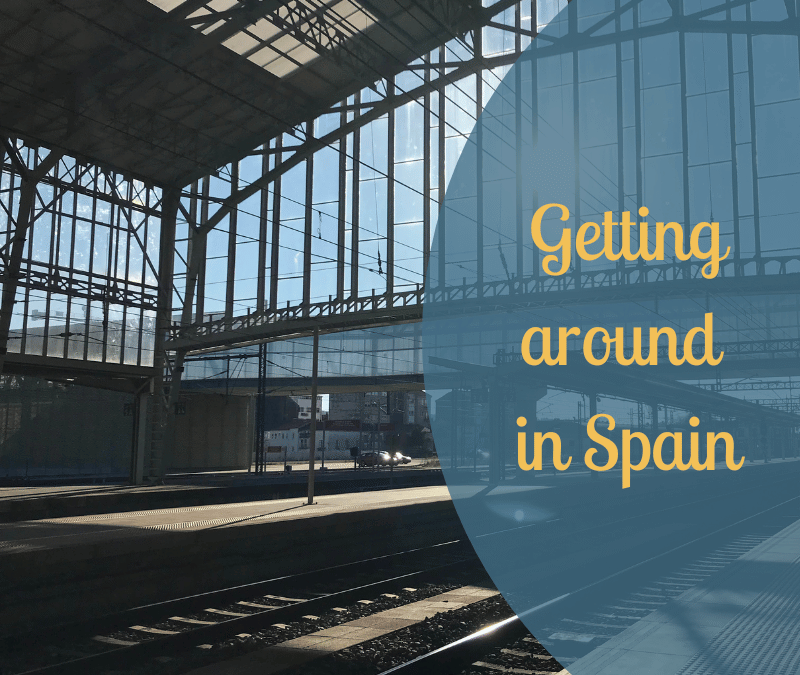
Travelling by train

Trains are a very popular way to move around Spain, especially for long distance trips. With high-speed trains, you can travel between Madrid and Santiago in under 4 hours, which is not possible by bus.

So, let’s go to la estación de tren (you might find it also referred to as estación de ferrocarril, but estación de tren is more common).

  • Whether you are travelling by train, bus or plane, your ticket is called billete (by the way, we use the same word for banknotes; 2 meaning, 1 word!)
  • If you’re already at the station, you can buy your ticket at the taquilla (ticket office). But be aware that certain trains tend to sell out, so I would advise to buy them in advance. RENFE (Spain’s national train operator) usually releases tickets for same 4-6 weeks in advance, so don’t panic if you’re trying to buy tickets a few months ahead of time and you can’t find them. It’s too early.
  • Your billete can be de ida (one way) or de ida y vuelta (return). Before you get on your train, there’s certain information you need to find on your ticket; 2 numbers, to be precise: your car and your asiento (seat). Seats are numbered, so it’s easier to check before you sit down than having to move later on when someone is claiming their seat.
  • The information screens at the station will show the vía (track) where your train is stopping.

    Discounts for over 60s

    If you are travelling by train in Spain and you are over 60, you can get a Tarjeta Dorada (golden card). You can buy it at any train station and it will entitle you to discounts of up to 40% on the price of your tickets.

    The Tarjeta Dorada cannot be bought online. You need to buy it in person, as you’ll have to show your passport to prove your age.

    The price of the Tarjeta Dorada is €6, and it’s valid for 1 year.  It can be renewed online.

    Here’s the link to RENFE’s website with all the information about it (it’s in Spanish): http://www.renfe.com/viajeros/tarifas/tarjeta_dorada.html


    Travelling by bus


    The full name for a bus is autobús, but you can call it bus for short. That’s what most Spanish people do.

    The good news is that a lot of the bus-related vocabulary is the same as the train’s, but not all. So let’s have a look at the changes:

    • The estación de tren becomes estación de autobuses. However, buses don’t stop at stations only. In fact, there are no stations in most villages and smaller towns. In those cases, buses stop at paradas (de autobús), also known as bus stops in English. 
    • Tickets are still billetes and they can also be bought from a taquilla. In many cases (local buses in particular), you can buy your ticket directly from the conductor (false friend alert! Conductor is the driver, not the English conductor).
    • There are many bus companies in Spain. Some, like Alsa, are big and have even international routes (like between Santiago and Porto). If you’re using one of them, you’ll be able to buy your tickets online in advance. But there are also lots of much smaller, local companies. In those cases, buying your ticket in person, either at the station or from the driver, might be your only option.


    Travelling by plane


    You are very likely to travel by plane either to get to Spain and start your Camino, and to go back home after you have finished your pilgrimage.

    So, what do you need to know about Spanish aeropuertos (airports)? The good news: they are very traveller‑friendly, and all signage is also in English.

    • When you land in Spain you will be in the llegadas (arrivals) area of the airport. You should easily find your way out. Just follow the signs for the salida (exit). 
    • If you are starting your journey from a Spanish airport, you should go to the salidas (departures) area first. You can find both words, salidas and llegadas, in train and bus stations too, on the screens listing all the departures and arrivals.


    • If you have luggage to check-in, or need a tarjeta de embarque (boarding pass), look for the the facturación (check-in) counters, 


    • If you have your boarding pass and equipaje de mano (hand luggage) only, you can go through security and look for your puerta de embarque (boarding gate).

    Transport’s Spanish vocabulary

    El botiquín

    El botiquín

    El botiquín |

    When you are packing your mochila you should leave some space for a small botiquín (first-aid kit). But what should it include? Of course, if you normally take any medications, make sure you pack enough of it, or find out if you can get it in Spain.

    As I mentioned in previous posts, it’s important to keep your mochila as light as possible. As one experienced pilgrim advised us last week:

    No “just in case” stuff. You can buy what you need in Spain.

    And where can you buy health related items? The most obvious answer is a farmacia. Here you can get medicines, with or without prescription, as well as a long list of other items for your personal care.

    The pharmacy sector is very regulated in Spain, which means you can’t just open a new farmacia anywhere you like. As a result, a few years ago a new type of business was created: the parafarmacia.

    Basically, in a parafarmacia you can find the same stuff as in a farmacia, except for medicines: they sell tiritas and Compeed, creams (sun protection and others), personal hygiene products: from jabón (soap), to shampoo, to pasta de dientes (toothpaste)…

    At times when shops are usually closed, such as late evenings and Sundays, there is always a farmacia de guardia (pharmacy on-call). All farmacias have to display a list of the farmacias de guardia in the area. The problem is that if you are in a small town, the nearest farmacia de guardia will probably be in the next town. Not very convenient!

    That’s why it is a good idea to always carry a few basic items with you.

    So, what should you carry in el botiquín?


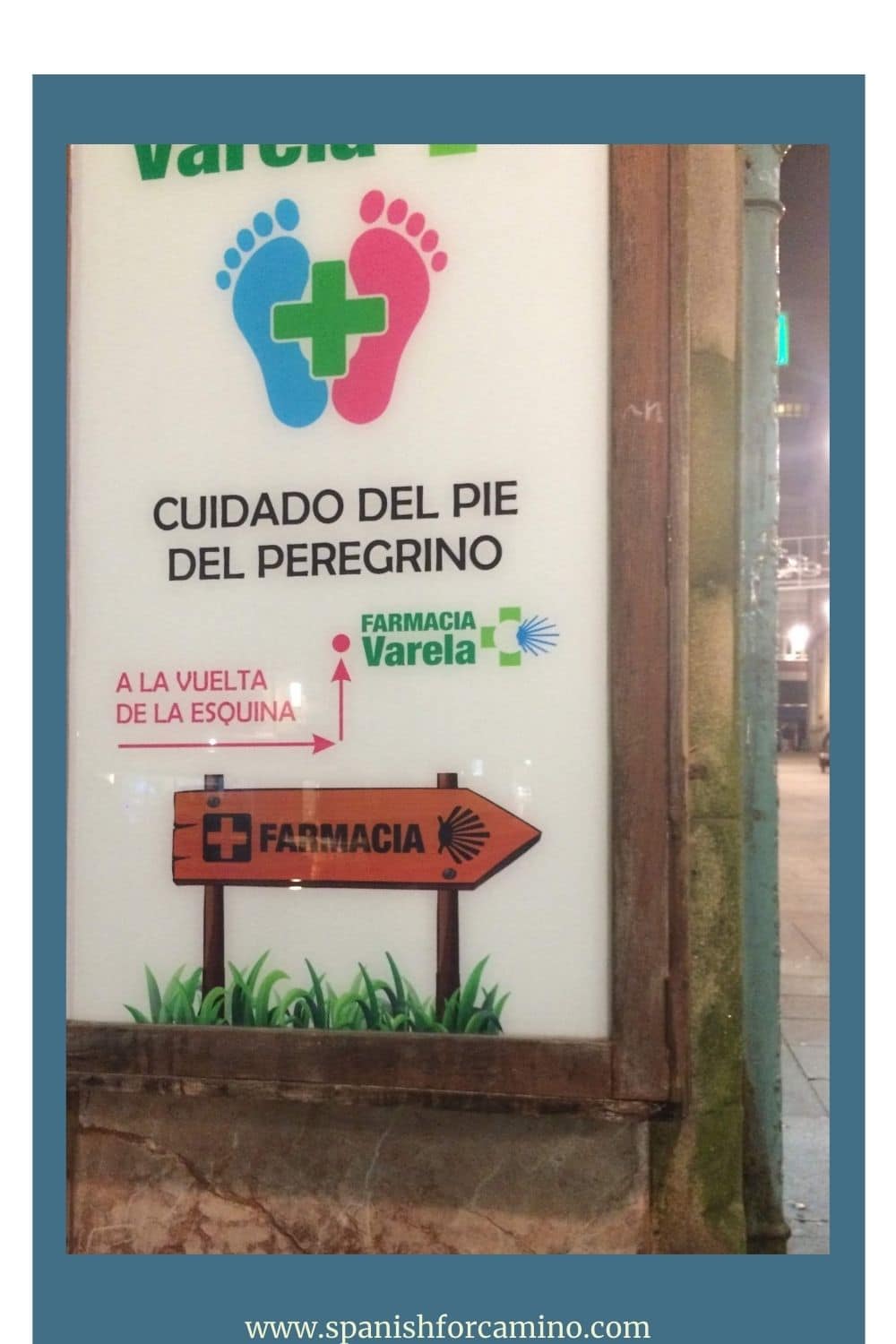
    Pilgrim foot care


    Your pies (feet) are the most important part of your body when you are doing the Camino de Santiago and not looking after them properly can put an early end to your walk.

    Ampollas (blisters) are the most common problem that pilgrims face. We should do whatever we can to prevent them, but sometimes they are inevitable. In previous posts I discussed calzado (shoes) and calcetines (socks), as well as vaselina and tennis balls. I have also read an article recently saying that paper tape could be an effective and cheap way to prevent blisters.


    • If all of the above fails and you get ampollas, you will need aguja (needle) to drain the fluid (but don’t remove the skin!). Make sure your aguja is disinfected before you use it and that you also disinfect the area afterwards. Then you can cover it with tiritas or something similar.


    • Depending on the time of the year when you do your Camino de Santiago, you might also need protector solar or crema solar (sun protection cream).


    • Ibuprofeno is a Camino favourite is everyone’s botiquín. It works as an anti-inflammatory if you have any swelling, and as pain relief, too. And you can get it in different formats (gel, tablets and even powder to mix with water). As with any other drug, just make sure you check what the right dose is as well as the possible side effects and contraindications.


    So, what are you planning to include in el botiquín? Or, if you already have Camino experience, what did you take? Did you have to buy anything?


    Today’s words

    Your packing advice

    Your packing advice

    Updated: January 2026


    What to pack in your backpack for the Camino de Santiago


    If you’re planning your Camino de Santiago, one of the most important decisions after choosing your route is what to take in your mochila (backpack).

    Unless you hire a luggage transfer service, you’ll be carrying your backpack for hours every day. That’s why it’s essential to pack only what you need. A general rule of thumb is to carry no more than 10% of your body weight.

    But what should you pack? Partily, it depends on your route, the season, and your personal needs, but there are some essentials every pilgrim should bring. I’ve asked other experienced pilgrims for advice and this is what they came up with:

    Clothing

    • Pantalones (trousers), camisetas (T-shirts), underwear, and calcetines (socks ), as well as a jacket and rain gear.

    • Quick-dry, lightweight clothing is best.

    • For spring or summer, a long-sleeve light shirt can protect against sun and chilly mornings.

    • Merino wool clothing is very popular among pilgrims: it dries quickly and doesn’t get smelly.

    Pilgrim advice: Don’t overpack clothes. Two changes of clothes are usually enough, plus one extra outfit for going out in towns or while doing laundry.

    Footwear

    Whether you choose hiking boots, shoes or sandals, don’t start your Camino with brand-new footwear. Break them in before your walk.

    Many pilgrims also bring sandals to let their feet rest in the evenings.

    Good socks are essential. Some prefer merino, other toe socks, or 2 pairs or socks… find out what works best for you.

    Other items

    • Toalla (towel): lightweight and quick-dry

    • Plasters/bandages: to prevent blisters and treat small injuries

    • Toiletries: toothbrush, toothpaste, deodorant

    • Mobile phone: for communication, GPS, and photos

    Highly recommended by pilgrims

    The most popular item, by far, among the ladies is a pareo (sarong), as it serves multiple purposes: it can be used as a sheet or towel or worn as a skirt or dress while washing other clothes; it provides privacy around your bed, acts as a pillowcase or extra layer for warmth and protects against sun.

    Safety pins and earplugs are both small but essential.


    What should you not pack

    What people regretted the most was packing too much stuff. I love Beth’s piece of advice:

    Don’t take anything on the Camino you aren’t willing to leave behind to lighten your load. I left toiletries and clothing at every albergue for the first 10 nights. I walked with people who carried way too much weight but were unwilling to ditch their items. Not being attached allowed me the freedom to let go, lighten my burden, and walk free!


    Most pilgrims I asked said they packed too many clothes. A Swiss Army knife was another item that many pilgrims packed and didn’t use.

    Some took a guía (guidebook) and didn’t use it, but some others did use their guidebooks, so just think about it: do you think you will use it? Or can you manage without it?


    When in doubt, follow this pilgrim’s advice:

    No “just in case” stuff. You can buy what you need in Spain.

    In summary


    Pack light, prioritize essentials, protect your feet, and choose multipurpose clothing and items. A well-packed backpack will make your Camino more comfortable and enjoyable.

    Minimal, multipurpose items are better than heavy, single-use items.

    Buy or replace items as needed along the Camino instead of carrying extra weight from the start.

    Today’s Spanish words

    ¡Buen Camino!

    Want more?

    Make sure you don’t miss any posts or announcements by subscribing for free here. You’ll receive a free Spanish vocabulary guide with your first Spanish words + cultural tips. And… you’ll get access to exclusive content too.

    La ropa

    La ropa

    In a previous post I discussed the things that you should pack in your mochila or backpack (you can read it here). On that occasion I only mentioned a few general items like ropa (clothes), calzado (shoes) or toiletries and promised to elaborate on the topic. So, this week it’s the turn of la ropa (clothes).

    So, what ropa should you take? As I said before, you shouldn’t pack too many items, unless you are planning to have your bag transported from one place to the next one: you will have to carry the weight, remember? And you can always do a bit of washing at the end of your walking day.

    Again, what ropa you take will differ slightly depending on the route you have chosen and the time of the year when you are doing the Camino de Santiago, but there are still some general recommendations you should follow!

    Two outfits are enough: The one you are wearing and another one for when you wash the first one. It might be a good idea to get technical clothing, made of improved fabrics that stay warmer, dry quicker, block the sun…


    La ropa

    • Camisetas (T-shirts). Dos (2) or tres (3) camisetas is enough, both short and long sleeve (this will also depend on what time of the year you are doing your Camino).


    • Pantalones (trousers). A couple of them. It might be a good idea to get one of those with a zip, that will convert into shorts when needed. Make sure they are comfortable and not itchy.


    • Calcetines (socks). Probably one of the most important clothes decision you will take: just think that you are going to walk for many hours every day, so you need to take good care of your feet.  Some people like to wear two pairs, some others wear one pair and change it half way through their daily walk… you should do what works for you. Just remember how important your feet are and make sure they stay dry.


    • Ropa interior (underwear). Again, two or three pairs is OK.


    • Chubasquero (rain jacket). Some people prefer to take a poncho that will cover themselves and their bag, some others prefer a waterproof jacket… there are many options, but some sort of raingear is advisable, especially if you are not doing the Camino in the summer (and even in the summer you can get wet days in the north of Spain).


    • Calzado (shoes): again, your choice will depend your route and the time of the year, but whether you choose trekking boots or shoes, make sure they are not new! If you need to buy a new pair of shoes, you should start wearing them at least three months before you start your Camino.


    • Apart from your walking shoes, you should also pack a pair of sandalias or chanclas (sandals, flip flops) to give your feet a rest after the walk. Chanclas are also very important to get into la ducha in albergues.


    If you already have experience doing the Camino de Santiago, I would love to hear your advice on things to pack, clothes and otherwise. What were the most useful things you took along? Did you get rid of anything along the way because it was not necessary and it only added weight to your backpack? I’d love to hear your stories! You can comment here or go to our Facebook group and leave a comment there.


    Today’s Spanish words

    washing your clothes on the Camino


    For the pronunciation of ducha, check albergues.


    Want more?

    Make sure you don’t miss any posts or announcements by subscribing for free here. You’ll receive a free Spanish vocabulary guide with your first Spanish words + cultural tips. And… you’ll get access to exclusive content too.

    ¡Buen Camino!