Camino Portugués: Pontevedra-Caldas de Reis

Camino Portugués: Pontevedra-Caldas de Reis

Camino Portugués: Pontevedra-Caldas de Reis |

Back in October I walked from Porriño to Redondela, on the Camino Portugués with a large group organised by the Asociación de Amigos del Camino Portugués (details about that stage here). I skipped the next 2 domingos (Sundays) because I had already walked those stages.

I walked Redondela-Pontevedra in 2020, right before the confinamiento (lockdown). And I have walked Pontevedra-Caldas de Reis twice now. Both times in julio (July), a year apart. It is my little contribution to the Luz del Camino project.


The first time I walked the Pontevedra-Caldas de Reis stage of the Camino Portugués was in 2020. I was part of a small group of 5 pilgrims, so I wasn’t alone. But it was a very lonely experience: there were no other pilgrims around and everything was closed.

The second time was in julio 2021. Again, I was part of a small group. But it was a very different experience. This time around, there were lots of other pilgrims walking too (mostly españoles but other nationalities too). Bars and cafés were open for business. The Camino felt alive again.


Peregrina Pontevedra

We had a very hot day in 2020, so we left at 6.00am, in the dark.

This time around, the weather forecast was not as hot. There was no need to start so early.

We left from the Peregrina Church in Pontevedra at 7.30am.

We crossed the bridge, and once out of Pontevedra and Lérez we met the first pilgrims of the day. It was a group of cinco polacos (5 Polish people) who wrote a message on the notebook that travels inside the mochila de la luz.

After Alba, I noticed an improvement on the route. There was a stretch where pilgrims had to walk on the side of the carretera (road). They’ve now added a new pedestrian path away from the road. Much safer than before.


Meeting other pilgrims

And then we crossed the road and quickly got to one of my favourite parts of this stage, a beautiful forest area. We met several other pilgrims here.

One of them was a Spanish woman who was walking from Tui by herself. She had wanted to walk the Camino for a while but could never find the right time. A few weeks before we met she found out she was embarazada (false friend alert! This means pregnant, not embarrassed). And she thought that she probably wouldn’t be able to walk for a long time if she waited until the baby was born. So, she packed a few things, got her partner to drop her in Tui and started walking.


We ended up walking together most of the rest of the stage and talking about all sorts of things. We got along quite well and the conversation kept flowing naturally.

Roughly halfway to Caldas we took a café con leche break. The place where we stopped was so busy! Full of pilgrims. So different from 2020.


After the break, we kept walking through bosques (forests) and aldeas (villages)… and meeting more pilgrims. Not what I’m used to. I know the July 2020 experience was kind of extreme, with everything closed and no pilgrims at all. But I must say I wasn’t used to meeting so many other pilgrims on the Camino. It actually felt crowded at times, especially coming out of a strict lockdown and over a year of so many restrictions and not socialising that much.


When the Camino joins the busy N-550 road (5 or 6km before Caldas de Reis), I recommend you cross it and take the short detour to “Parque Natural Río Barosa”. It’s a beautiful place with waterfalls and old watermills. There’s a picnic area there. It’s a popular spot for the locals to go for the day. It’s about 500m off the Camino, but it’s well worth it. That’s what we did again, although our stop was shorter than the previous year.

And before we knew it, we were in Caldas and we all went our separate ways. Somehow I lost sight of my new friend and couldn’t find her again. I would have liked to say goodbye and wish her luck with the rest of her Camino and with her pregnancy too. No pudo ser (it couldn’t be).

Read about the Caldas-Padrón stage here.

* Caldas de Reis and Caldas are the same place. Caldas de Reis is the official name of the town, but we usually refer to it as just Caldas.


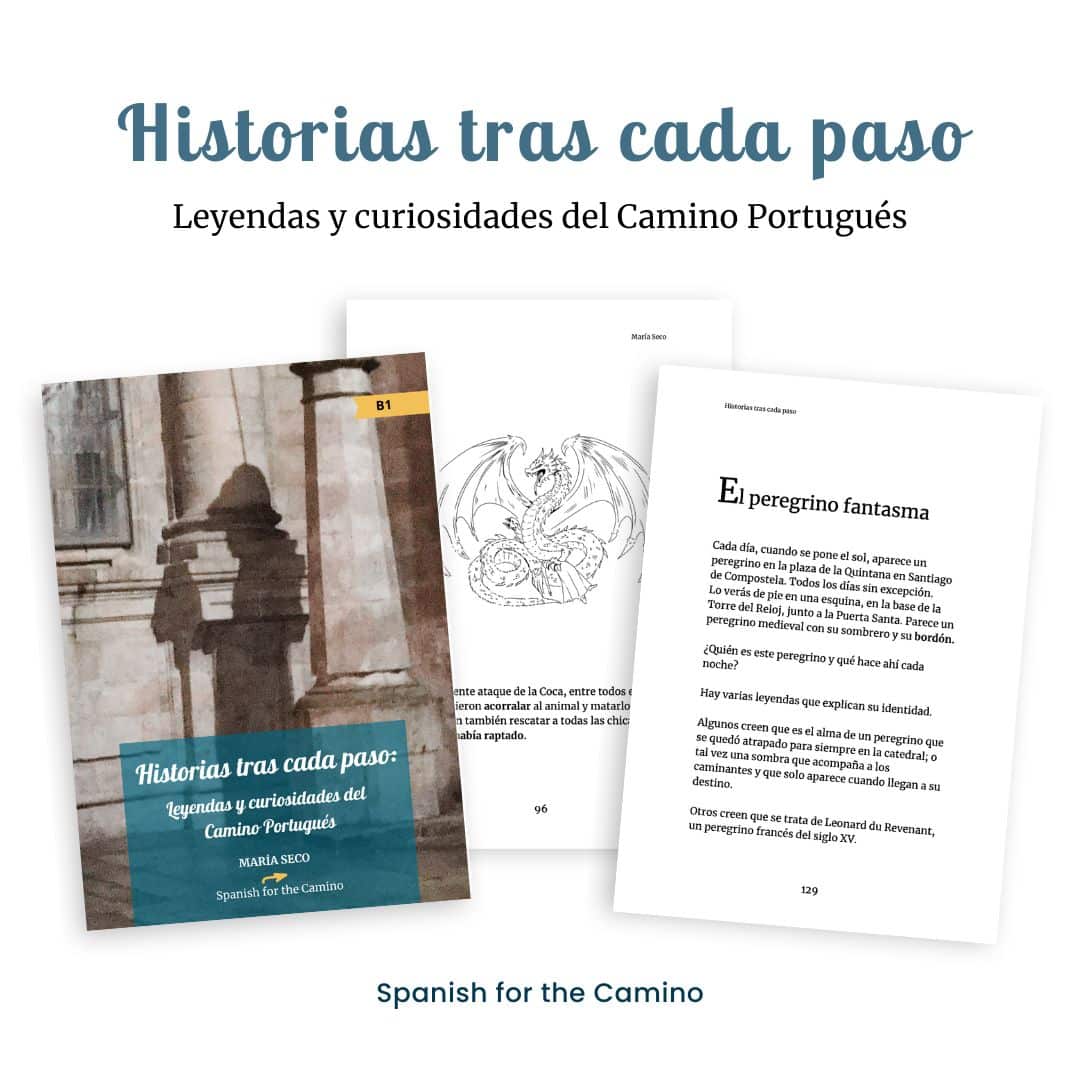
For a collection of legends and historical tidbits about this route, check my book Historias tras cada Paso. Leyendas y curiosidades del Camino Portugues. All the stories are about places along the Camino Portugués; many of them are directly related to the Camino or St. James. The book is in Spanish, for intermediate learners, and includes a vocabulary guide with English translation.


See inside book of Camino Portugues legends
For a collection of legends and historical tidbits, check my book Historias tras cada paso. Leyendas y curiosidades del Camino Portugués.
All the stories are about places along the Camino Portugués; many of them are directly related to the Camino or St. James.
The book is in Spanish, for intermediate learners, and includes a vocabulary guide with English translation.

Want more?

Make sure you don’t miss any posts or announcements by subscribing for free here. You’ll receive a free Spanish vocabulary guide with your first Spanish words + cultural tips. And… you’ll get access to exclusive content too.


¡Buen Camino!
Camino Portugués: Porriño-Redondela

Camino Portugués: Porriño-Redondela

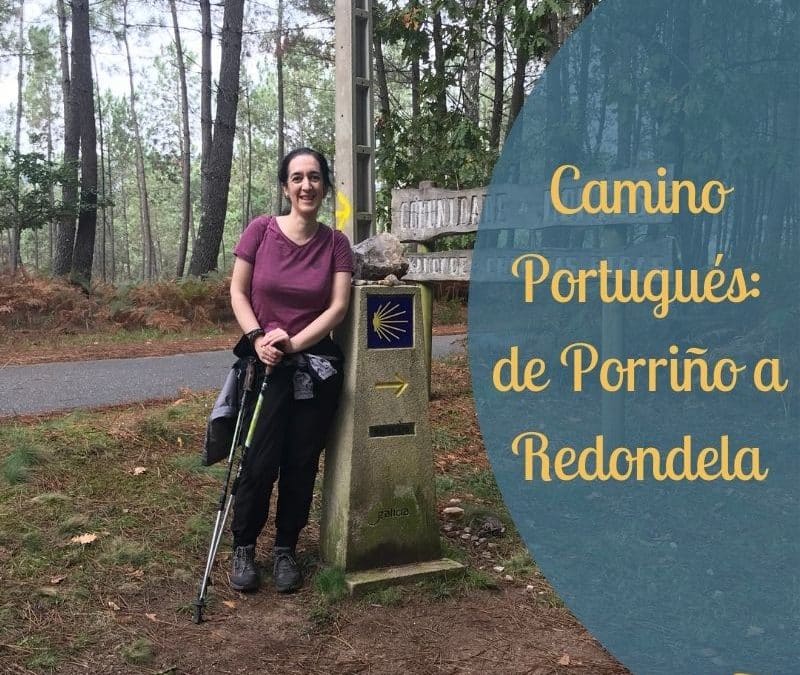
A few Sundays ago I walked a stage of the Camino Portugués: Porriño-Redondela. It’s one of the perks of living on the Camino; you can walk anytime you like. No need to take time off work or do much planning. Just go.


In fact, I didn’t just walk Porriño-Redondela. I’ve walked several stages of this route in the past few weeks. A different one every Sunday. This is a common way for Spanish people to do the Camino. Whenever you have some time off, you walk as far as you can. You then go back home. The next time you’re free, you pick up where you finished the last time and you keep going.


It’s a different experience from walking to Santiago in one go. No better. No worse. Simply different.


I’ve walked with my family before and I’ve also led a small group of strangers. This time around, I was also part of a group. It was quite a large group, actually. Also strangers. But a totally different experience.


There is an Asociación de Amigos del Camino Portugués (Association of Friends of the Camino Portugués) in Pontevedra. Among other things, they organise a yearly pilgrimage from Porto to Santiago. They walk on Sundays only. By the time I heard about it this year I had already missed the stages in Portugal. But I was still able to join in for most of the Spanish section.


This Sunday Camino works as follows: early in the morning we get on a bus that the Association has hired. This bus takes us to our starting point for the day. Once there, one of the organisers says a little oración (prayer), we take some group pictures and start walking.


There is a coche de apoyo (support car) for anyone who is not able to walk the whole stage. The bus will pick us up at our finishing point and take us back to Pontevedra for lunch (I’m talking Spanish lunch, around 2.30pm).


Porriño-Redondela

My first stage with the group was Porriño-Redondela.

Tui, right on the Portuguese border, is the most popular starting point for those who walk the last 100km of this Camino. But Porriño is actually on the 100km mark. So it is possible to start here and obtain a Compostela. On the other hand, Tui is a much nicer town, it would be a pity to miss it. But you could start in Porriño, and still qualify for a Compostela.


When I signed up for my first stage, I wasn’t quite sure what to expect. I didn’t know how big the group would be or what the people would be like. Not the type of situation where I feel most comfortable. So, I asked a friend to join me. She was going to, but then something came up and I had to face this unknown group by myself.


The group

There were between setenta (70) and ochenta (80) people in total. My impression was that they all knew each other and they all had their little groups. The vast majority were over 70 years of age. I was almost the baby of the group! There were a couple of niñas (young girls) accompanying their abuelo (grandfather), but they soon got on the support car.

Empezando Porriño-Redondela

These 2 pictures are taken from the Association’s blog, which you can find here. We’ve just arrived in Porriño and are outside Las Angustias (Our Lady of Anguish) chapel. The president of the Association read the prayer this time. Then, group pictures before we started walking.


The Porriño-Redondela stage

This stage is around 16 km.

Following current covid restrictions, we were wearing our mascarillas (facemasks) on the bus and at the beginning of the walk, while the whole group was still together and it was impossible to social distance. We took them off once the group scattered.


The first half of the stage is quite flat and easy. I guess it’s not the most beautiful stretch of the Camino, as it’s mostly through villages, on paved roads, but at least there are no busy roads or anything like that.


The second half, after Mos, is a bit more challenging, but nothing too hard. There is an ascent first up to the Santiaguiño de Antas chapel. And, when you get to the top, a harder descent into Redondela. I was glad I had my poles for that. Otherwise, I would have probably been tempted to just roll down the hill 😅  This half of the stage also has some nicer stretches through forest.


The weather forecast for the day wasn’t great, so we were all prepared for the rain that was supposed to fall. But it turned out to be quite a lovely morning, with no lluvia (rain) and some sol (sun).


Mos

So, as I mentioned, nothing much to report up to Mos. The Camino is very well marked and it’s impossible to get lost unless you’re very, very distracted and not paying attention at all.


In Mos, there is a church and a pazo (manor house), as well as several places where you can stop for a café con leche and a bite. You can also see here a big sign with the town’s name made out of bobbin lace (check the video below).


Up to here I walked partly alone, partly with someone. As we were taking the group pictures, I recognised someone familiar: it was a friend and former colleague of my mum’s. I walked with her for a while, but she’s not well and after a while I needed to walk a bit faster than her. So I went on by myself.


I took a short break in Mos and, as I was getting ready to continue, I saw another familiar face. The mum of one of my daughters’ classmates. She was walking with another woman I didn’t know. I thought they were friends, but I later found out they had met while walking the previous stage, from Valença to Porriño (which I missed). From then on, I walked with them.


Porriño-Redondela

This is us in Redondela, waiting for our bus to go back home.


This picture is also borrowed from the Association’s blog.

Up and down the hill

The next part of the walk was more interesting. On the way to Porriño (on the bus), they had warned us about the uphill section after Mos. I’m not a huge fan of walking uphill, to put it mildly. So I was a bit concerned. But the ascent is quite gradual, so it’s not too bad.


The descent was actually worse, not as gradual. I was so grateful I had my 2 poles! And I was also grateful it didn’t rain. I can imagine how slippery that road would be if it was wet…


There are some beautiful views of Redondela in the distance and a lovely walk through a forest with huge (and kind of odd) stone picnic tables.


After that, you’re just outside Redondela. We had also been warned about crossing the busy national road N-550 here, but they must have made some changes to the route, because there is now a very safe place to cross, with a traffic light.


Our meeting point was outside the albergue in Redondela, which is in a very beautiful old building, a 16th century pazo.

I’ve put together some pictures of the Porriño-Redondela stage in the following video. Enjoy!


For the Tui-Porriño stage, check this post. You can read about the Redondela-Pontevedra stage here.


Today’s Spanish words

For the pronunciation of Tui, Porriño and Redondela, check Camino Portugués.

For the pronunciation of lluvia & sol, check The weather on the Camino.

For the pronunciation of mascarilla, check The Camino and the new normal.


Want more?

Make sure you don’t miss any posts or announcements by subscribing for free here. You’ll receive a free Spanish vocabulary guide with your first Spanish words + cultural tips. And… you’ll get access to exclusive content too.


¡Buen Camino!

Muxía

Muxía

After making it to Santiago de Compostela, many pilgrims decide to continue on to the sea, to reflect, and to truly finish their Camino.

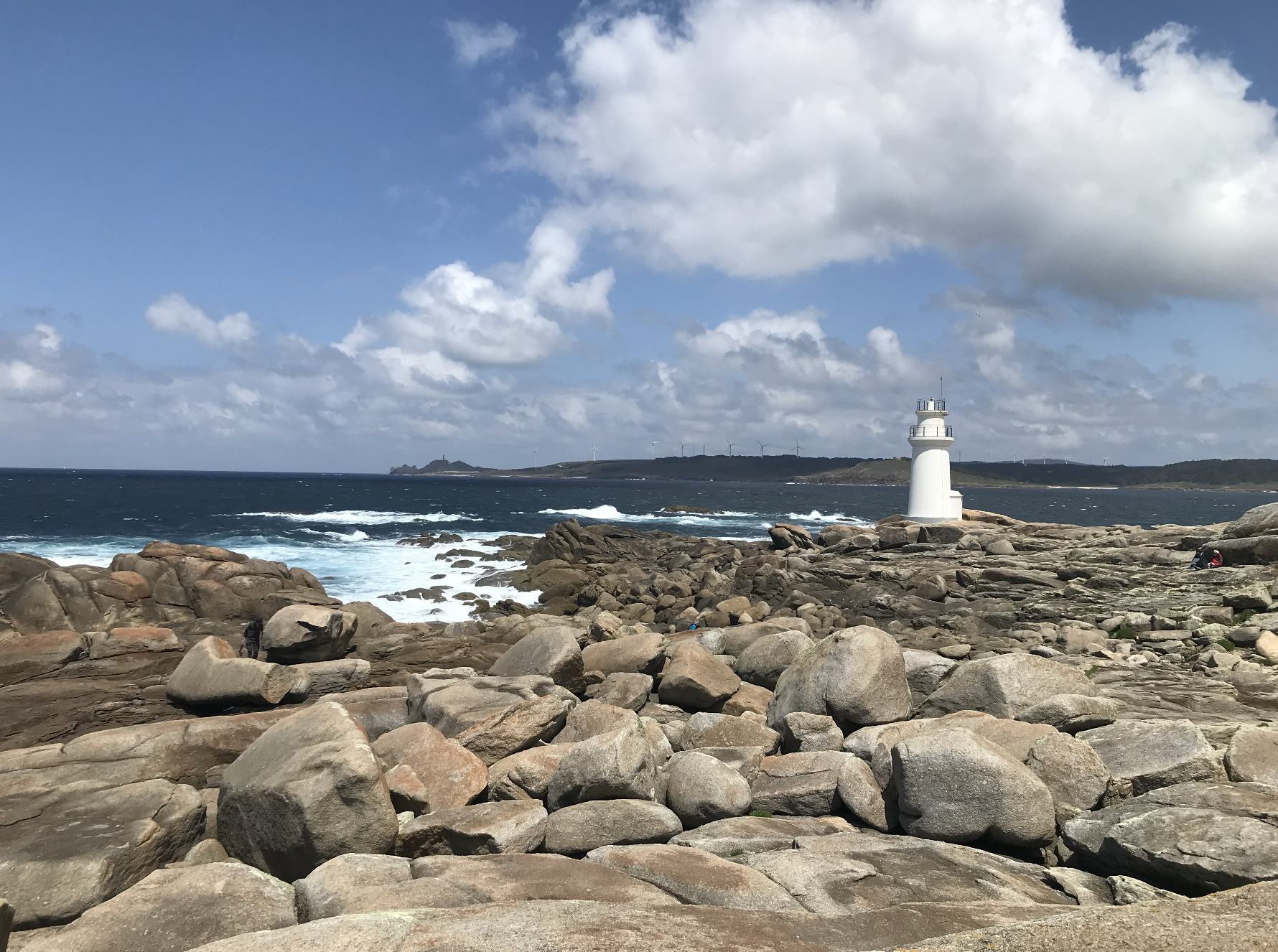
Fisterra, the ‘end of the world’ is a popular destination. But there’s another powerful and mystical place a little further north: Muxía, a coastal town steeped in legend and natural beauty.

Some, of course, go to both places. They’re both close to 90km from Santiago, and they both have a connection to the Camino. 


Where is Muxía?

Like Fisterra, Muxía is located on Galicia’s rugged Costa da Morte (Coast of Death).

Both towns sit roughly 90 km from Santiago de Compostela, and both form part of the Camino de Fisterra-Muxía, a route that many pilgrims follow after completing the main Camino de Santiago.

Though less visited than Fisterra, Muxía holds deep spiritual significance and offers a unique experience to those who journey there.


Muxía and the Camino

This little fishing town, located on the coast of Galicia, is considered one of the last stops of the Camino de Santiago. But in order to understand how this small remote village became an essential part of the Camino, we must dive into history.

The history of Muxía is ancient. Megalithic monuments like the Dolmen de Dombate reveal that the area has been spiritually significant since prehistoric times. In fact, in this corner of Galicia, stones were always sacred. They marked holy sites, were believed to possess healing powers, and served as bridges between the human and the divine.

These beliefs endured and eventually merged with Christian tradition.


According to local legend, Saint James was preaching along the Galician coast, struggling to inspire converts. In a moment of despair, he knelt in prayer near the rocky shore of what is now Muxía. There, the Virgin Mary appeared to him. She arrived on a boat made entirely of stone to offer encouragement.

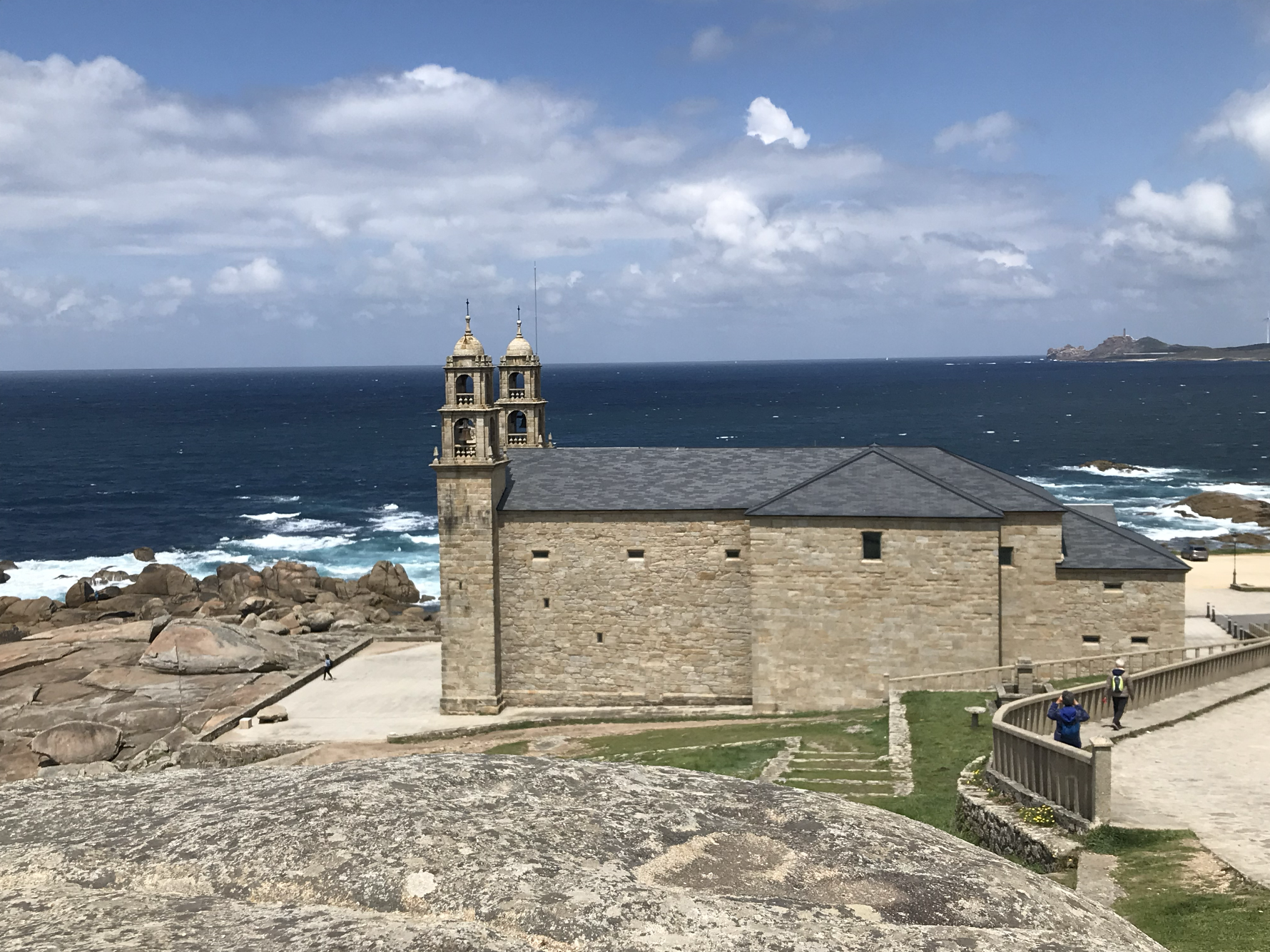
After she vanished, the stone boat remained, and its pieces can still be seen today near the Santuario da Virxe da Barca (Sanctuary of the Virgin of the Boat).

These stones are known by their Galician name:

Pedra de Abalar (rocking stone) would have been the boat. This massive slab used to move (hence the name) and through the centuries it has been used for divination, healing, and fertility rituals.

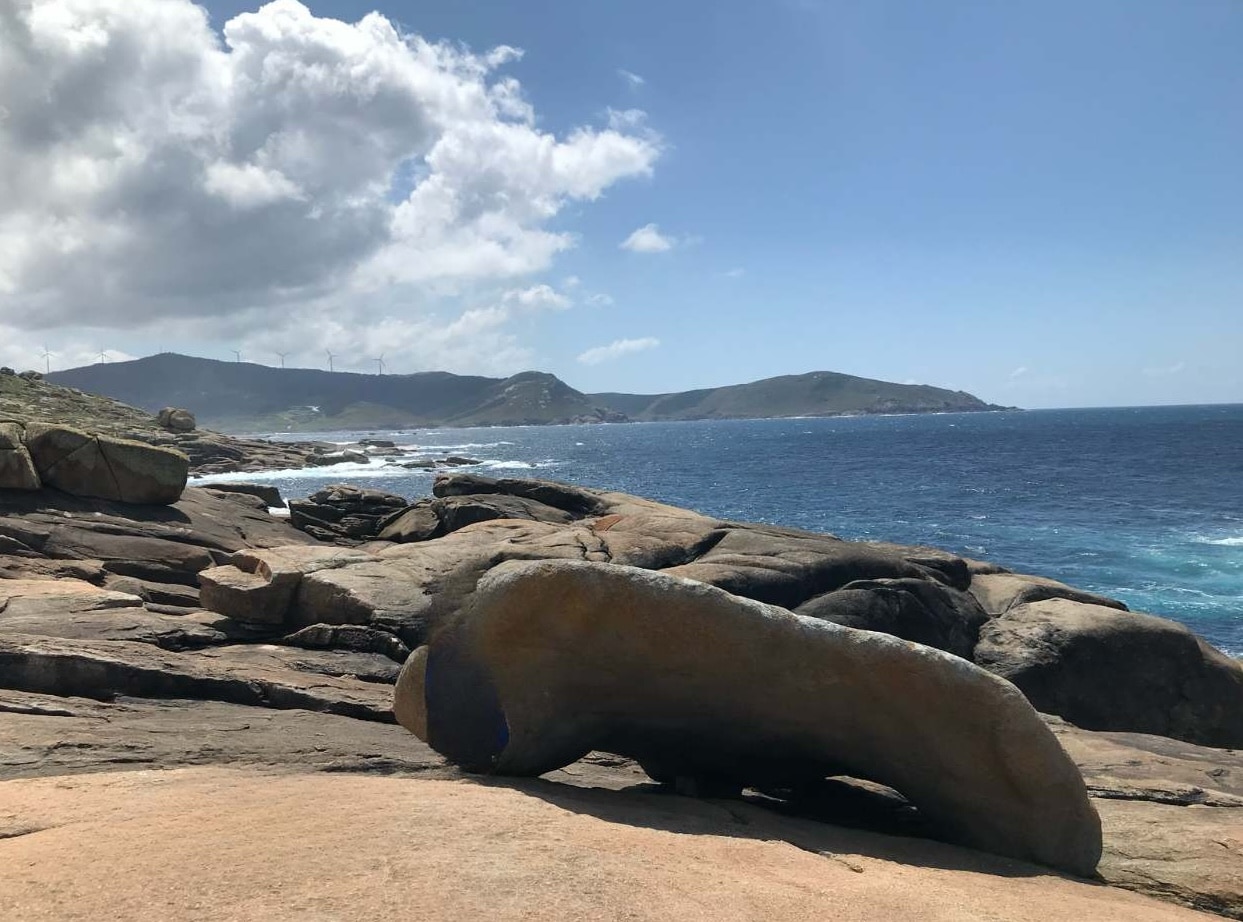
Pedra dos Cadrís – This would have been the sail of the boat. It is said to have healing powers. They say that if you go under it 9 times, back pain, headaches and kidney problems will be cured.


Santuario Virxe da Barca en Muxía

Church of the Virgen de la Barca.

Pedra dos cadrís Muxía

Pedra dos cadrís.

Muxía

Why End Your Camino in Muxía?

Many pilgrims choose to walk from Santiago to Muxía as part of their spiritual journey’s conclusion.

Some pilgrims walk to Fisterra first, then continue to Muxía. Others go to Muxía first. Either way, it’s a powerful way to close the Camino.

The walk to Muxía is around 90 km and typically takes 3-4 days, longer if you go to Fisterra first. The route is well marked and offers breathtaking coastal views, peaceful forests, and small villages along the way. 

Ending your pilgrimage in Muxía is more than just reaching another town—it’s a journey through layers of history, legend, and personal reflection. So, as you plan your Camino, ask yourself:

Where do you want to end your Camino de Santiago?


Basic Spanish for the Camino

*pedra dos Cadrís: ‘pedra’ is the Galician word for stone (piedra in Spanish). Cadrís is also a Galician word and it means hips.

Abalar is another Galician word. It means to rock or swing.

For the pronunciation of Fisterra and costa da Morte, check this post.


See inside book of Camino Portugues legends
Read more about St. James’ travels and miracles in Spain in my book Historias tras cada paso. Leyendas y curiosidades del Camino Portugués.
Most of the stories are about places along the Camino Portugués; many of them are directly related to the Camino or St. James. But there’s also a section about St. James and the origins of the Camino.
The book is in Spanish, for intermediate learners, and includes a vocabulary guide with English translation.

Want more?

Make sure you don’t miss any posts or announcements by subscribing for free here. You’ll receive a free Camino food guide. And… you’ll get access to exclusive content too.


¡Buen Camino!

Galician language on the Camino

Galician language on the Camino

We’re not going to learn Spanish today. Instead, I’m going to tell you about the Galician language. More specifically, I’m telling you about the Galician language you’re more likely to see on the Camino de Santiago.


Yes. I know this page is called Spanish for the Camino and (almost) every post includes a few Spanish words or phrases you can use on the Camino, or elsewhere in the Spanish-speaking world. But Spanish is not the only language spoken in Spain. It’s not the only language you’ll encounter on the Camino either, as we discussed in previous posts.

For instance, you will come across Basque as you walk through País Vasco and Navarra. Oihana teaches us some basic words in this post.


Also, once you enter Galicia you’ll start seeing and hearing galego (Galician). Rest assured. Everyone can and will speak Spanish. But it can be nice and even helpful at times to be familiar with some common words you’re likely to see often.


I wrote another post about the Galician language before. In it, I gave you a very summarised history of the language, and your first basic words (greetings, please, thank you…). You can read that post here.

In this post, I thought I’d focus on things you will see around you, like names of towns or signs.


But first, let me give you some more background, so you understand the sometimes difficult linguistic situation we have over here.


Some more history of Galician

As I told you in a previous post, Galician was banished from public life in the 15th century, and it remained so until the 19th century. During this period, the upper classes spoke Spanish, while Galician remained the language of the lower classes. Add to this the fact that Galicia became impoverished during this time and many had to emigrate. In many cases, these people were ridiculed and made fun of because of their language.


These 2 facts contributed to create the belief, that many still hold today, that Galician is an inferior language, that if you want to do well in life, you must speak Spanish and not Galician. This explains why during that period many names of towns (and family names too) were changed to make them sound more Spanish.


Today, the official name of every Galician town is in galego, but there are still remnants of those old beliefs. To use an exampled I’ve mentioned before, Fisterra is the official name of the town where many end their Camino, but you’re likely to see Finisterre too.


Not every town has 2 names, but there are several well-known Camino towns where this happens. Wikipedia, for instance, tends to favour the Spanish name. Certain apps will only display the Spanish name too.


Muxía is an example of this. The Spanish-sounding version is becoming less and less common, but you may still see Mugía in places. Melide may sometimes appear as Mellid and Tui is still frequently spelled as Tuy (no change of pronunciation in this case).


Galician on the Camino

The use of galego varies across the region, so how much of it you see or hear will depend on where you are. But there are common words you’re likely to see.

Rúa (calle in Spanish): street

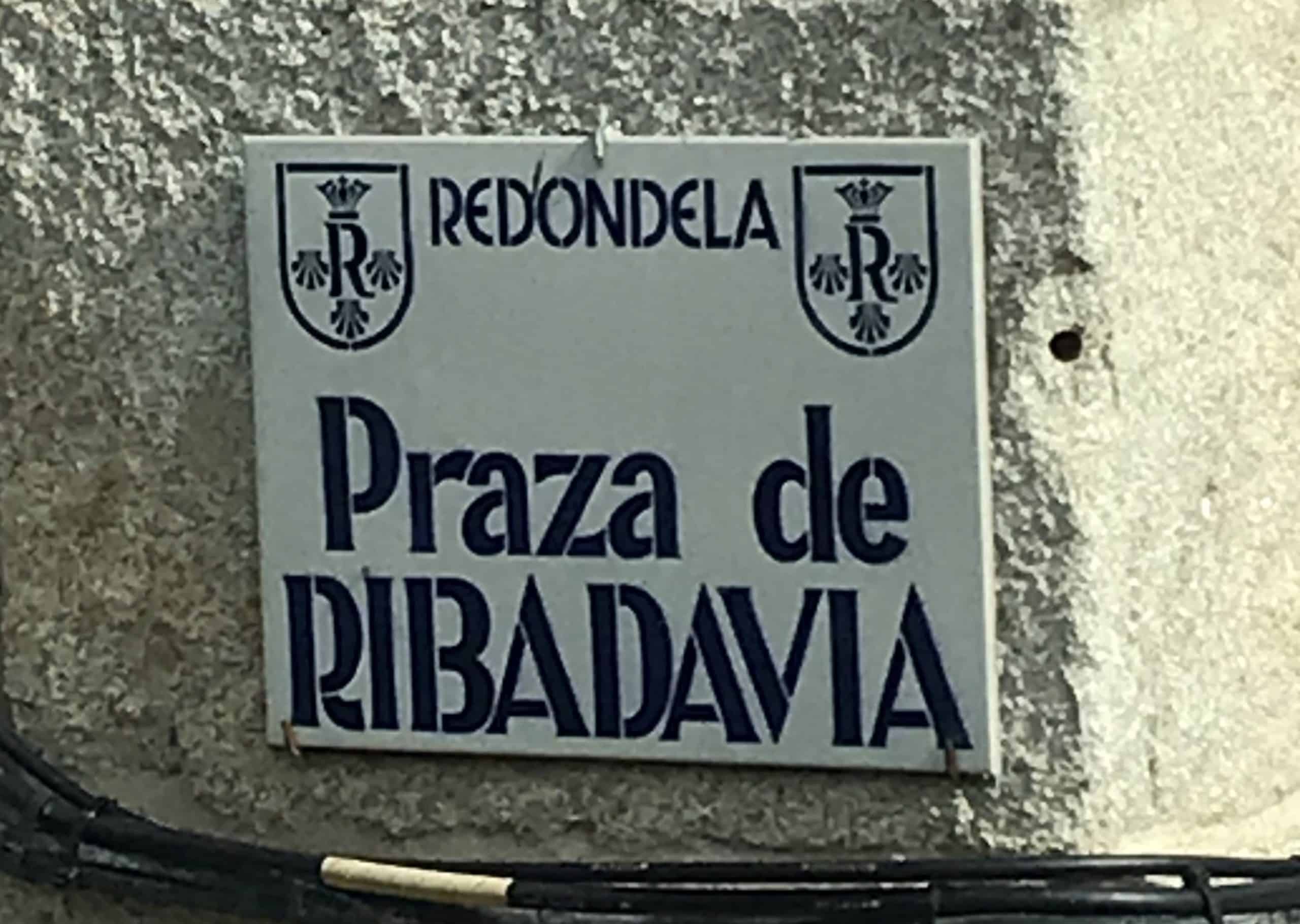
Praza (plaza in Spanish): square

Igrexa (iglesia in Spanish): church

Mosteiro (monasterio in Spanish): monastery

Concello (ayuntamiento in Spanish): town council

Castelo (castillo in Spanish)


Galician language
Calle Peregrina Pontevedra

What is your experience? Has this ever caused confusion for you? Share your anecdotes!


Today’s words

For the pronunciation of calle, iglesia and monasterio, check Camino Inglés: de Ferrol a Neda.

For the pronunciation of plaza, check Santiago de Compostela.

For the pronunciation of castillo, check Finisterre.

Want more?

Make sure you don’t miss any posts or announcements by subscribing for free here. You’ll receive a free Spanish vocabulary guide with your first Spanish words + cultural tips. And… you’ll get access to exclusive content too.


¡Buen Camino!

Pontevedra

Pontevedra

As you may already know, soy de Pontevedra (I’m from Pontevedra). I grew up here, then lived abroad in Ireland for a few years and moved back here in 2014. Oh! And I love the place. There are so many things I’d love to tell you… but this post would go on forever. So, I’ll try to control myself.

For those not familiar with the Camino Portugués, Pontevedra is around 65km (3 days) from Santiago. The coastal and central routes join in Redondela, before Pontevedra. And right outside Pontevedra the Camino splits again: a la derecha, the traditional Camino. A la izquierda, la Variante Espiritual.

Pontevedra is the biggest town on the Spanish section of the Camino Portugués, after Santiago. It’s common now to see pilgrims throughout the year, but it hasn’t always been like that. I don’t remember ever seeing any pilgrims growing up and until the time I moved abroad. There were no flechas amarillas or conchas de vieira in every corner either.

The Camino has always been there. In fact its origins date back to the 12th century. So, it is part of the history of the city, and we have many references to prove it, like a calle Virgen del Camino or a calle and plaza Peregrina.


Calle Peregrina
Calle Virgen del Camino

And, of course, one of the main symbols of Pontevedra is the popular Iglesia de la Virgen Peregrina, dedicated to the patron saint of the Camino Portugués. Its construction began in 1778 and its most characteristic feature is its floor plan, in the shape of a scallop shell.

So, we can’t imagine Pontevedra without its links to the Camino de Santiago, but the 20th century was not a good one for the Camino in general. Until the Holy Year of 1993. The Camino was then heavily promoted by the Galician authorities; pilgrims started returning. Nowadays, the Camino Portugués is the second one in number of pilgrims, after the Camino Francés.


La historia de Pontevedra

According to legend, Pontevedra was founded by Teucro (Teucer or Teucrus), one of the heroes of the Trojan War. The truth is that it’s not clear when Pontevedra was founded exactly, but it goes back at least to Roman times. There is evidence of a settlement on the Vía Romana XIX, in the area close to the Puente del Burgo. This is the bridge pilgrims must cross on their way out of town.


The Middle Ages

In the Middle Ages, Pontevedra was a prosperous city: it had one of the most important ports in western Europe, which attracted a lot of international trade. There was an important shipyard too. In fact, the Santa María, one of the 3 ships that Columbus took to the Americas, came out of here.

In 1467, King Enrique IV granted the city the right to host a ‘feira franca’, a 30-day tax free market that attracted many people, rich and poor.  

This market is remembered nowadays with a medieval festival. It’s called Feira Franca and it takes place during the first weekend in September. People dress up in medieval fashion, the whole historic centre is decorated to look more medieval, there’s a market, music, entertainment and other events (there are a couple of images of it in the video below).


Pontevedra was the most populated city in Galicia during the 16th century. But the next 2 centuries brought in a recession, caused by several factors.

Then, in the 19th century, it started to grow again. The old city walls were demolished to allow the expansion of the city. Some remains of those old walls have been found in recent years and you can visit them.


More recent times

The end of the 19th and beginning of the 20th centuries was an era of great expansion, and not just physically. Pontevedra was then a cultural and intellectual hub. It was also the first Galician city with electric light. In fact, you can still see where the electricity was produced. The place is aptly called Casa da Luz (house of light) and you can find it in one of Pontevedra’s many squares: praza da Verdura. 

The Civil War (1936-1939) put an end to this. The repression afterwards was important and a new era of depression and decay started.

Then, around 20 years ago, Pontevedra began a deep transformation to become more ‘people friendly’. During this period, most of the city centre has been pedestrianised. Streets that used to be full of cars, with only a small space for people, are now virtually car-free and full of people. CO2 emissions are down 70%. Kids can safely walk to school unaccompanied.


The historical centre was very run-down and it was a rough area that most of us would avoid.  Then cars were banned. The area was renovated. Now, it’s perfectly safe and full of life. And winning international awards.

I love just walking around, enjoying the atmosphere, going for a drink, shopping,  admiring the architecture, discovering new details every time…


What to see in Pontevedra

 What not to see?! 

I’m a big fan of my city so I’d love for everyone to spend some time exploring it and falling in love with it. It is the perfect size to walk around and with the historical centre being mostly car-free, it is a very enjoyable experience too. So, you can simply wander around and admire your surroundings. But there are a few places you shouldn’t miss.

Iglesia Peregrina Pontevedra

First on the list is, of course, the Iglesia de la Virgen Peregrina.

It’s right on the Camino, so you can’t miss it and it’s full of Camino symbols. As I mentioned earlier, its floor plan has the shape of a scallop shell. You can appreciate this if you climb to the base of the dome.

I know climbing stairs is not your ideal plan after a long day on the Camino. But the perspective is totally different.

Anyway, in case you don’t feel like climbing the stairs, I got a picture for you.

There’s a statue of a parrot opposite the Peregrina church. It’s not just any parrot. It is an important figure in the city’s recent history. Would you like to find out more about it? Read (or listen to) the whole story here.

If you keep following the arrows, you’ll arrive at the Plaza de la Herrería, the heart of the city. On one side, you can see the typical soportales (arcade), on the other, there’s the convent and church of San Francisco. According to tradition, St. Francis himself  founded the convent when he stopped in Pontevedra while walking the Camino Portugués.


Other churches

 Pontevedra belongs to the diocese of Santiago, so there’s no cathedral here. But there are several churches worth a visit, apart from the 2 I already mentioned.

The main one is the Basílica de Santa María. The main façade is quite spectacular (can you spot the saint wearing glasses?) and the interior is very beautiful too. It was built in the 16th century with money donated by the sailors guild, which was quite powerful at the time.

Iglesia de San Bartolomé. The Jesuits built this church between the 17th and the 18th centuries. The buttresses on one of the sides were added later to reinforce the building after the Lisbon earthquake in 1755.

Ruinas de Santo Domingo. Only the ruins are left of this church and convent but they’re quite magnificent. Little story about them: the remains of this once spectacular building were almost blown up at the end of the 19th century. The local council wanted to clear the space and build something else there, despite many requests to preserve the remains. So they secretly hired someone from out of town to place some explosives there and make the church disappear.

But there used to be an orphanage next door. The person hired to cause the explosion heard children’s cries and decided he didn’t want to be responsible for killing or injuring any children. So, he left without completing the job.


The squares

If you wander around the historical centre you’ll discover many squares, some bigger, some smaller. The main one, as I said, is the Plaza de la Herrería. But if you keep on the Camino route, you’ll see the Plaza de Curros Enríquez (where the arcade ends) and the Plaza del Teucro. 


Other squares that are worth visiting are:

Praza da Verdura. There used to be a vegetable market here, hence the name. Today, it’s the perfect location for a drink and some tapas. This square is also the location of the Casa da Luz that I mentioned earlier. You can also find here the oldest farmacia in town.

Praza da Leña. It takes its name from the firewood that used to be sold there in the past. Today, it’s another great location to enjoy some food in one of its many bars and restaurants (there’s even a Michelin star restaurant here!).

Praza de Méndez Núñez. There is a statue of Galician writer Valle-Inclán here. When you get to Santiago, you can look for a similar statue of the same author in the Alameda.


Other things to see in Pontevedra 

Correos (the post office) is not far from the Iglesia de la Peregrina. You can get your credencial stamped here as well as admire the beauty of this historic building.

Santuario de las Apariciones. Not many people know this but Lucia, one of the 3 children who reported the apparitions of the Virgin Mary in Fátima (Portugal), later joined the St. Dorothy congregation in Pontevedra. While staying there, she had another apparition in 1925. This place is considered the third most important Marian shrine, after Lourdes and Fátima.

And finally, why not walk around the Alameda park or even along the river, towards the sea. Sunsets there can be quite beautiful.


Where to stay

Albergue Pontevedra

There is a public albergue in Pontevedra. It is next to the train station, as you enter the city. More info about it and contact details here.

If you prefer something else, the options are many.

For obvious reasons, I haven’t stayed at any of the following places but I know people who have and are happy to recommend them, so I’ll pass the recommendation on. All these places have the perfect locations to explore the city.

Hotel Rúas. Right in the heart of the historical centre, between 2 popular squares with plenty of places to have a drink or some food. This hotel has a restaurant/bar too. That, I can recommend. 

Casa Sara Hospedaje. A cosy pensión, also in the historical centre. It’s on a quieter street, but still close to all the ‘action’.

Acolá Hostel. A modern albergue with a view to the Santa María church.

And, of course, if you’d like to splurge a little, we have a Parador too. 


I have so many pictures of Pontevedra and I wanted to share them all but that was not possible, so I made a selection and put them together in the video below.


See inside book of Camino Portugues legends
For the story behind the statue of the parrot, the miracle that St. James performed in Pontevedra and other stories, check my book Historias tras cada paso. Leyendas y curiosidades del Camino Portugués, a collection of legends and historical tidbits about places along the Camino Portugués.
The book is in Spanish, for intermediate learners, and includes a vocabulary guide with English translation.

Today’s Spanish words


Warning: You should be aware that the names of towns, streets, squares, etc. can be in either Spanish or Galician. I wrote a post a while ago about the Galician language, and I think I’m due a new one, with more common Galician words you will come across.

You may have noticed that I used both plaza and praza. The first one is the Spanish word, the second one is the Galician one. Pronunciation is the same, except for the l/r. Keep this in mind if you see similar names. They probably refer to the same thing, just like plaza/praza, or virgen/virxe.

For the pronunciation of albergue, check ¿Dónde vas a dormir?

For the pronunciation of parador, check ¿Dónde vas a dormir? (II)

For the pronunciation of plaza, check Santiago de Compostela

For the pronunciation of iglesia, check the post about Finisterre


Want more?

Make sure you don’t miss any posts or announcements by subscribing for free here. You’ll receive a free Spanish vocabulary guide with your first Spanish words + cultural tips. And… you’ll get access to exclusive content too.


¡Buen Camino!
Through a field of stars

Through a field of stars

Through a Field of Stars

Brian John Skillen, is a professional filmmaker, author, and international dance instructor. His many adventures around the world have strongly influenced his life, but nothing has affected him more than his pilgrimages along the Camino de Santiago. He was first inspired to write the Through a Field of Stars trilogy on his pilgrimage in 2017, where he was told about the clues the Knights Templar left behind on the Camino de Santiago.

Since 2017 he has walked over 1,000 miles across Spain doing research for the trilogy. He has walked the miles his characters have walked and learned the lessons they have learned. All of the characters in the novel that aren’t based on historical people are based on pilgrims Brian met on his Camino. Brian’s goal with the trilogy is to inspire one million people to take a pilgrimage on the Camino de Santiago.

He tells us more about in this guest post. Over to Brian!

Flecha azul


Have you ever seen something so amazing it changed your life in an instant?

In 2017, I took an epic pilgrimage on the Camino de Santiago. I saw many amazing things, but when I first saw the Arc of San Anton, I knew my life would never be the same. To me, it looked like something that could only exist in a movie or a novel. Stepping through the Arc was like stepping into another world. Something about me and my life changed as I emerged on the other side.


I didn’t know it then, but that was a defining moment for me as a person. I didn’t know that after stepping through the Arc of San Anton, I would  hang up my dance shoes and trade them in for a story. I didn’t know that I would face one of my biggest fears and achieve something that I thought was impossible… 


Just past the Arc of San Anton is the city of Castrojeriz—a hilled city with the ruins of a castle on top. Once again my breath was taken away. When I first saw the city, I thought, My God, someone has to write a book about this place! Little did I know I was going to be that someone.


Every Camino is like a lifetime—you begin as one person and end up leaving as someone completely different. 

The Knights Templar

At the albergue (pilgrims Shelter), I looked at my credencial (pilgrims passport) and noticed that the stamp for the city was the cross of Jerusalem. After seeing some Knights Templar symbology at the Arc of San Anton and in the city, I made a comment about the Templars. The hospitalero (person who runs the hostel) raised an eyebrow and asked, “What do you know about the Knights Templar?”

This question led to a long discussion about the importance of the Templars on the Camino de Santiago and in Castrojeriz. The hospitalero told me that there used to be several Templar commanderies in the city, and that the entire hill was hollowed out with tunnels that the Templars had used for rituals and to store their treasure. As we were finishing, he lowered his voice and told me to look for the clues that the Templars had left behind on the Camino.

The next morning I woke up with the hospitalero’s stories still in my head. As I was leaving the town, I did something significant that has changed my life. I took my most valuable possession—my dance shoes—from my backpack and left them at a second-hand store. I said to the world, “I will trade these in for a story.” This may not seem like such a big deal, but for someone who has been a professional dancer for the past twenty years, it was huge. This was my symbolic gesture of stepping into a new time in my life.

Every day after I made that declaration, the people I met and the experiences I had, all came together to form The Way: Through a Field of Stars. 

There was only one problem though, I grew up with dyslexia and a third-grade reading and spelling level in highschool—who was I to write a book?


Writing the story

However, once it has been unleashed, nothing can stop inspiration. On the Camino, I woke up every morning before the sun and walked under the stars. As I hiked, The Way: Through  Field of Stars played like a movie in my head, and I dictated exactly what I was seeing into my phone. 

By the end of my Camino, I had the entire story outlined in an audio format. Now, I had to face my biggest fear, actually writing the book down on paper.

I mix up letters in words, and I didn’t learn the rules of grammar—so writing a book was something I never thought I would do. As I returned home, I committed to writing 2,000 words a day no matter what. At first it was incredibly hard and took a very long time—as I had to teach myself the rules of grammar. But, I stayed committed—and within three months, I had finished the first draft of my novel. I thought it was perfect, however as most of you know, the Camino doesn’t always provide what you want, but exactly what you need to fulfill your life’s purpose.

When I showed the book to my girlfriend (who is now my wife), she answered honestly and said it needed some work. After learning more about editing and publishing, we reached out to fifty agents and all we got in return were two rejection letters and forty-eight other agents that didn’t even bother to write back.

In 2020, we realized the book was as far as we could take it ourselves so we ran a Kickstarter to hire professional editors, formatters, designers, etc. We raised $10,000 in presells on Kickstarter and since publishing The Way: Through a Field of Stars, it has won an Eric Hoffer Award in the Spiritual Fiction category and has also reached the #1 Amazon Bestseller spot in several categories.


My wife and I are currently launching the second book in the series Back: Through a Field of Stars on Kickstarter until July 9, 2021. Follow our Kickstarter link to get both books and support the creation of a new novel. Also, if you are interested in how we launch books on Kickstarter, you can join our free group on Facebook—Kickstarter to Amazon Best Seller. We believe in a life of contribution and are happy to share some of the things we have learned along the way.


My wife and I returned to the Camino in 2019 and my favorite phrase to say was Soy escritor. I declared that “I am a writer” in Spanish, long before I did in English. I hope your Caminos bring you as much growth, inspiration, and love as mine did—Buen Camino!


Some of our favorite Spanish words and phrases we use on the Camino

Zumo de naranja – Fresh squeezed orange juice

Tortilla – an egg dish they serve at breakfast

Leche de soja  – Soy milk

¿Dónde está el albergue municipal? – Where is the state run hostel (these are usually the most cost efficient)

¿Cuándo es la misa?  When is the Mass?

Through a field of stars

For more on Brian and his novels, follow this link.


Today’s Spanish words

For the pronunciation of credencial, check ¿Cómo vas a hacer el Camino?

For the pronunciation of albergue, check ¿Dónde vas a dormir?

For the pronunciation of hospitalero, check El albergue.


Want more?

Make sure you don’t miss any posts or announcements by subscribing for free here. You’ll receive a free Spanish vocabulary guide with your first Spanish words + cultural tips. And… you’ll get access to exclusive content too.


¡Buen Camino!