Soy vegano/a

Soy vegano/a

Soy vegano. Or soy vegetariano.

I’ve seen an increase in the number of future pilgrims asking about the availability of vegetarian or vegan dishes along the Camino de Santiago. They worry that it will be hard for them to find suitable food. And it’s understandable.

Obviously, you need adequate nourishment.

And, although it’s true that the Mediterranean diet includes a lot of vegetables and pulses, it is also true that Spain is not the most vegetarian-friendly country. It’s common for an ensalada to have tuna; and a “vegetable sandwich” with either tuna or a slice of ham is a classic (and nobody thinks it’s odd!).

Things are changing and it’s not unusual now to find restaurantes vegetarianos or veganos. But they are not available everywhere. They are more common in the bigger cities. But the Camino goes through a lot of smaller towns and rural areas. So, is it possible to do the Camino as a vegetariano/a* or vegano/a*?

The short answer is: YES! It’s possible, with some planning.


What are your options as a vegan or vegetarian on the Camino?


You have two main choices:

  • You can buy food and snacks from the local fruterías and supermercados (see Shopping on the Camino for the pronunciation of these words). Some albergues have kitchens where you can prepare your own meal. You just need to find out if the place where you are staying has such facilities.


  • Or you can also eat out and enjoy the local cuisine, even in the smaller towns. And it’s probably easier than you think.


There are many Spanish dishes that are naturally vegetariano/vegano or can be easily adapted (In this article you can find a long list of Spanish dishes that are suitable for vegans: https://www.thenomadicvegan.com/the-ultimate-vegan-guide-to-spain/). You just need to know a few Spanish words and phrases to make sure you get the right food:


Soy vegetariano / Soy vegetariana or Soy vegano / Soy vegana

I’m a vegetarian or I’m a vegan.


*If you are a male, you will refer to yourself as vegetariano/vegano. If you are a female, you will use vegetariana/vegana instead.


  • You can also specify the foods you don’t eat by saying No como… (I don’t eat…) + anything you need to mention, such as carne (meat), pescado (fish), huevos (eggs), lácteos (dairy) or queso (cheese). If you have food allergies, get more info here.


  • Let’s say you are not sure about the ingredients of any particular dish: you can ask ¿Lleva carne, huevo…? (Does it have… meat, egg…?).


  • If a dish is mostly vegan, but it has some egg or cheese, for instance, you can still order it and ask them to serve it sin huevo (without egg) or sin queso (without cheese).


  • You could even take advantage of the menú del día. I know I said in this previous post that the second course is normally pescado or carne. No problem! You can explain that you are vegetariano/vegano and ask if you could take dos primeros (two first courses) instead of a primero and a segundo. Most places wouldn’t have a problem with that.


Do you have any experience as a vegetariano/a or vegano/a in the Camino de Santiago? You can share it in the comments!


Today’s Spanish words

Want more?

Make sure you don’t miss any posts or announcements by subscribing for free here. You’ll receive a free Camino food guide. And… you’ll get access to exclusive content too.



¡Buen Camino!

Menú del día

Menú del día

Menú del día |

What is a menú del día? When can you have it? And when can you find comida (food) in Spanish?

Before I answer those questions, let me clarify that the word comida is also what we call the most important meal of the day: lunch. You can refer to lunch as almuerzo, but comida is used more frequently -and it’s easier to pronounce! So I’ll use comida.

If you have been to Spain before you will know this. But if you haven’t, you should be warned: mealtimes in Spain are late compared to other countries. The reason for this is that we are living in the wrong time zone (this article explains it in more detail).


Mealtimes in Spain

As I was saying, la comida is the most important meal, but obviously not the only one. We also have:

  • Desayuno (breakfast). Spaniards, in most cases, don’t take desayuno too seriously. Many just drink a cup of coffee before leaving their homes. That’s why it’s common for people to go down to their nearest bar or cafetería during their break, for a mid-morning café con leche and pincho. Despite that, we have a verb meaning “to have breakfast”: desayunar.


  • Cena (dinner). It is usually a light meal. 10:00pm is a perfectly acceptable (and normal) time to have dinner. It’s not common for restaurants to start serving la cena before 8:30pm. We also have a verb meaning “to have dinner”: cenar.


Having lunch in Spain

Since it’s the most important meal, let’s concentrate on la comida. I already said that lunch in Spain is late, compared to other countries: don’t expect restaurants to start serving lunch before 1:30pm. And you normally have a couple of options:

  1. You can choose from the full carta (menu). This option tends to be more expensive, but it gives you the freedom to choose exactly what you want.
  2. You can go for the menú del día. Generally a more economical option. The price is set and you get at least 2 or 3 choices for each course.


El menú del día

Menú del día was introduced by law in the 60’s. Back then it was called menú turístico and, as the name suggests, it was created to cater for all the tourists that started visiting Spain in those days. The government set the prices and what the menu should include. It should be served as fast as possible and it should also try to promote typical Spanish dishes among the tourists.

Things have changed since, and restaurantes don’t have to offer a menú del día, although many do. Needless to say, prices are not set by the government either and they can vary a lot from one place to another.

menu del dia

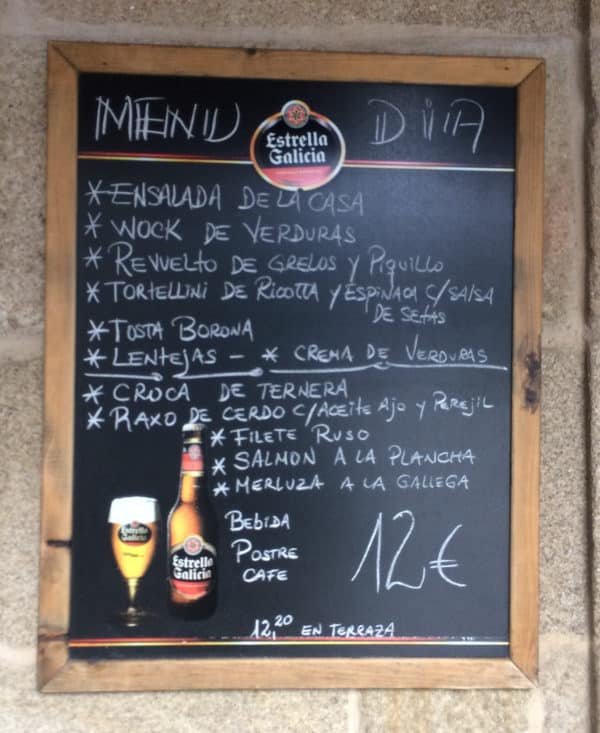
The picture shows a real menú del día from a restaurant along the Camino Portugués.


In this menu, you can see the first and second courses separated by a line. So you have siete  (7) primeros and cinco segundos to choose from. The price is €12.00 (€12.20 if you sit outside) and it also includes a bebida (drink), postre (dessert) and café (coffee).

The primeros usually include vegetables, soups, eggs and/or pasta. All of these are included in this menu:

Vegetables: ensalada (salad) as well as vegetable wok.

Soups: lentejas (lentil soup) and crema de verduras.

Eggs: revuelto (scrambled eggs).

Pasta: tortellini.

The segundos are in most cases either fish or meat dishes.


Some places may offer a vegetarian option among their segundos, but you’re more likely to find one among the primeros. So, if you’re a vegetarian and you still want to avail of the menú del día, you can ask to have 2 primeros, instead of a primero and a segundo. That’s an acceptable practice and most places will be happy to oblige.


What is frowned upon and not allowed in many places is to share a menú del día between 2 people. 

In some places, they have a plato del día (just 1 course instead of 2).


Today’s Spanish words


For the pronunciation of primero and segundo, check Eating on the Camino.


Want more?

Make sure you don’t miss any posts or announcements by subscribing for free here. You’ll receive a free Camino food guide. And… you’ll get access to exclusive content too.


¡Buen Camino!

¿Dónde vas a comer?

¿Dónde vas a comer?

¿Dónde vas a comer? |

Last week I answered a couple of basic questions about food/eating on the Camino. In short, you can buy food in the shops and cook your own meals, if you are staying at an albergue with cocina. Or you can eat out.

I also explained how the menú del día works: it’s usually a three-course meal for a set price. You get at least 2-3 dishes to choose from for each course (primero, segundo and postre).

In restaurantes along the Camino you can also find a menú del peregrino, which works in the same way as menú del día.

But restaurantes are not the only place where you can eat, and menú del día or menú del peregrino are not your only choices. So,

¿Dónde vas a comer?

or

Where are you going to eat?


  • You can get comida in a bar. Apart from drinks, bares also serve bocadillos (sandwiches), raciones, tapas and pinchos (or pintxos).

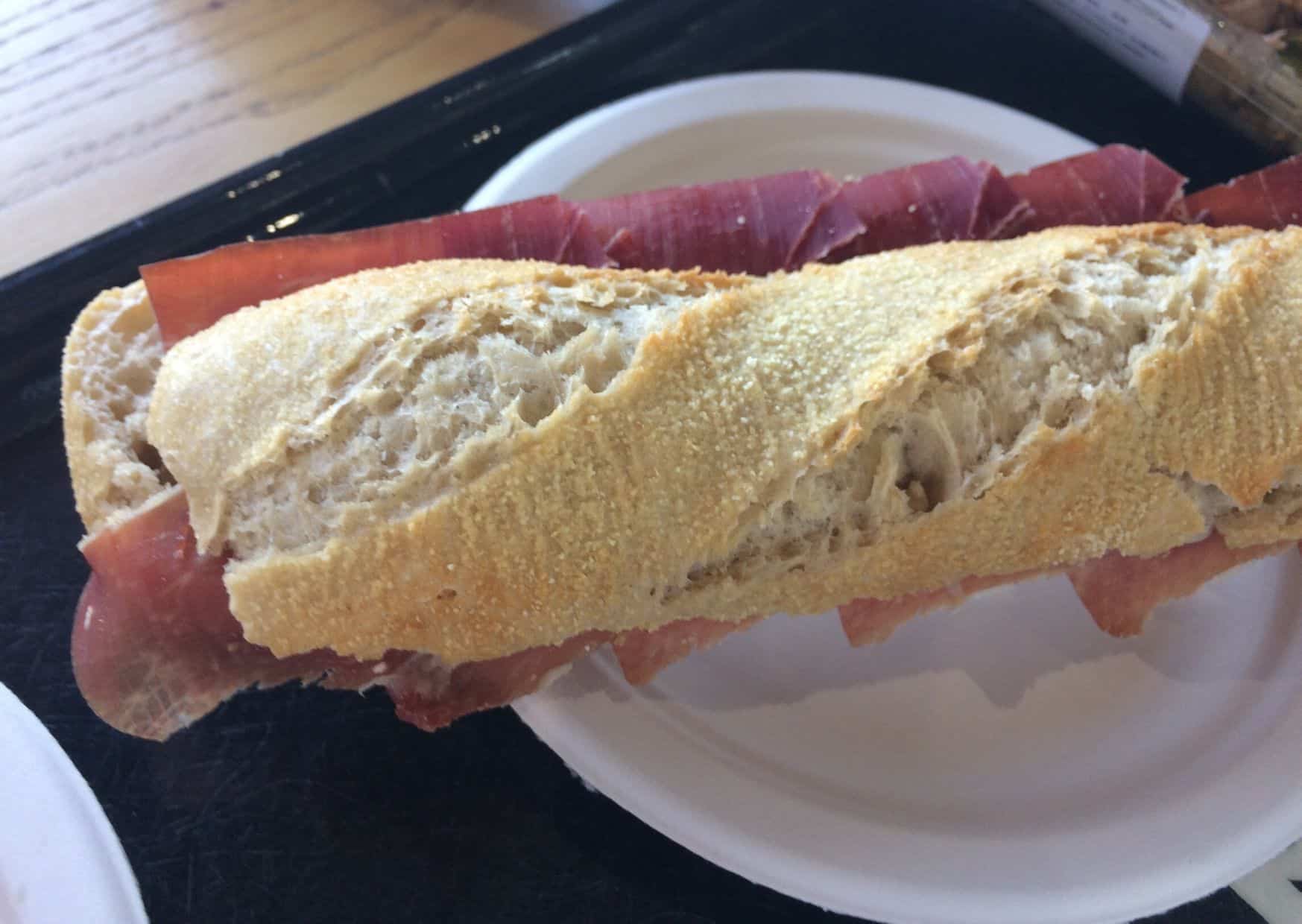
I have translated bocadillo as sandwich, but I should warn you! A bocadillo is not made with sliced bread. It’s served on baguette (or a similar type of bread) and it can be filled with almost anything: cold meats, fish, beef, pork, chicken… If you prefer sliced bread, then the word is sandwich, just like in English (but the choice of fillings will be more limited).

Raciones, tapas and pinchos are not different types of food. The different words refer to portion size:

Ración is the biggest of the three. It’s a normal size dish, enough for one person.

Tapa is a smaller portion, like a quarter of a ración.

Pincho (pintxo) is the smallest portion. Traditionally, it was a small piece of bread with something on top, all held together with a cocktail stick. However, pinchos have evolved a lot in recent years. In the Basque Country in particular, pintxos (you will find this spelling there) can be very elaborate, almost like a form of art.

So, if you are on the Camino del Norte, make sure you go and experience the pintxo culture. San Sebastián is very famous for its pintxos bars.

dónde vas a comer pinchos
dónde vas a comer bocadillo
  • You can also get comida in a cafetería. Cafeterías don’t have “proper” cocinas, so the comida they can offer is limited to cold dishes or hot ones that can be cooked on a grill.


In both bares and cafeterías you might get a complimentary tapa or pincho. But this practice differs a lot from one town to another and even from one bar to another.

If you have any favourite foods that you tried on the Camino, I’d love to hear about it. You can just leave a comment!


Today’s Spanish words

Want more?

Make sure you don’t miss any posts or announcements by subscribing for free here. You’ll receive a free Camino food guide. And… you’ll get access to exclusive content too.


¡Buen Camino!

Eating on the Camino

Eating on the Camino

Eating on the Camino |

In this post I address some common questions you, as a pilgrim, may have about food in Spain:

Is food easily available along the Camino?

What kind of food will I find? Will it be nutritious enough? 

How much money do I need to budget for food? 

Should I carry food with me?

Should I carry food with me?

The short answer to this question is NO. Remember what I said about the mochila? Yes, you have to carry the weight, so you should not pack any unnecessary items. You can take a couple of snacks such as frutos secos (nuts), chocolate (no translation needed, right?) or fruta (fruit) in case you need an energy boost at any point in time.

And agua (water), to make sure you stay hydrated. Again, no need to take huge amounts, as you will be able to refill your bottle in fountains and taps along the way. I know this is an issue that worries many, but tap water is generally safe to drink. It gets checked on a regular basis and if it’s not suitable for consumption, it will be marked “no potable”.


Is food easily available along the Camino?

YES, comida is widely available along the Camino. You will be walking through towns and villages with shops, cafés, bars, restaurants… So, no need to carry a big load.

For your main meals you have several options:

  • Some albergues provide food, but not all. And many of the public albergues have a cocina (kitchen), although the equipment might be insufficient. If a cocina is available, you could decide to cook your own meals. You should then find a supermercado and buy what you need.


  • Another option is to eat out. It’s a bit more expensive than cooking your meals, but it can still be done on a budget. Most restaurants offer a menú del día (menu of the day) for a very reasonable price.

Menú del día is a set menu that usually consists of three courses: a primero (starter/ first course), a segundo (main course) and a postre (dessert). It includes some bebida (drink), too. For each course, you will have a choice of at least two or three dishes. Unless you have any dietary restrictions, this should cover all your nutritional needs.

In restaurants along the Camino you can also find a menú peregrino (pilgrim menu) which works in the same way as menú del día.

Just one warning: if you are a vegetarian, check before you eat! Salads often have tuna and even a “vegetable” sandwich could have a slice of ham or some tuna!


The food might not be what you are used to, but you should be open to try new things. It’s all part of the experience!


Today’s Spanish words


¡Buen Camino!

Want more?

Make sure you don’t miss any posts or announcements by subscribing for free here. You’ll receive a free Camino food guide. And… you’ll get access to exclusive content too.
Shopping on the Camino

Shopping on the Camino

Shopping on the Camino |

Last month I wrote a series of posts about the things you should and should not pack for your Camino de Santiago. In the last one, “Your packing advice“, I tried to summarise all the suggestions I got from experienced pilgrims. One of my favourites was:


No “just in case” stuff. You can buy what you need in Spain.

With that in mind, I thought it would be a good idea to have one of our mini lessons on shopping on the Camino: shops you might need, what to buy in them and how to ask some basic questions… 

Shops and stuff

  • Farmacia (pharmacy) – in a previous post entitled El botiquín I covered the most relevant information about farmacias, as well as the difference between farmacia and parafarmacia and the meaning of farmacia de guardia (you can also listen to the pronunciation of these words there). To sum it up, farmacia is where you can get medicines, with or without prescription, as well as a long list of other items for your personal care.


In a parafarmacia you can find the same stuff as in a farmacia, except for medicines: they sell tiritas and Compeed, creams (sun protection and others), personal hygiene products: from jabón (soap), to shampoo and pasta de dientes (toothpaste)… (check El botiquín for the pronunciation of these words).


Tip: personal care products tend to be cheaper in supermarkets.


  • Frutería (greengrocer’s) – you can buy lots of fruta (fruit) and vegetables here. Loose fruit and veg is sold by weight, so the price you see, unless something else is specified, is the price for a kilo. Let’s say you just want an apple or two; no problem! You pick what you want, they will weigh it for you and you pay for what you take.


  • Panadería (bakery) – you can buy pan (bread) here, obviously. But you can also get empanada (savoury pie) and empanadilla (small version of empanada). Many panaderías are also pastelerías (cake shop), so you can also get all sorts of sweet pies, cakes and pastries.


  • Supermercado (supermarket) – In the bigger supermarkets you can buy all of the above (except for medicines), as well as other things. If you are in a small town with a small supermercado, your options will be more limited but you are still likely to find a bit of everything.


Do you just need a snack? A panadería or frutería  might be all you need. But if you are planning to cook your meals at the albergue or need non-food items, you might want to visit the supermercado.


You should be aware of shops’ opening times. If you are starting your walking day very early in the morning, as most people do, you will find that pretty much everything is closed. So, if you need something for the early morning, your safest bet is to buy it the previous evening.


Also, almost everything is closed on Sundays (not bakeries and cafés) and festivos (public holidays). And during “lunch time”, which is roughly between 13:30-16:30, although it can vary depending on the shop. Again, try to plan your shopping ahead.


And finally, some useful phrases you can use when shopping


  • If you can’t find what you need and want to ask if they have it, you can simply say ¿Tienen…? (do you have?) and add the name of the item you are looking for. For instance, you go into a supermercado looking for tiritas, but you can’t find them. You can ask a member of staff ¿Tienen tiritas?


  • If you need to ask for something, quería (I’d like) followed by the name of the item you want is what you say. Let’s say you go into a farmacia looking for ibuprofeno. What do you say? Quería ibuprofeno. Easy, right?


  • If you want to know the price of an item, you can ask ¿Cuánto cuesta esto? (how much is this?) while pointing at it. You can drop esto if you think it’s not necessary because it’s obvious enough what item you are asking about.


  • ¿Cuánto es? (how much is it?) is similar to ¿Cuánto cuesta?, but they are used differently. As I just said, we use ¿cuánto cuesta? to ask about the price of a specific item. However, we use ¿cuánto es? when we finish our shopping, to find out how much the total is.

Are you ready to go shopping on the Camino de Santiago?


Today’s Spanish words


​ 

¡Buen Camino!


Want more?

Make sure you don’t miss any posts or announcements by subscribing for free here. You’ll receive a free Spanish vocabulary guide with your first Spanish words + cultural tips. And… you’ll get access to exclusive content too.