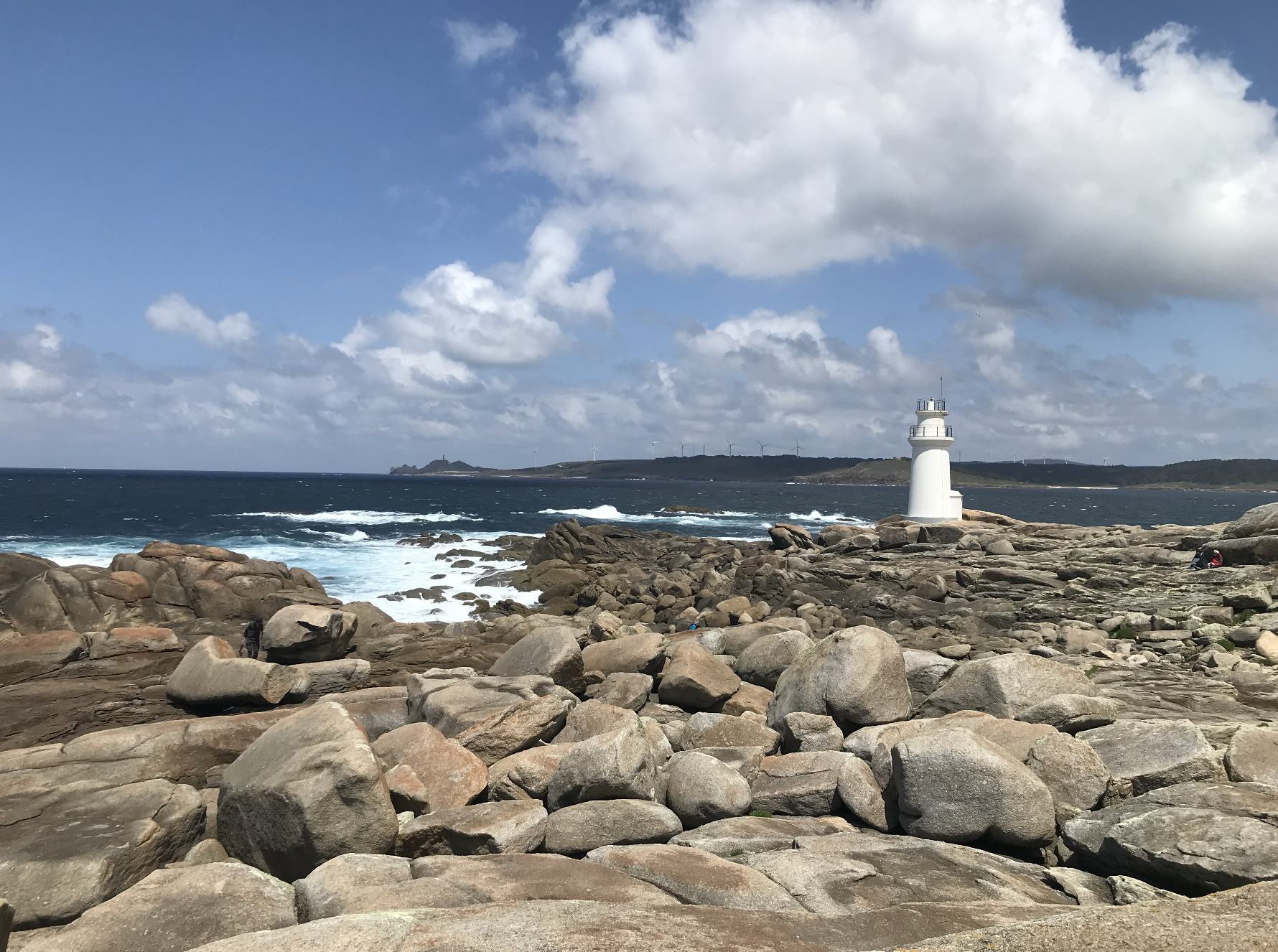
Camino Portugués: Padrón-Milladoiro

Camino Portugués: Padrón-Milladoiro

A new domingo (Sunday), a new stage of the Camino Portugués: Padrón-Milladoiro.


Again, I walked with a large group organised by the Asociación de Amigos del Camino Portugués. We could have walked to Santiago. In fact, most people do that.


But the Asociación had some things organised for the arrival in Santiago and a shorter walk suited those plans much better. That’s for the next post. Today we focus on Padrón-Milladoiro.


After several stages, I’m familiar with the routine now: we get on the bus early in the morning; we’re dropped at our starting point; we gather in front of an iglesia or capilla, where one of the organisers says a prayer; we take group photos and start walking. It was a chilly morning but there was not a cloud in sight and 0% chance of rain.


We covered a distance of around 19 km, mostly flat with some ascent in the final part.
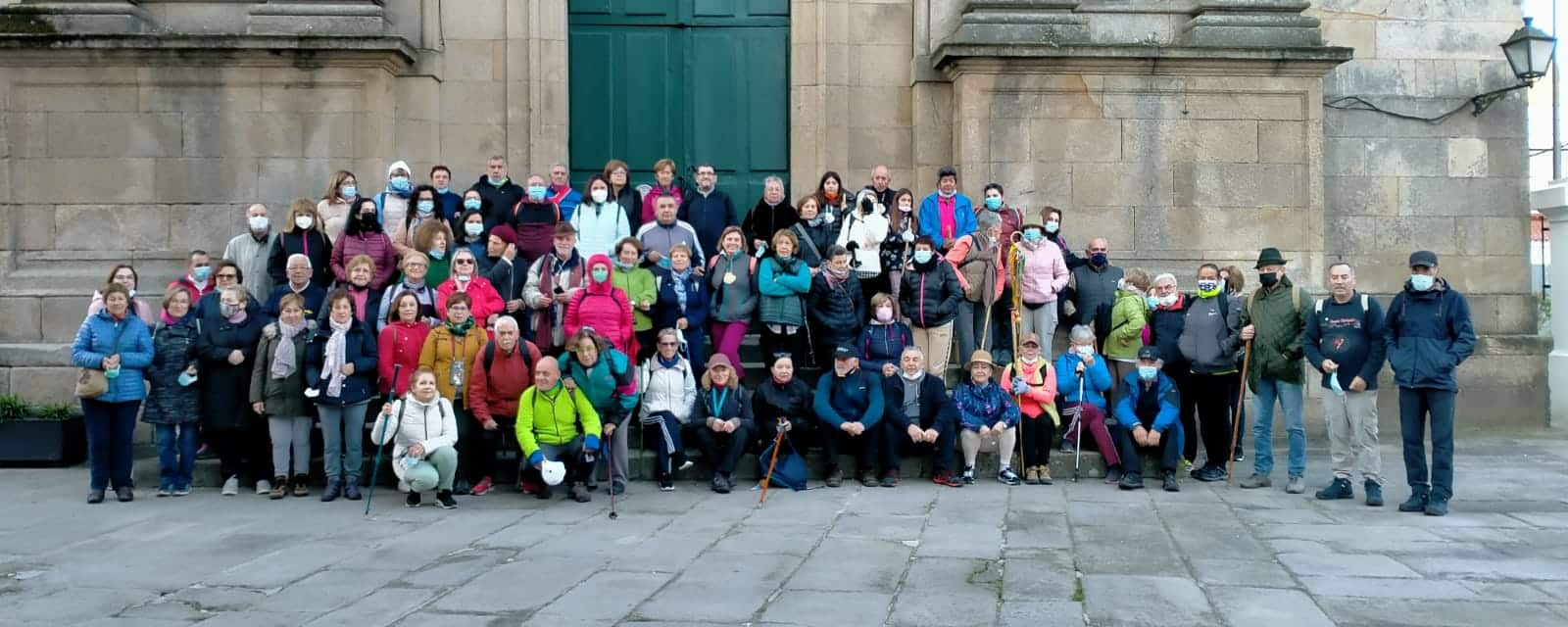
 

Padrón-Milladoiro

Group photo outside iglesia de Santiago borrowed from the Asociación’s blog.


A strange stage

This was kind of a strange stage for me. My dad is from this area and I grew up going to some of the places we passed through. In fact, we walked in front of 2 of my tío (uncle) and tía‘s (aunt) houses; we also passed the cementerio (cemetery) were my paternal grandmother is buried and the church were I attended several family occasions like bautizos (christenings), bodas (weddings) and funerales (funerals).

But that was a long time ago.

My uncle and aunt have long been muertos (dead); there’s a big age gap between my primos (cousins) and I, so we were never very close; I lived abroad for 15 years… in other words: I’ve lost contact and haven’t been in the area in years.

And then, there’s also the fact that I always went to those places by car. Walking there gave me a totally different perspective.

But let’s talk about the stage.


Padrón

Our starting point was Padrón. When we got there, people were setting up the Sunday market. Lots of activity there, but obviously not crowded like the previous Sunday, when the market was in full swing.


As I mentioned in my previous post, about the Caldas de Reis-Padrón stage, Padrón is a very relevant place in the history of the Camino. According to legend, the remains of St. James first arrived by boat here, when they were brought back to Spain by his disciples. The stone they used to moor their boat, called Pedrón, can be found today inside the iglesia de Santiago.


At the tourist office or municipal albergue you can obtain the Pedronía, a certificate issued by Padrón’s town council stating that you have visited the place where St. James’ remains were brought ashore. More info on how to get the Pedronía here.


If you have time, cross the Santiago bridge to the Convento del Carmen and, from there, the 132 steps up to Santiaguiño do Monte, another significant location in the history of the Camino. According to tradition, St. James was preaching there in the year 40 a.C. There is a cross and statue of St. James there now.


There are also other things worth checking, not related to St. James or the Camino.


You will see many references to Rosalía de Castro (1837-1885), one of the most important writers in the Galician language. She was from Padrón and one of the first to write in Galician after centuries of the language being banned from public life. Her house has been turned into a museum. You will see signs for it as you walk out of Padrón.


Padrón also has a beautiful botanic park with more than 300 species and a nice walk along the river.


And last, but not least, I must mention the famous pimientos de Padrón (Padrón peppers). As the name suggests, they come from here. And, as the saying goes, uns pican e outros non (some are hot and some are not).


Padrón-Milladoiro

Right after we left Padrón we passed the church of Iria Flavia. Iria Flavia is the birthplace of Nobel Literature Prize Camilo José Cela (1916-2002).


Lots of walking through villages in this stage, some of them familiar to me, as I mentioned earlier.I walked mostly with the same people I met on my first day walking with the group (Porriño-Redondela).


But many other faces were becoming familiar and I also got to chat for a while to a couple of ladies who volunteer at the albergue in Pontevedra. They were sharing stories about different pilgrims who stayed there and caught their attention for one reason or another. This led to a very interesting conversation about cultural differences between different countries.

Miracles

Five or 6km into the stage we came to a very familiar place for me: Santuario da Escravitude. Despite the unusual name, this church has nothing to do with slavery. In 1732, a man was on his way to the hospital in Santiago, looking for a cure for his health problems. He stopped at the spot where the church now stands, drank from the fountain here and asked the Virgin Mary for help.


According to legend, he was cured 3 days later and expressed his gratitude for being freed from ‘the slavery’ of his disease. This started to attract other people looking for miraculous cures and, eventually, the church was built.


Getting to Milladoiro

After this, we kept walking mostly through villages, some forest areas too, chatting about all sorts of things. We were so engrossed in our conversation that at some point we missed one of the yellow arrows and went the wrong way! Luckily, there were people behind us who saw us and alerted us.

The hardest part of the stage came in the final part, before Milladoiro. Nothing difficult, really. But not what you’re looking for at the end of your walk, when you’re tired! But we made it, with time to spare before the bus brought us back home.


Today’s Spanish words

For the pronunciation of domingo, check Está cerrado.

For the pronunciation of iglesia, check Finisterre.

For the pronunciation of capilla, check Redondela-Pontevedra.


Want more?

Make sure you don’t miss any posts or announcements by subscribing for free here. You’ll receive a free Spanish vocabulary guide with your first Spanish words + cultural tips. And… you’ll get access to exclusive content too.


¡Buen Camino!

Camino Portugués: Caldas de Reis-Padrón

Camino Portugués: Caldas de Reis-Padrón

It’s the turn of the Caldas-Padrón stage of the Camino Portugués today.

And it’s back to walking with the big group from the Asociación de Amigos del Camino Portugués. The number of people was roughly the same as when we walked Porriño-Redondela. A couple of new faces, others missing, but mostly the same.


Another Sunday morning, as usual. It had rained the previous 2 Sundays, the ones I skipped because I had already walked those stages. The forecast for the day was good. Chilly in the morning. But that’s to be expected in November. Otherwise, bright and sunny. ¡Perfecto!


We got on the autobús at the usual spot, beside the capilla de San Roque in Pontevedra and left for Caldas de Reis. It’s a short drive from Pontevedra, so we were soon in Caldas, taking our group pictures outside the Santa María church.

Caldas-Padrón

Group picture borrowed from the Association’s blog.

Caldas de Reis

After the fotos and the oración, we started walking. We crossed the bridge over the río Umia into the town centre. One of the first things you’ll see is the fuente termal (hot spring), that Caldas de Reis is famous for. In fact, the town gets its name from the hot springs present in the area: Caldas comes from the Latin caldus, meaning hot.

So, if you’re stopping in Caldas, look out for one of its 2 balnearios (spa). Caldas’ thermal waters are meant to be good for your respiratory tract, rheumatism and skin conditions, among other things.


Another thing to do in Caldas de Reis: visit its botanic garden. It contains species from almost every continent, as well as a carballeira (that’s Galician for oak grove). Unlike the eucalyptus, which is an invasive species in Galicia, carballos or robles (oak trees in Galician and Spanish respectively) are native to Galicia. But they have been decimated, so carballeiras such as the one in Caldas are hard to come by these days.


The second part of the name, Reis,  means kings in Galician. This was added to the name in 1105, after future king Alfonso VII was born here.


But Caldas de Reis goes much further back.


There is evidence that the area has been inhabited since prehistoric times. In 1940, a group of local farmers found several objects made of gold while working on a viña (vineyard). They kept the discovery secret and started selling pieces little by little… until they were discovered a few months later. The remaining pieces (36) are known as Tesoro de Caldas (Caldas treasure) and can be seen at the museum in Pontevedra. They weigh around 15kg and it’s one of the biggest gold treasures found in Europe. They date back to 1500-1600 b.C.

Later, the Romans built 3 puentes in present-day Caldas. We crossed one of them on our way out of town.


On our way to Padrón

As a whole the Caldas-Padrón stage is my favourite stage of the central Camino Portugués in Spain. Other stages have nice stretches, of course. But this one goes mostly through gorgeous bosques (forests) that are virtually eucalyptus-free.

I’ve heard so many pilgrims mention how much they love walking through eucalyptus trees on the Camino. Sorry, but I can’t agree. Walking through eucalyptus trees makes me sad. They smell good. I agree. But the nice scent is not worth the environmental damage they’re causing in Galicia.

Anyway, I’ll leave the rant for another occasion… But walking through these native forests felt awesome. It was a little tiring on the legs, because of constant ups and downs. Nothing too difficult, though.


Before you get to Padrón, you have to go through Pontecesures. If you decide to take the Variante Espiritual after Pontevedra, Pontecesures is where you join the central route again.


Padrón

After you cross the bridge in Pontecesures, that’s it. You’re in Padrón. That was my memory of going through Padrón with my parents as a child, either on our way to Santiago or to see family. Well, the Camino takes longer, as I discovered that day, because it takes a detour away from the main road. So, when I thought I was already there, I still had to keep walking for a while. Not what you’re wishing for at the end of your stage. But nicer and safer than walking along that busy main road.


I eventually made it… with time to spare before taking the bus back home.

Remember this was a Sunday?

Well, there is a very busy mercado (market) in Padrón every Sunday. One of the biggest markets in Galicia, in fact, with more than 600 stalls where you can find all sorts. From socks to legs of ham. Vegetables, clothes, shoes, tools, crafts… you name it!


It was a bit of a shock to suddenly walk into so many things on display and so many people after the idyllic walk in the forest seeing only the occasional person and listening to the sound of birds. One other disadvantage: I didn’t know where our meeting point was, so I was following someone from our group… but I lost them in the crowds. I had a second of panic thinking I wouldn’t be able to find it and I would miss the bus. Just a second. Truth is, it wasn’t very hard to find.

By the way, we met in front of the Pementeira (in Galician, pepper lady) statue. Of course. Who has walked the Camino and not tried Padrón peppers? This is where they come from. Well, they come from neighbouring Herbón, to be precise. But we still call them Padrón peppers.


Padrón is quite a relevant place in the history of the Camino, but I’ll leave that for the next post about our Padrón-Milladoiro stage.

Today’s Spanish words

For the pronunciation of río, fuente, puente and autobús, check De Pontedeume a Betanzos.

For the pronunciation of oración, check Camino Portugués: de Porriño a Redondela.

For the pronunciation of Pontecesures and Variante Espiritual, check Variante Espiritual.

For the pronunciation of bosque, check De Pontevedra a Caldas de Reis.


Want more?

Make sure you don’t miss any posts or announcements by subscribing for free here. You’ll receive a free Spanish vocabulary guide with your first Spanish words + cultural tips. And… you’ll get access to exclusive content too.


¡Buen Camino!

Camino Portugués: Pontevedra-Caldas de Reis

Camino Portugués: Pontevedra-Caldas de Reis

Camino Portugués: Pontevedra-Caldas de Reis |

I’ve walked the stage between Pontevedra and Caldas de Reis 3 times so far. 

The first time was in julio (July)  2020. I was part of a small group of 5 pilgrims, so I wasn’t alone. But it was during Covid lockdowns and it was a very lonely experience: there were no other pilgrims around and everything was closed.

The second time was a year later, in July 2021. Again, I was part of a small group. But it was a very different experience. This time around, there were lots of other pilgrims walking too (mostly españoles but other nationalities too). Bars and cafés were open for business. The Camino felt alive again. Both were my little contribution to the Luz del Camino project.  


Peregrina Pontevedra

We had a very hot day in 2020, so we left at 6.00am, in the dark.

This time around, the weather forecast was not as hot. There was no need to start so early.

We left from the Peregrina Church in Pontevedra at 7.30am.

We crossed the bridge, and once out of Pontevedra and Lérez we met the first pilgrims of the day. It was a group of cinco polacos (5 Polish people) who wrote a message on the notebook that travels inside the mochila de la luz.

After Alba, I noticed an improvement on the route. There was a stretch where pilgrims had to walk on the side of the carretera (road). They’ve now added a new pedestrian path away from the road. Much safer than before.


Meeting other pilgrims

And then we crossed the road and quickly got to one of my favourite parts of this stage, a beautiful forest area. We met several other pilgrims here.

One of them was a Spanish woman who was walking from Tui by herself. She had wanted to walk the Camino for a while but could never find the right time. A few weeks before we met she found out she was embarazada (false friend alert! This means pregnant, not embarrassed). And she thought that she probably wouldn’t be able to walk for a long time if she waited until the baby was born. So, she packed a few things, got her partner to drop her in Tui and started walking.


We ended up walking together most of the rest of the stage and talking about all sorts of things. We got along quite well and the conversation kept flowing naturally.

Roughly halfway to Caldas we took a café con leche break. The place where we stopped was so busy! Full of pilgrims. So different from 2020.


After the break, we kept walking through bosques (forests) and aldeas (villages)… and meeting more pilgrims. Not what I’m used to. I know the July 2020 experience was kind of extreme, with everything closed and no pilgrims at all. But I must say I wasn’t used to meeting so many other pilgrims on the Camino. It actually felt crowded at times, especially coming out of a strict lockdown and over a year of so many restrictions and not socialising that much.


When the Camino joins the busy N-550 road (5 or 6km before Caldas de Reis), I recommend you cross it and take the short detour to “Parque Natural Río Barosa”. It’s a beautiful place with waterfalls and old watermills. There’s a picnic area there. It’s a popular spot for the locals to go for the day. It’s about 500m off the Camino, but it’s well worth it. That’s what we did again, although our stop was shorter than the previous year.

And before we knew it, we were in Caldas and we all went our separate ways. Somehow I lost sight of my new friend and couldn’t find her again. I would have liked to say goodbye and wish her luck with the rest of her Camino and with her pregnancy too. No pudo ser (it couldn’t be).


Read about other stages of this route:


* Caldas de Reis and Caldas are the same place. Caldas de Reis is the official name of the town, but we usually refer to it as just Caldas.


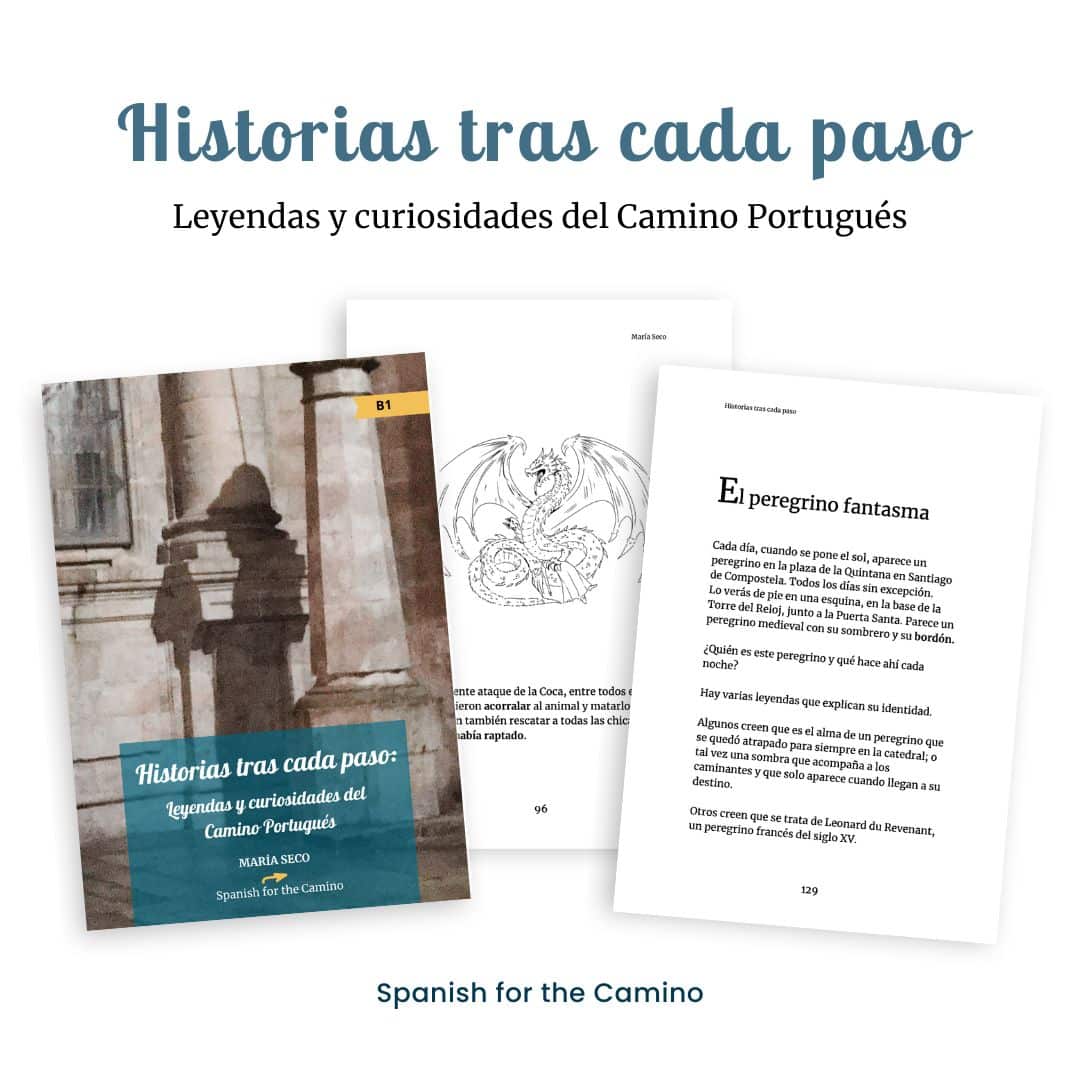
See inside book of Camino Portugues legends
For a collection of legends and historical tidbits, check my book Historias tras cada paso. Leyendas y curiosidades del Camino Portugués.
All the stories are about places along the Camino Portugués; many of them are directly related to the Camino or St. James.
The book is in Spanish, for intermediate learners, and includes a vocabulary guide with English translation.

Want more?

Make sure you don’t miss any posts or announcements by subscribing for free here. You’ll receive a free Spanish vocabulary guide with your first Spanish words + cultural tips. And… you’ll get access to exclusive content too.


¡Buen Camino!

Camino Portugués: Porriño-Redondela

Camino Portugués: Porriño-Redondela

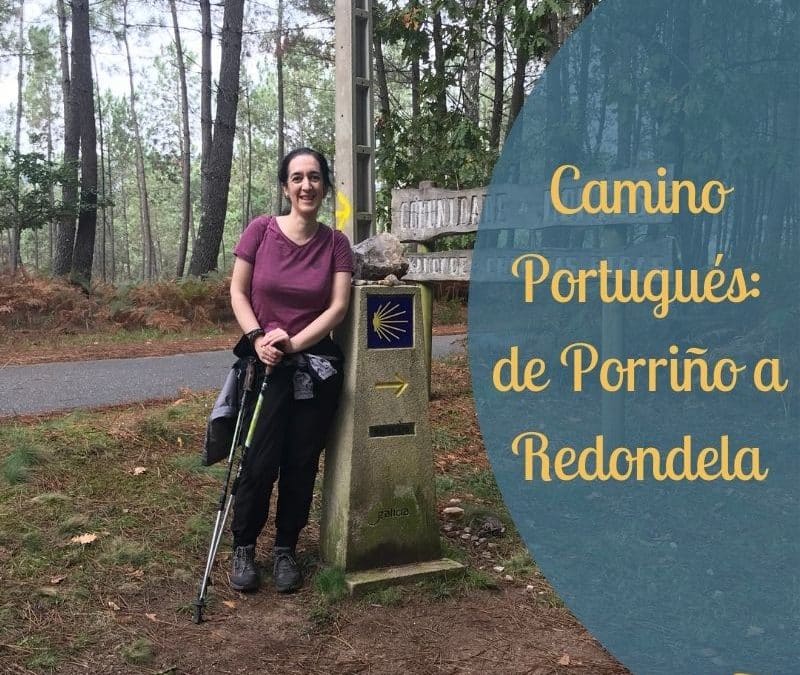
A few Sundays ago I walked a stage of the Camino Portugués: Porriño-Redondela. It’s one of the perks of living on the Camino; you can walk anytime you like. No need to take time off work or do much planning. Just go.


In fact, I didn’t just walk Porriño-Redondela. I’ve walked several stages of this route in the past few weeks. A different one every Sunday. This is a common way for Spanish people to do the Camino. Whenever you have some time off, you walk as far as you can. You then go back home. The next time you’re free, you pick up where you finished the last time and you keep going.


It’s a different experience from walking to Santiago in one go. No better. No worse. Simply different.


I’ve walked with my family before and I’ve also led a small group of strangers. This time around, I was also part of a group. It was quite a large group, actually. Also strangers. But a totally different experience.


There is an Asociación de Amigos del Camino Portugués (Association of Friends of the Camino Portugués) in Pontevedra. Among other things, they organise a yearly pilgrimage from Porto to Santiago. They walk on Sundays only. By the time I heard about it this year I had already missed the stages in Portugal. But I was still able to join in for most of the Spanish section.


This Sunday Camino works as follows: early in the morning we get on a bus that the Association has hired. This bus takes us to our starting point for the day. Once there, one of the organisers says a little oración (prayer), we take some group pictures and start walking.


There is a coche de apoyo (support car) for anyone who is not able to walk the whole stage. The bus will pick us up at our finishing point and take us back to Pontevedra for lunch (I’m talking Spanish lunch, around 2.30pm).


Porriño-Redondela

My first stage with the group was Porriño-Redondela.

Tui, right on the Portuguese border, is the most popular starting point for those who walk the last 100km of this Camino. But Porriño is actually on the 100km mark. So it is possible to start here and obtain a Compostela. On the other hand, Tui is a much nicer town, it would be a pity to miss it. But you could start in Porriño, and still qualify for a Compostela.


When I signed up for my first stage, I wasn’t quite sure what to expect. I didn’t know how big the group would be or what the people would be like. Not the type of situation where I feel most comfortable. So, I asked a friend to join me. She was going to, but then something came up and I had to face this unknown group by myself.


The group

There were between setenta (70) and ochenta (80) people in total. My impression was that they all knew each other and they all had their little groups. The vast majority were over 70 years of age. I was almost the baby of the group! There were a couple of niñas (young girls) accompanying their abuelo (grandfather), but they soon got on the support car.

Empezando Porriño-Redondela

These 2 pictures are taken from the Association’s blog, which you can find here. We’ve just arrived in Porriño and are outside Las Angustias (Our Lady of Anguish) chapel. The president of the Association read the prayer this time. Then, group pictures before we started walking.


The Porriño-Redondela stage

This stage is around 16 km.

Following current covid restrictions, we were wearing our face masks on the bus and at the beginning of the walk, while the whole group was still together and it was impossible to social distance. We took them off once the group scattered.


The first half of the stage is quite flat and easy. I guess it’s not the most beautiful stretch of the Camino, as it’s mostly through villages, on paved roads, but at least there are no busy roads or anything like that.


The second half, after Mos, is a bit more challenging, but nothing too hard. There is an ascent first up to the Santiaguiño de Antas chapel. And, when you get to the top, a harder descent into Redondela. I was glad I had my poles for that. Otherwise, I would have probably been tempted to just roll down the hill 😅  This half of the stage also has some nicer stretches through forest.


The weather forecast for the day wasn’t great, so we were all prepared for the rain that was supposed to fall. But it turned out to be quite a lovely morning, with no lluvia (rain) and some sol (sun).


Mos

So, as I mentioned, nothing much to report up to Mos. The Camino is very well marked and it’s impossible to get lost unless you’re very, very distracted and not paying attention at all.


In Mos, there is a church and a pazo (manor house), as well as several places where you can stop for a café con leche and a bite. You can also see here a big sign with the town’s name made out of bobbin lace (check the video below).


Up to here I walked partly alone, partly with someone. As we were taking the group pictures, I recognised someone familiar: it was a friend and former colleague of my mum’s. I walked with her for a while, but she’s not well and after a while I needed to walk a bit faster than her. So I went on by myself.


I took a short break in Mos and, as I was getting ready to continue, I saw another familiar face. The mum of one of my daughters’ classmates. She was walking with another woman I didn’t know. I thought they were friends, but I later found out they had met while walking the previous stage, from Valença to Porriño (which I missed). From then on, I walked with them.


Porriño-Redondela

This is us in Redondela, waiting for our bus to go back home.


This picture is also borrowed from the Association’s blog.

Up and down the hill

The next part of the walk was more interesting. On the way to Porriño (on the bus), they had warned us about the uphill section after Mos. I’m not a huge fan of walking uphill, to put it mildly. So I was a bit concerned. But the ascent is quite gradual, so it’s not too bad.


The descent was actually worse, not as gradual. I was so grateful I had my 2 poles! And I was also grateful it didn’t rain. I can imagine how slippery that road would be if it was wet…


There are some beautiful views of Redondela in the distance and a lovely walk through a forest with huge (and kind of odd) stone picnic tables.


After that, you’re just outside Redondela. We had also been warned about crossing the busy national road N-550 here, but they must have made some changes to the route, because there is now a very safe place to cross, with a traffic light.


Our meeting point was outside the albergue in Redondela, which is in a very beautiful old building, a 16th century pazo.

I’ve put together some pictures of the Porriño-Redondela stage in the following video. Enjoy!


For the Tui-Porriño stage, check this post. You can read about the Redondela-Pontevedra stage here.

Today’s Spanish words

For the pronunciation of Tui, Porriño and Redondela, check Camino Portugués.

For the pronunciation of lluvia & sol, check The weather on the Camino.


Want more?

Make sure you don’t miss any posts or announcements by subscribing for free here. You’ll receive a free Spanish vocabulary guide with your first Spanish words + cultural tips. And… you’ll get access to exclusive content too.
 

¡Buen Camino!

Muxía

Muxía

After making it to Santiago de Compostela, many pilgrims decide to continue on to the sea, to reflect, and to truly finish their Camino.

Fisterra, the ‘end of the world’ is a popular destination. But there’s another powerful and mystical place a little further north: Muxía, a coastal town steeped in legend and natural beauty.

Some, of course, go to both places. They’re both close to 90km from Santiago, and they both have a connection to the Camino. 


Where is Muxía?

Like Fisterra, Muxía is located on Galicia’s rugged Costa da Morte (Coast of Death).

Both towns sit roughly 90 km from Santiago de Compostela, and both form part of the Camino de Fisterra-Muxía, a route that many pilgrims follow after completing the main Camino de Santiago.

Though less visited than Fisterra, Muxía holds deep spiritual significance and offers a unique experience to those who journey there.


Muxía and the Camino

This little fishing town, located on the coast of Galicia, is considered one of the last stops of the Camino de Santiago. But in order to understand how this small remote village became an essential part of the Camino, we must dive into history.

The history of Muxía is ancient. Megalithic monuments like the Dolmen de Dombate reveal that the area has been spiritually significant since prehistoric times. In fact, in this corner of Galicia, stones were always sacred. They marked holy sites, were believed to possess healing powers, and served as bridges between the human and the divine.

These beliefs endured and eventually merged with Christian tradition.


According to local legend, Saint James was preaching along the Galician coast, struggling to inspire converts. In a moment of despair, he knelt in prayer near the rocky shore of what is now Muxía. There, the Virgin Mary appeared to him. She arrived on a boat made entirely of stone to offer encouragement.

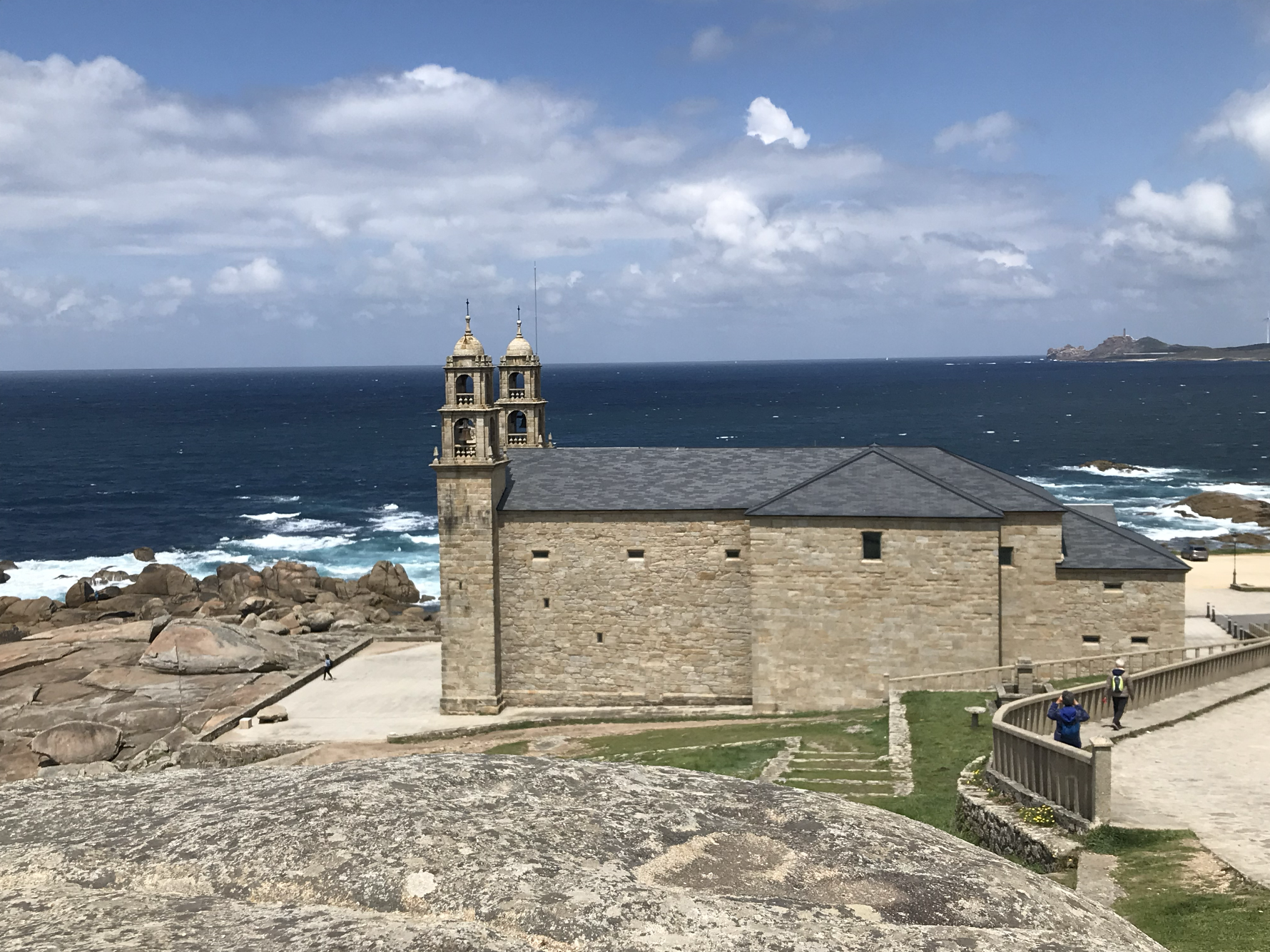
After she vanished, the stone boat remained, and its pieces can still be seen today near the Santuario da Virxe da Barca (Sanctuary of the Virgin of the Boat).

These stones are known by their Galician name:

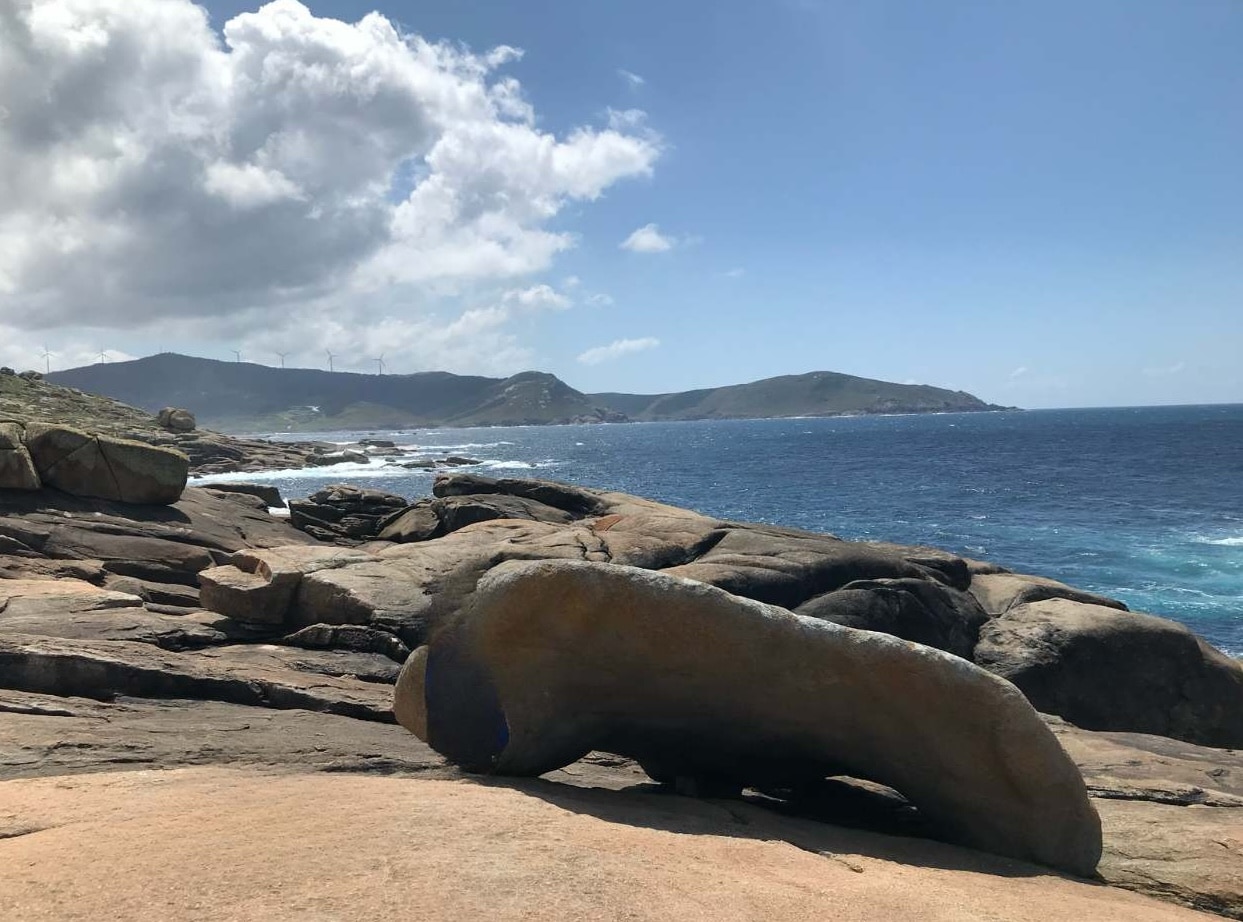
Pedra de Abalar (rocking stone) would have been the boat. This massive slab used to move (hence the name) and through the centuries it has been used for divination, healing, and fertility rituals.

Pedra dos Cadrís – This would have been the sail of the boat. It is said to have healing powers. They say that if you go under it 9 times, back pain, headaches and kidney problems will be cured.


Santuario Virxe da Barca en Muxía

Church of the Virgen de la Barca.

Pedra dos cadrís Muxía

Pedra dos cadrís.

Muxía

Why End Your Camino in Muxía?

Many pilgrims choose to walk from Santiago to Muxía as part of their spiritual journey’s conclusion.

Some pilgrims walk to Fisterra first, then continue to Muxía. Others go to Muxía first. Either way, it’s a powerful way to close the Camino.

The walk to Muxía is around 90 km and typically takes 3-4 days, longer if you go to Fisterra first. The route is well marked and offers breathtaking coastal views, peaceful forests, and small villages along the way. 

Ending your pilgrimage in Muxía is more than just reaching another town—it’s a journey through layers of history, legend, and personal reflection. So, as you plan your Camino, ask yourself:

Where do you want to end your Camino de Santiago?


Basic Spanish for the Camino

*pedra dos Cadrís: ‘pedra’ is the Galician word for stone (piedra in Spanish). Cadrís is also a Galician word and it means hips.

Abalar is another Galician word. It means to rock or swing.

For the pronunciation of Fisterra and costa da Morte, check this post.


See inside book of Camino Portugues legends
Read more about St. James’ travels and miracles in Spain in my book Historias tras cada paso. Leyendas y curiosidades del Camino Portugués.
Most of the stories are about places along the Camino Portugués; many of them are directly related to the Camino or St. James. But there’s also a section about St. James and the origins of the Camino.
The book is in Spanish, for intermediate learners, and includes a vocabulary guide with English translation.

Want more?

Make sure you don’t miss any posts or announcements by subscribing for free here. You’ll receive a free Camino food guide. And… you’ll get access to exclusive content too.
 

¡Buen Camino!