Camino Inglés: de Neda a Pontedeume

Camino Inglés: de Neda a Pontedeume

Welcome to Day 2 of my Camino Inglés: de Neda a Pontedeume. If you missed Day 1, you can catch up here.

On Day 2 of our Camino Inglés, we had planned to walk from Neda to Pontedeume, but the weather forecast was not good. In fact, we were on orange alert, with gales and heavy rain… or temporal, as we call it in Spanish.


Neda

We woke up to strong winds and grey skies. We checked our weather app again and the chances of lluvia (rain) during the morning seemed to be slim. The owner of our pensión looked quite sceptical when I commented that we might be lucky and make it to Pontedeume with no rain. But, in any case, we decided to leave and see how things went.

Neda was still asleep. We refilled our bottles at the fuente (fountain) outside the concello (town hall in Galician) and kept going.

Iglesia de Sta. María de Neda

We were in Paradise!

Refilling our bottles

The second day was the complete opposite of the first one. On the one hand, there was the issue of the weather. The rain held off until we make it to Pontedeume (phew!), but el viento (wind) was so strong that we could hardly walk at times. We would just hold on to each other so that no one fell, and we tried to keep moving.

This was not one of the windiest moments of the day


On the other hand, the terrain was quite different too. While Ferrol-Neda was mostly flat, Neda-Pontedeume was a bit of a rollercoaster, constantly going up and down. And I discovered that walking uphill is not one of my specialties!

My youngest daughter tends to be a fast walker. My husband is not, generally; but today he was in a hurry to make it to Pontedeume as soon as possible, before the rain started pouring. So the two of them walked in front.

Between the uphills and my tendency to stop and take pictures, I was constantly behind. My older daughter (the grumpy teenager), was kind enough to slow down and stay with her poor, slow mother. And that’s how we walked most of the time.

For me, the only good thing about the uphills is that, occasionally, you get rewarded with stunning views like these:

This stage was mostly through rural areas, either tiny aldeas (villages) or forests.


**Warning: rant ahead

A lot of the forest areas we crossed today were full of eucaliptos (eucalyptus). I often read other pilgrims’ posts in blogs or social media, about walking through an eucalyptus forest: it’s always about the wonderful smell, how nice it is and how much they love it.

Sorry, but I can’t agree on this one. I do like the smell of eucalyptus, but not in Galician montes (forests)! For me, eucalyptus equals economic interest, destruction of native vegetation and increased risk of fires, among other things. In short, a total disregard for the environment. So, walking through an eucalyptus forest (in Galicia) saddens me greatly **end of rant.


To stop or not to stop

Anyway, after going up and down a few times, we got to Fene, a larger town with cafeterías and other services. We took a vote and decided to continue.

More uphills, villages and eucalyptus. After one of these uphills through eucalyptus, we came to a couple of yellow arrows painted under a bridge, that seemed to indicate that we had to get off the path we were following. That didn’t seem right. So, after a couple of minutes’ deliberation and checking maps, we decided to stay on the path. Good decision: after a bend, we could see a stone marker a few metres ahead.

Shortly after, we came to an industrial state (Polígono Vilar do Colo) with a big Gadis supermarket and a bar-restaurante on the other side of the road. So we crossed and enjoyed a well-deserved break. Once inside we realised the place is linked to a petrol station (or gas station, depending where you are from) and small convenience store.

After the break, we went back out into the wind and continued our walk through some more villages until we came to this crossroads:


More decisions

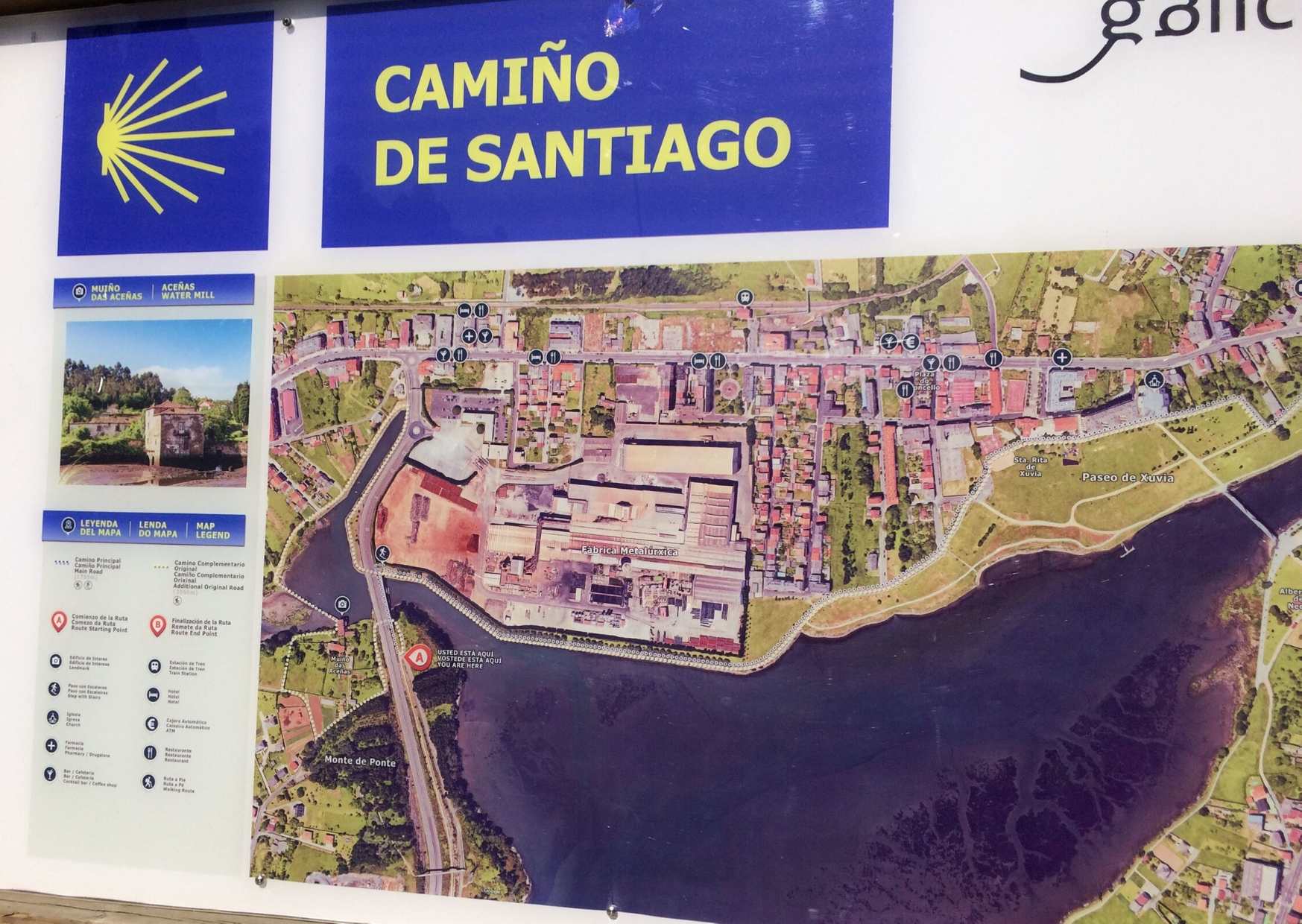
Again, like in Day 1, we had to decide: continue on the “regular” Camino (right) or take the Camino complementario (left). The latter added almost 2 km to our day, the first one included a dangerous spot, according to the information panel.

Yesterday we were all in agreement: skip the Camino complementario.

Today, it was hard to decide. On the one hand, nobody wanted to add unnecessary kilometres to our day. But we didn’t want to take risks either. Or at least, the more responsible adults didn’t; teenagers didn’t really agree. So, we took the longer route, which includes plenty more uphills. Yay!

Eventually, we joined the “regular” Camino, walked through Cabanas and crossed the bridge that gives Pontedeume its name.
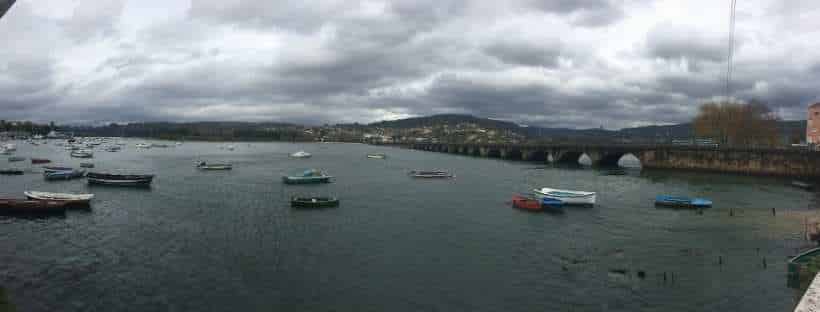
We had booked a couple of rooms at Pensión Luis, so that’s where we headed. All the rooms have private bathrooms and the price is €15.00 per person.

After dropping our mochilas in the rooms, we had lunch at the restaurant they have downstairs (menu for €9.00; tasty and abundant).

After lunch we went out with the intention of exploring Pontedeume, but it soon started raining and rain gear was back at the pensión, so we went to our rooms. Good excuse to go back to Pontedeume.

Anything is possible during the Carnival. While we were having lunch, a group of ancient Romans came into the restaurant. They parked their vehicles outside. Later, while the Romans were still eating, a gust of wind dragged chariots and horses all over the street.

For more info about Pontedeume, click here.

Theme of the day

On Day 1 we say at least 6 “tanque de tormentas”. I must admit I don’t remember ever seeing one of those and I had to check out what they were. Apparently, these structures generally hold water from storm water runoff and release it gradually, reducing damage from erosion and other physical changes.

On Day 2, we kept seeing a different type of construction: lavaderos. Women used to gather around them to do their laundry in the past. According to this article, Cabanas council has been repairing some of them, not just because of their historical value, but also to turn them into meeting points and rest areas for pilgrims.

Day 1: tanques de tormentas

Day 2: Lavaderos

It was again a lonely day. I think we encountered a couple of people only: a woman in Fene saw us while we were deciding whether to stop or to continue, she thought we were lost and showed us the way. And later, we saw a guy on a tractor. That was it! And we saw horses again.

Will the weather improve for Day 3? Will there be a new theme? All will be revealed in the next post.


Today’s Spanish words

Want more?

Make sure you don’t miss any posts or announcements by subscribing for free here. You’ll receive a free Spanish vocabulary guide with your first Spanish words + cultural tips. And… you’ll get access to exclusive content too.


¡Buen Camino!

Camino Inglés: de Ferrol a Neda

Camino Inglés: de Ferrol a Neda

Before I start my account of day 1 on the Camino Inglés: from Ferrol to Neda, let’s get some practical info out of the way.


Guidebooks


  • For a more “traditional” guide, with very detailed information on the route and background information, I bought The Confraternity of St. James‘ Guidebook, by Johnnie Walker.

I bought both of these books in the digital version. Then, at the last minute, for some reason, I decided to buy a paper one, in Spanish. Don’t ask me why… I’m not really sure. Of course, I am aware of the advantages of digital books in terms of space and weight, but I still prefer browsing through a paper one. I think that was why.


  • So I got “Guía del Camino de Santiago: Camino Inglés”, by Antón Pombo. It does include a whole chapter about Santiago (around 20 pages) and also the route from Santiago to Fisterra and Muxía (close to 40 more pages). So there was a lot of book we were not going to need on this occasion, but I still decided to take it along. Being a book lover, I struggled with the idea of tearing the book apart and taking only the pages we needed, as I’ve read that some people do.


Accommodation

  • Ferrol: we stayed at Hotel Real Ferrol (calle Dolores, 11). We chose it because it was one of the few places that offered a family room and the location was great too. We paid €45 for the four of us in a very spacious room with 2 double beds and a private cuarto de baño. All new and clean… the perfect choice for us!


  • Neda: Pensión Maragoto, not far from the albergue. As well as the rooms, they also have a cafetería-restaurante, where you can have a menú del día for €9.50. They open at 8.00am in the morning. We had our breakfast there before heading off to Pontedeume on Sunday.


Sábado, 2 de marzo. De Ferrol a Neda

After el desayuno (breakfast) and a bit of walking around Ferrol (check Empezando el Camino Inglés), we headed towards Muelle Curuxeiras, the starting point of the Camino. Despite reading about it before, my initial instinct was to look for the stone marker closer to the water. I had read on forums about previous pilgrims having trouble locating it and others explaining where it was exactly and I was still looking for it in the wrong place. Then I remember and so we crossed the road… and there it was!

But before we started walking towards Neda, there was one more thing to do: pick up our credenciales from the tourist office, which is conveniently located right next to the stone marker. There is also a farmacia there, in case you need to get any last minute tiritas (plasters) or paracetamol. And if you haven’t had your desayuno yet, there are also a couple of cafeterías here.

We went through the arch into Rúa Carmen Curuxeiras. I’ve been trying to find out who this woman, Carmen Curuxeiras, was; but apparently it is unknown. Also, in case you are wondering and getting confused, rúa is the Galician word for calle (street). You may see both used.

Anyway, this part of town is called Ferrol Vello (Old Ferrol in the Galician language) and it really lives up to its name! Almost the first thing you see after walking under the arch is a few collapsed buildings (or about to collapse).


Walking through Ferrol Vello

These are not too bad!

Out of Ferrol

So we walked through Ferrol, past the Parador and iglesia (church) de San Francisco, along the rúa Real and cantón de Molíns, and past iglesia de las Angustias. The last stretch out of Ferrol was not particularly appealing, with modern/boring buildings on our left and army property on the right, blocking the view of the sea. Eventually, you get to enjoy the view, walking by playa (beach) de Caranza.

Then, it’s a busy road for a while until you reach an industrial state, where you have to turn right. There is a Lidl supermarket here, in case you need to buy anything. We already had some fruta, galletas and frutos secos (fruit, biscuits and nuts), so we kept going, but not for long, because we got to a leisure area with benches and we decided to take a short break, have a snack and enjoy the view.

According to this, there’s a cafetería behind Lidl where you can get your credencial stamped. Well, the sign actually says you can get your Compostela stamped; I guess that’s a mistake. It also says it’s the cafetería of a tanatorio or funeral home. None of us needed a toilet break and we were not too keen on hanging out at a funeral home, so a bench outside was good for us. There’s another bar right on the Camino if you keep walking just a bit longer.

After the break, it was not so nice again, going through an industrial area with busy roads and roundabouts, before walking through villages. We passed the monasterio de San Martiño but it was closed, so we kept going.

Monasterio de San Martiño

We kept walking

Decisions, decisions…

After going through a forest area, we came to this:

Left or right?

Map detailing the 2 options

The Camino complementario on the right was longer (it adds close to 1km) and the main reason to take it was to see an old water mill. We’ve seen a few of those before, so we took the “regular” camino on the left and over the bridge. After the bridge, you have to go down some stairs and then you are in a nice promenade by the water. We had almost made it through our first day!


Neda

Now we only had to decide which bridge to cross

The old bridge?

…or the new bridge?

We went for the old one and so we got to see this 300 year old magnolia tree:

We quickly found our accommodation, left our mochilas in our rooms and went to have lunch.

A couple of games while waiting for the food

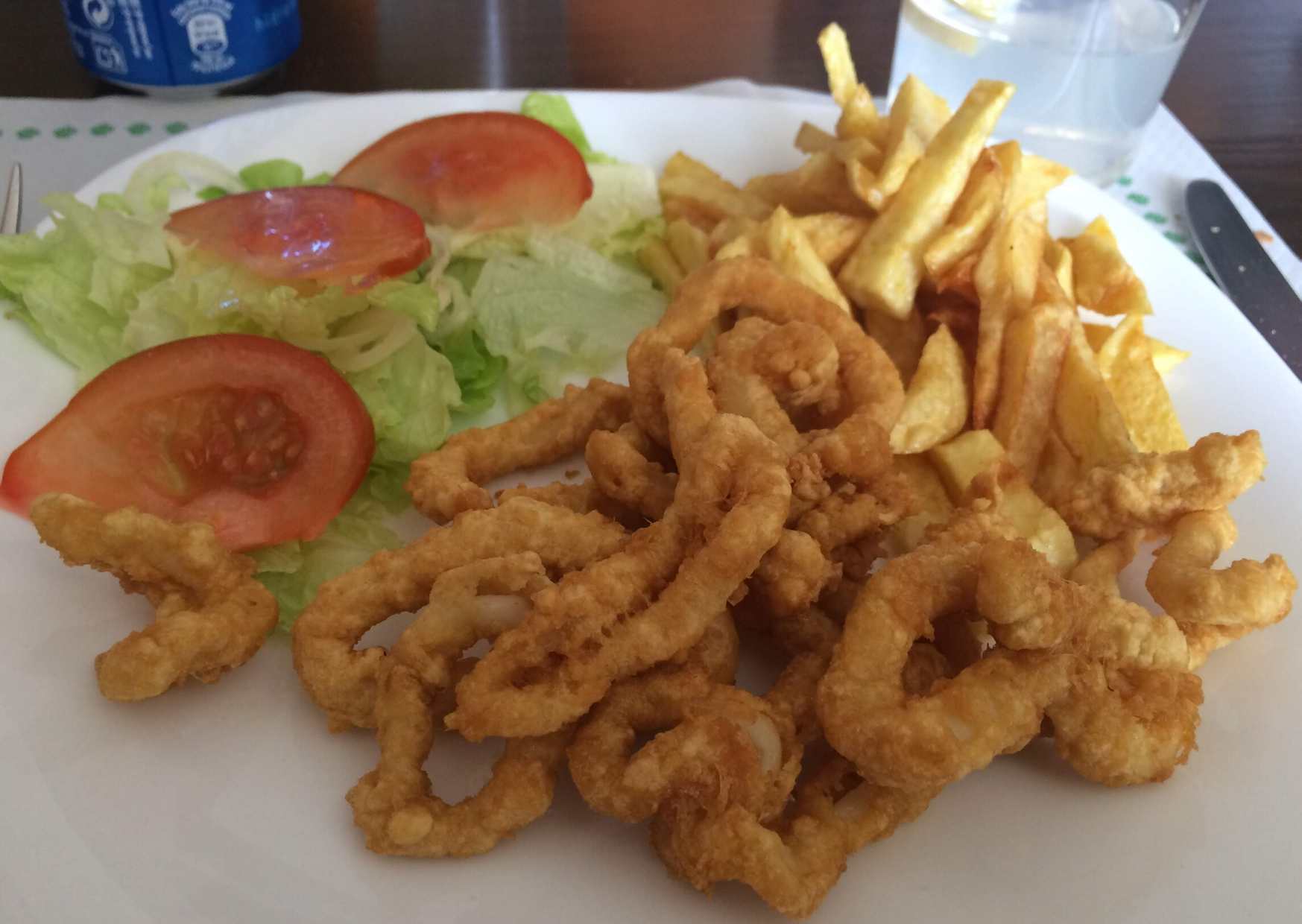
Calamares a la romana

After lunch, a rest and a ducha (shower), we went to have a look around. The park area across the bridges has one of these “playgrounds” for adults, with equipment to exercise instead of slides and swings. Well, the girls still had plenty of energy to play around and compete to see who could jump higher or do more pull-ups. I really envy them!

Up the road from our pensión, there is a Día supermarket. If you are not stopping for the day in Neda, you will pass it as you continue on your way. If you are spending the night in Neda and need to buy anything, don’t leave it till the next morning, as it will be closed.


 I didn’t know this, but apparently Neda’s bread is famous and they even have a monument to it!

On company and weather

I think we only encountered one person during our walk, an old man keeping an eye on his sheep. Our company during the day… horses, cows, sheep and goats!

Day 1 was a nice and easy start to our Camino Inglés. Despite the rain the previous night, the weather was bright and sunny, with very pleasant temperatures… not really what you would expect at the beginning of March. The forecast, however, was not good. There was an orange alert for the next couple of days, with gales and heavy rain. In fact, we could already see it changing in the evening: it was becoming increasingly windier and the sky was getting grey. According to our weather app, there would be no rain the next morning, at least not any significant amount. We were a bit concerned about walking through forests and branches falling… but that’s for Day 2.


Today’s words

Want more?

Make sure you don’t miss any posts or announcements by subscribing for free here. You’ll receive a free Spanish vocabulary guide with your first Spanish words + cultural tips. And… you’ll get access to exclusive content too.


¡Buen Camino!

Empezando el Camino Inglés

Empezando el Camino Inglés

Empezando el Camino Inglés means “starting the English Way”. Why starting? you may ask. Well, because I didn’t get the chance to finish it… yet. And because I’m not telling you the whole story today. But let’s start from the beginning.

When I first decided I HAD to do the Camino, my first question was: which one?


Why the Camino Inglés?

Somehow, the Camino Francés didn’t sound so appealing. Maybe because it’s so popular… I don’t know. I’ve always had a tendency to go against the flow and NOT do stuff for the simple reason that everybody else was doing it. So maybe that was it.

Then, the obvious choice was the Camino Portugués, as it passes almost right in front of my doorstep. I’ve walked parts of it, although just as day trips or hikes, and not as a Camino experience. But I still was not convinced.

And then I started reading about the Camino Inglés and my decision was made! The English Way was the one followed by British, Irish and other northern pilgrims from the 12th century onwards. So, in a way, it made perfect sense for me to walk this route, since I lived in Ireland for 15 years.

Anyway, “where?” was clear. But “when?” was a bit more complicated. I’m not going to bore you with the details, but I’ve had to cancel this Camino a couple of times. And now the Carnival gave us a few days off; the perfect opportunity to finally do it.

The plan was for my husband and myself to walk for cinco días (5 days) and leave our dos hijas (2 daughters) with their grandparents. But… all of a sudden, a week before our start date, plans changed and that was not an option anymore. So, we could either cancel (again!) or take the kids. And we went for the second option.


Change of plans

The decision to take the girls affected our initial plans in several ways:

  • First. We were not able to walk for 5 days, because they needed some time to do homework and study for exams before going back to school el jueves (Thursday). So we walked tres días (3 days) instead: sábado, domingo y lunes (Saturday, Sunday and Monday), starting in Ferrol and finishing in Betanzos. El martes (Tuesday) we did a bit of sightseeing around Betanzos before returning home.
  • Second. Our 2 mochilas were a bit heavier than planned, because we split the girls’ stuff between them. The girls only carried a small day-bag with some snacks.
  • Third. We pre-booked all our alojamientos (accommodations). There being four of us and two of them being girls close to adolescence, we thought that was the best choice for us (one of them turned trece (13) this week and the other one had turned once (11) a week before our Camino).


Getting to Ferrol

We made our way to Ferrol el viernes (Friday), March 1: train to A Coruña and then bus to Ferrol. The train and bus stations in A Coruña are very close to each other, so it’s an easy switch. There are trains going from A Coruña to Ferrol too. However, we found that they took longer than the bus and they were not so frequent.

Empezando Camino Inglés: waiting for train

For train routes, schedules and tickets, you can check RENFE‘s website. And you can find buses covering A Coruña-Ferrol (but also Miño, Betanzos and Pontedeume), on ARRIVA‘s website.

Anyway, el viernes was a school day. So, by the time we got to Ferrol it was dark already. It was also raining a bit. That means that, basically, all we did was find our hotel, do a bit of last minute planning for the next day and go to sleep early.

El sábado we got up early, got ready and went out looking for a place to have breakfast.

Breakfast in Ferrol

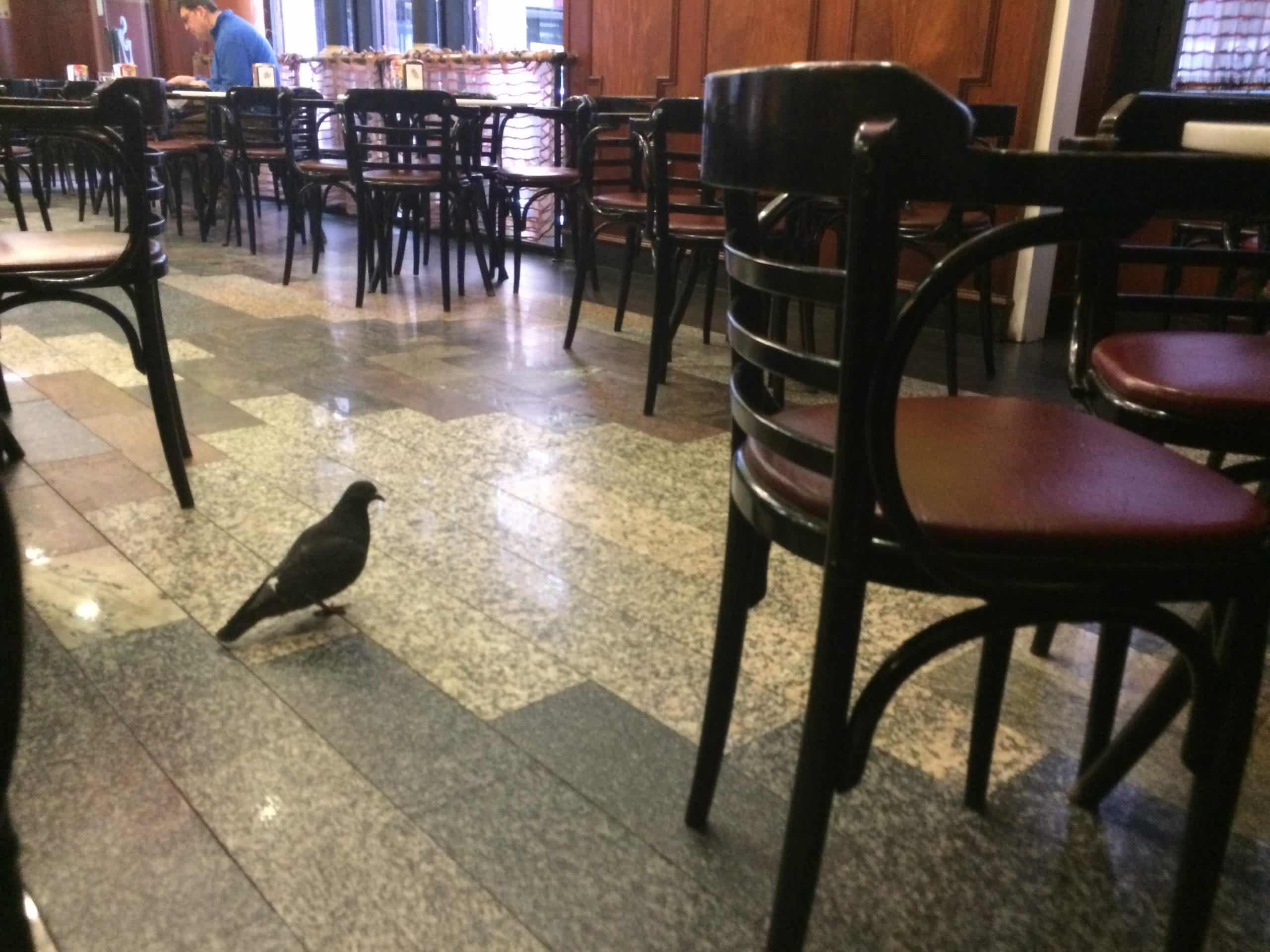
We had company while having breakfast in Ferrol.

I didn’t know it at the time, but this really was a sign of how our Camino was going to be: we encountered more animals than people…

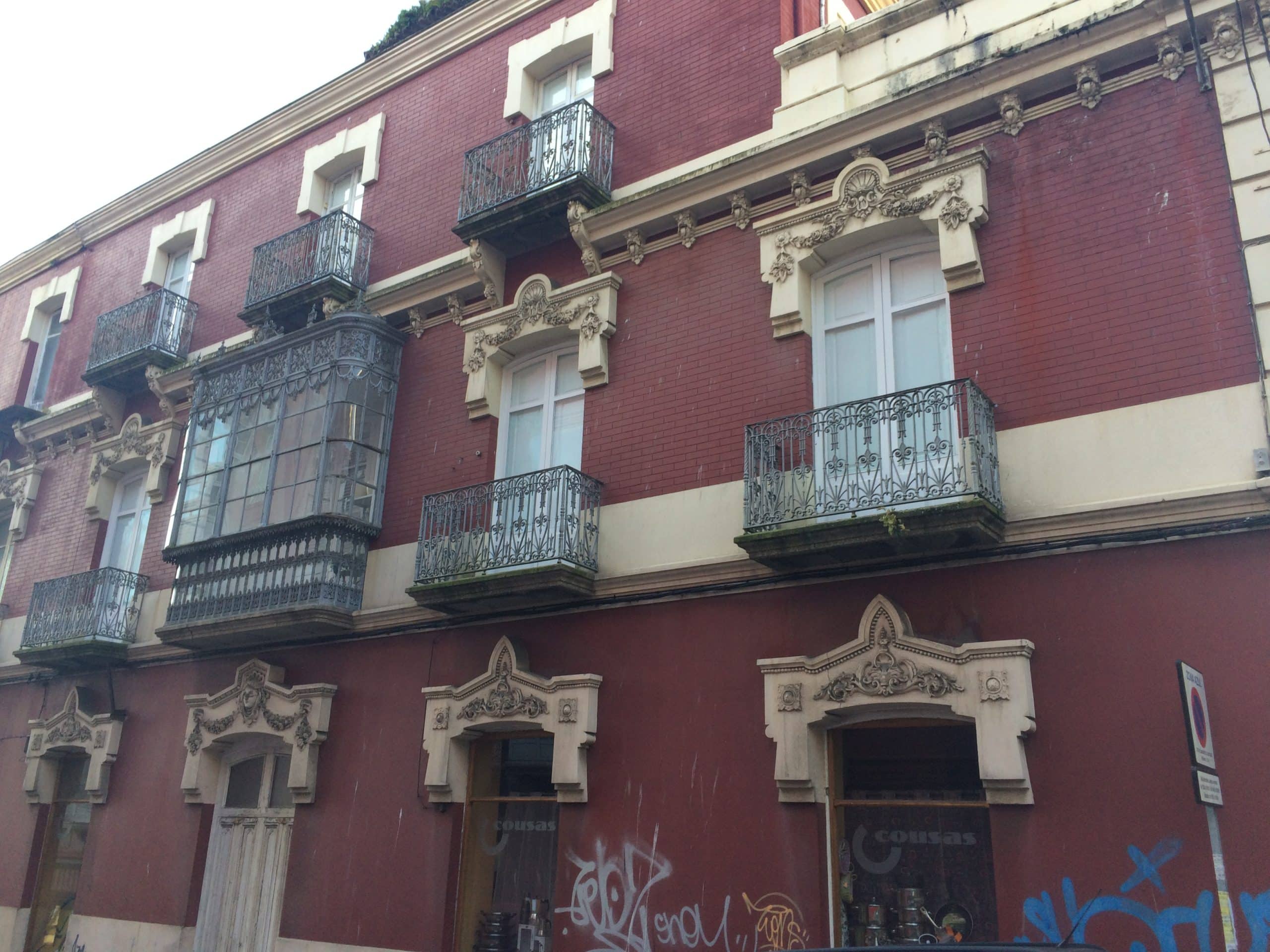
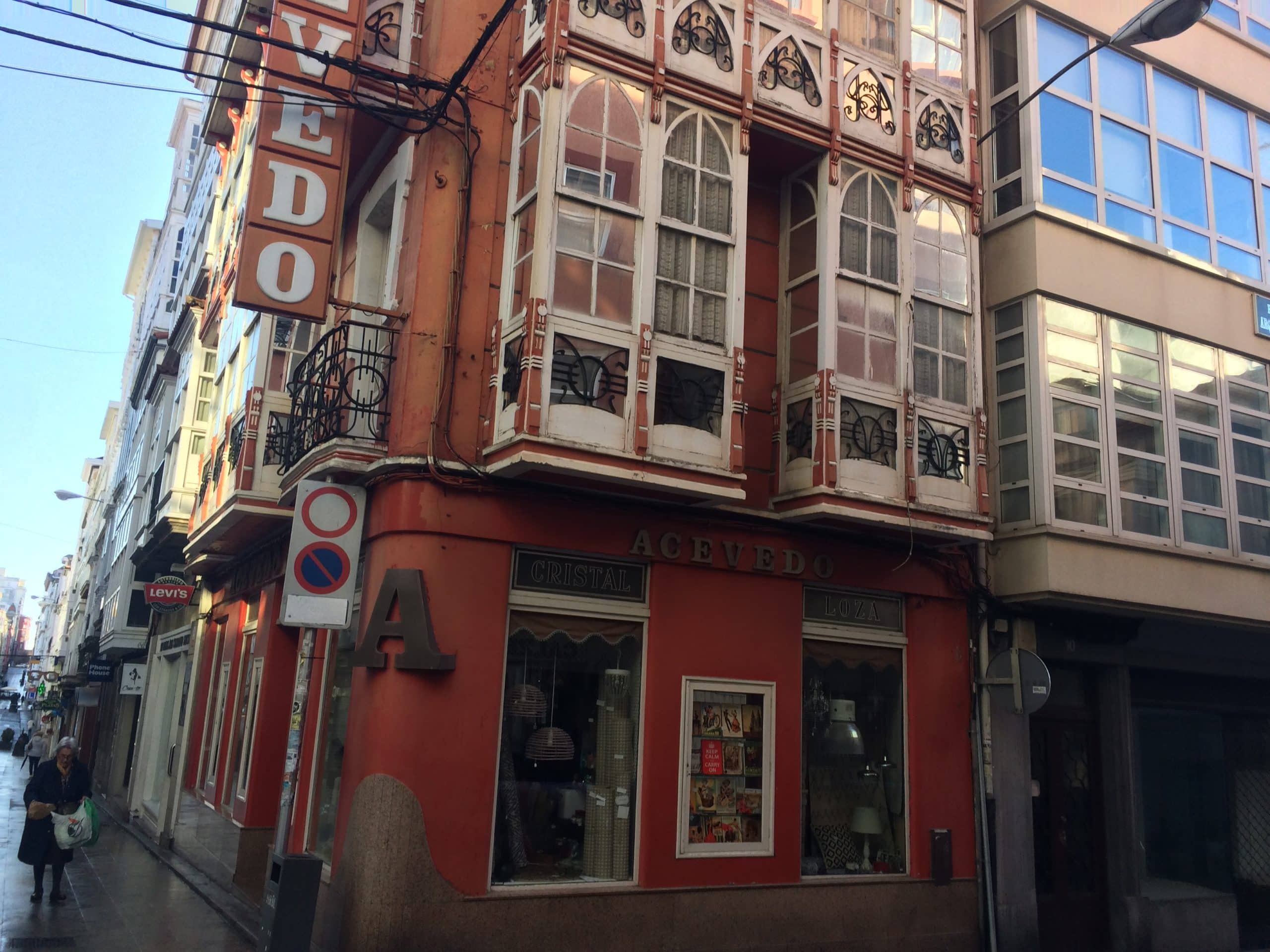
After breakfast, we walked around Ferrol for a short while, before we headed to the starting point of the Camino. Some parts are a bit run down and in need of a lot of care, but there’s still some amazing and interesting architecture. I’ll let the pictures speak for themselves.

Ferrol

This is the stone marker signalling the beginning of the Camino, quite close to the tourist office, in the port area. From there on, the route is very well signposted. You can’t get lost!

We bought our credenciales from the tourist office.

For more tourist information about Ferrol, you can check https://visitferrol.com

And that’s it for today! Don’t forget to come back for the rest of the story…

Read all about Day 1: Ferrol-Neda, Day 2: Neda-Pontedeume and Day 3: Pontedeume-Betanzos


Today’s Spanish words

Want more?

Make sure you don’t miss any posts or announcements by subscribing for free here. You’ll receive a free Spanish vocabulary guide with your first Spanish words + cultural tips. And… you’ll get access to exclusive content too.


¡Buen Camino!

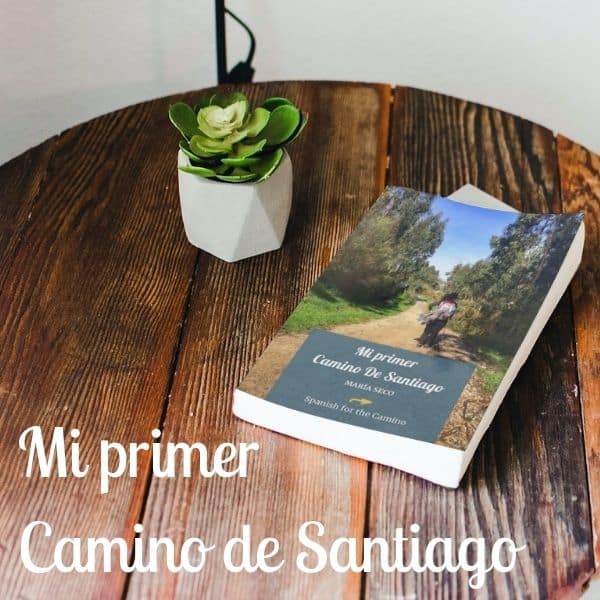
Mi primer Camino short novel for beginners

Mi primer Camino de Santiago is a short novel written in easy Spanish (A1-A2), perfect for those who have walked or are planning to walk the Camino de Santiago in Spain and want to improve their Spanish skills. But it’s also suitable for anyone looking for a fun and effective way to improve their Spanish through stories.

And it’s set on the Camino Inglés, so you can also learn about this route while you read.

A conversation with Julia

A conversation with Julia

This week I’ve been chatting to Julia, a German pilgrim who walked the Camino Francés after she finished college. Read the whole conversation to find out how the Camino changed her life.

Please tell us a bit about yourself.

My name is Julia, I am 35 years old and I am from Northern Germany. I’ve been living in Spain now for four years in a small town called Oliva, which is on the eastern coast, with my husband and our two children. I am a German teacher and I run an online language agency: www.milengua.com

When did you first hear about the Camino and why did you decide to do it?

I’ve always been up to traveling and especially to hiking and trekking. After finishing my university degree in German Philology I decided to go on a trip on my own and among all the different long distance trekking roads I chose the Camino de Santiago as it seemed to me physically not too difficult but very interesting. Besides, I wanted to get to know Spain, where I hadn’t been before. Also, I had a friend who did a part of the Camino and he highly recommended it.


Did you prepare either physically or mentally? How?

Basically, I got prepared by hiking on every possible occasion. Moreover, I was into running and biking at this time so I found myself in physically good condition. Mentally?  I don’t know. I had a book with the single legs of the way. But to be honest, I just started the journey without thinking too much about it. I was just excited about being outside everyday and walking as far as I could.


Tell us about your Camino. How was your experience?

It was certainly one of my best experiences ever. I met a lot of wonderful people and even though you only shared a couple of days together until each one went on at her or his speed, it felt always like a lifetime. You get to know people that deeply in an incredible short time and I remember almost all of them now 5 years later.

Another deep impression that I will bear forever is the feeling of freedom and peace of mind. You only have to walk. That’s your only mission for several weeks. Enjoying the simplicity of life and the beauty of nature made me feel really “light”.


How did it change your life? Is there any particular anecdote you would like to share?

My anecdote is a romantic one: I met my future husband here, to be precise, in Molinaseca near Ponferrada. From there we went the remaining way together to Santiago and later to Fisterra, where we separated. More than 2 weeks together on the Camino, that’s like 2 years in real time. We stayed in contact ever since but it took us 18 month until we met again. Soon after that I decided to move to Spain  – and I stayed.


Did you learn any Spanish prior to the Camino? Did that have any impact on your Camino?

Actually I didn’t know any Spanish before. I learned quickly how to order breakfast, to ask for free beds and to wish a “buen camino”. But it was actually a pity not to be able to talk to the locals. One time I met an older man walking with his dog and as we went the same way for quite a while, we started a conversation. He didn’t speak English so we communicated with gestures, by pointing at things; he showed me photos he had in his wallet and we drew in the sand with sticks we found.  I wished we really could talk as he seemed to be a very interesting person.

Without any Spanish you stay mainly with other pilgrims but you will miss the option to talk with the locals which is basically an important aspect if you want to get to know a country for real.  Another point is the medical assistance, if needed. Whether it’s at a doctors or just in the pharmacy: Some basic vocabulary to explain what’s your problem is more than helpful.


Julia’s words

I usually ask my guests to pick 5-10 Spanish words or phrases: the ones they think every pilgrim should know before their Camino, the ones they knew, the ones they learnt… Julia chose what she learnt on the Camino,  mainly food orders and one phrase that the Spanish pilgrims liked to say when they had wine for dinner: El vino te pone fino, peregrino.
 
I must confess I’d never heard this phrase before and it can be interpreted in several ways, as it plays on the meanings of the word fino, as well as a couple of expressions that contain it. It could simply mean that wine makes you drunk. But it could also mean that wines makes you wittier!
 
 
If you would like to know more about either the menú del día or menú peregrino, check this post.
 
 
The word cigüeña means stork and Julia learnt it because she was surprised at how many of these birds she saw while on the Camino. According to her, there are not many storks left in Germany.

Want more?

Make sure you don’t miss any posts or announcements by subscribing for free here. You’ll receive a free Spanish vocabulary guide with your first Spanish words + cultural tips. And… you’ll get access to exclusive content too.


¡Buen Camino!

A conversation with David

A conversation with David

A conversation with David |

Less than ten years ago David had not heard about the Camino. Now he’s planning for his 5th. And that’s not his only connection to the Camino. If you’re curious about David’s story, read our conversation!


Please tell us a bit about yourself

My name is David and I’m from Dublin, Ireland. I love to write, and I have been keeping my own blog ClearskiesCamino.com for over 6 years. I also love the outdoors and have recently taken up photography. I love trying new things, and new gadgets!


When did you first hear about the Camino? When or why did you decide to do it?

I heard about the Camino de Santiago by pure accident! I hope your readers believe in fate. In late 2010, I was handed a leaflet with the words “Walk the Camino” framed across the top. I thought to myself, “this will be a great challenge” and I instantly registered. I raised €3000 for a mental health charity in Ireland and on the 6th of June 2011, we would start our Camino from Sarria to Santiago de Compostela on the  – the final stretch!

At the time, walking 10 kilometres was a struggle for me so walking 15 kilometres, 4 or 5 days in a row would really test me. But it was achievable. I also wanted to see another part of the world, to see the culture, to hear the language and see how people tick. All in all, it was an enjoyable week, despite the blisters.

We had a guide, a great guy from Australia who got us around. He had the Spanish even though I had a few simple phrases to get me by like Gracias, ¿Qué tal?Buenos días and of course ¿Dónde está?

I loved Santiago and was blown away when I arrived under the archway into the Praza do Obradoiro– it’s not something you see every day. I have my Compostela framed in my apartment in Dublin and I will treasure it.


You’ve done several Caminos after that. What is it about the Camino that makes you want to come back?

On return to Dublin, I felt that this was my one and only Camino experience and it was time to experience something else. I would return to work the following Monday and life would go on. It wasn’t until later in the year, however, when I received an email from the Australian guide checking up on me, just to see how I was.

At this stage, the Camino was just a memory but over the course of a week, a simple hello had changed my mind. I suppose if it wasn’t for his email I wouldn’t be where I am today, who knows?

Over the last 6 years, I have walked various parts of the Camino Francés and more recently I have walked from A Guarda to Santiago with my brother on the Portuguese Coastal Route.

I find the Camino is a great way to get away from strains of modern daylife. You can experience simplicity in all its forms – get up in the morning, carry all your belongings, just walk, and rest when you are tired. It’s as simple as that.

But the people you meet make it for me, and it is so easy to meet lifelong friends here. I also like the idea that I walk in the footsteps of thousands of people before me. I am walking from A Coruña in May – a route taken by pilgrims from Ireland in medieval times (for more info on this route: Camino Inglés).


How have your experiences been so far?

I have had very positive experiences so far, but with all things in life you learn as you go on. On my first Camino, I was badly prepared and suffered with blisters but over the years, you learn how to treat them and buy the suitable equipment. My Camino from León to Sarria in 2012 was much more enjoyable I found.


Is there any particular anecdote you would like to share?

On my Camino from Logroño to León in 2013, I met a large Camino family and we still keep in touch. There is one story that strikes a chord to this day and it is from May 2015. I was walking from Belorado in La Rioja to Molinaseca, just short of Ponferrada and had met a good bunch of pilgrims, from Ireland, Belgium, Holland and England.

We had reached Sahagún and I had run out of money before checking in at the albergue. I went to the ATM to get some more. An error message appeared. My heart sank. I asked the bank teller inside: “¿Hablas inglés?” “Yes”. OK. So there was a problem with the card. Now what…?

Hmm! I walked back to the albergue where the rest of the gang were. I explained my predicament and they said not to worry. The offer was there to pay for any expenses until I got fixed up. Three evenings later in León, I had money wired to me via Western Union. The Camino provides! I have always been grateful for my peregrino friends.


Walking the Camino is not your only connection to the pilgrimage to Santiago. Tell us about Camino Society Ireland and Shamrocks and Shells.

That’s correct. As I mentioned above, I have been writing since 2012 at ClearskiesCamino.com about my experiences on the Camino. I love writing and giving people hints and tips about how to prepare for their Caminos. In 2015, I became a member of Camino Society Ireland as a way of giving back and more recently, I started to volunteer. I just thought it was the next step after walking my 4thCamino and planning for my 5th.

Camino Society Ireland offers an opportunity to all those interested in the Camino to meet and share practical information and experiences. We meet for monthly walks throughout Ireland as preparation for a Camino and in the past, there have been talks, films nights and Information days for those who are preparing.

Shamrocks and Shells is Camino Society Ireland’s quarterly newsletter. Its first issue was published in Spring 2018. It was designed with the intention of publishing stories from pilgrims, news from Santiago and the Camino and practical advice on equipment. The great thing is when I normally come home from a Camino, I am always talking about life on the Camino, much to the bemusement of my family. So, if it is easy to talk about it, then it should be easy to write about. We are also looking to introduce more articles en español.

Our newsletter can be found at shamrocksandshells.wordpress.com.

Did you learn any Spanish prior to the Camino? Do you think knowing (or not) Spanish had any impact on your Camino?

Yes, I tried Duolingo and several podcasts. I had some vocabulary, but it was difficult to use these in conversation. That said, I still use Duolingo today and find it useful.

My knowledge of Spanish prior to my first Camino was limited, however I found myself more switched on while in Spain. I remember routinely asking the guide what various items meant in English. I suppose I would have enjoyed it more if I was able to talk to the local Spanish people. By just saying Hola and Gracias, I felt a disconnect.

However, now that my level of vocabulary has improved through the years, I feel a lot more confident being on the Camino.

David’s words

Conversation with David

I asked David to pick a few Spanish words that she thought you should all know before you start your Camino and this is his list:

Sello: stamp (the ones on letters and on your credencial).

Credencial: Pilgrim Passport

Compostela: the certificate you can get if you walk the last 100km of any Camino

Shops and useful questions

¿Dónde está…?: where is…?

…el albergue: hostel

…la tienda: store

…el supermercado: supermarket

…la panadería: bakery

…la pastelería: cake shop

…el cajero automático: cash machine (ATM)

…la farmacia: chemist

 Lo siento, no sé: I’m sorry, I don’t know

Si, hablo un poquito de español: Yes, I speak a little bit of Spanish.

Perdón: Pardon / Excuse me

¿De dónde eres?: Where are you from? – Great way to meet people

¿Cuánto cuesta?: How much does it cost?

Comida: food

Patatas bravas:  Fried potatoes with a spicy sauce

Jamón: ham

Pescado: fish

Pulpo a la Gallega: boiled octopus (with salt, paprika and olive oil; and served with boiled potatoes)

Chorizo: cured smoked sausage

Paella: rice with seafood and/or chicken

Tortilla española: Spanish omelette (with eggs, potatoes and, in most cases, onion)

La cuenta, por favor: asking for the bill.


Today’s Spanish words & phrases

About David

David Smith

My name is David, I live in Dublin and I am a pilgrim. I started to blog way back in 2008 writing about many different things, but in 2011, I discovered the Camino de Santiago. Since then, I return to the north of Spain to walk a part of this amazing trail, to take in its culture, to meet people and of course, give my spirit some food for thought.

The Camino de Santiago is a pilgrimage but, in my eyes, it is also a challenge, a way of meeting people and a great way of getting away from the hustle and bustle of modern day life.

I love writing and talking about the various Caminos to Santiago and if you are one of the many people who has walked these routes, you may well feel the same. I also write and edit the Camino Society Ireland’s newsletter Shamrocks and Shells.

You can find me on Instagram @clearskiescamino also and I use this account the most while on Camino.


Want more?

Make sure you don’t miss any posts or announcements by subscribing for free here. You’ll receive a free Spanish vocabulary guide with your first Spanish words + cultural tips. And… you’ll get access to exclusive content too.


¡Buen Camino!

Your words

Your words

A couple of weeks ago I asked the following question on Facebook:

If you could only learn 5 Spanish words or phrases for the Camino, what would they be?

I got many answers. The 2 most popular words were por favor (please) and gracias (thank you), closely followed by ¿Cuánto cuesta? (How much is it?) and vino tinto (red wine). Vino blanco (white wine) was a bit less popular.

After those, there were many different suggestions that I’ll try to organise. These are your words:

  • Greetings

Buen Camino. This doesn’t need a translation, right?

Hola (hello) can be used any time of the day.

Buenos días (good morning). This one is specifically for the morning, which technically ends at midday, but in Spain we stretch it till lunchtime; Spanish lunchtime, that is. After 13.30-14.00 (1.30-2.00pm) you can start saying buenas tardes (good afternoon/evening) until around 21.00 (9.00pm). Then you can say buenas noches (good evening/night). For pronunciation and to learn more about different customs regarding greetings, check the second part of my interview with Kelli.

  • Food and drink

Next in popularity after vino tinto and vino blanco were café con leche and café americano. Cerveza (beer) came in third position.

Tortilla (potato omelette) was the only food mentioned. For the pronunciation and the recipe, check this post.

  • Accommodation

¿Tiene una cama para esta noche? (Do you have a bed for tonight?)

Habitación privada (private room)

You can also combine both and say ¿Tiene una habitación privada (para esta noche)? (Do you have a private room (for tonight)?).

  • Miscellaneous

¿Habla inglés? (Do you speak English?).

Más despacio, por favor (more slowly, please). Very handy when someone is talking to you and you need them to slow down in order to understand what they are saying.

¿Dónde está…? (Where is…?). Check my interview with Susan Jagannath for more on this.

¿Cuándo es la próxima misa? (When is the next mass?).

¿A qué hora es la cena? (At what time is dinner?). You can use this in albergues that serve communal dinners as well as in restaurants.

Necesito una bolsa de hielo (I need a bag of ice). Or just necesito (I need) + whatever it is you need.


  • The toilet

¿Dónde está el baño? (Where is the toilet?). This particular phrase proved to be quite controversial, with people arguing what the right word for “toilet” is. The truth is that there are 4 words I can think of you can use for toilet:

First of all, we have cuarto de baño, which is a bathroom with toilet, sink and bath/shower, so we would NOT use this for the toilets in a café, for instance.

However, the short version baño means bathroom too but it has some extra meanings: it can also be a bath (as in taking a bath or even a swim), bathtub or toilets. All of these definitions are included in the dictionary; don’t let anyone correct you!

Servicio, aseo and lavabo are 3 more words that can be used to refer to toilets in public places. I’m not sure if there is a regional preference, but I can guarantee that they are all valid and all in use.

Aseo means cleanliness or cleaning in general; or a “bathroom” with just a toilet and sink, but no bath/shower.

Servicio means service, in general. It can be used in other contexts, not just when talking about toilets.

Finally, a lavabo is the type of sink you can find in bathrooms/toilets. By extension, we use this word to refer to toilets in public places.

Would you like to add anything to this list? You can leave your suggestions in a comment!


Your words

Want more?

Make sure you don’t miss any posts or announcements by subscribing for free here. You’ll receive a free Camino food guide. And… you’ll get access to exclusive content too.


¡Buen Camino!