The Camino Inglés: 6 days (or less) to Santiago

The Camino Inglés: 6 days (or less) to Santiago

When I felt I had to walk the Camino, one of my first questions was:

Which Camino should I do?

I didn’t feel ready to tackle a long one, and it wasn’t feasible either, given my personal circumstances. So I started looking into doing the last 100 km of a Camino. And then I came across Susan Jagannath‘s book The Camino Inglés: 6 days (or less) to Santiago. I read it and my decision was made!

It’s a fantastic little book full of practical information. It takes you from the planning stages all the way to the start of the Camino in Ferrol and from there to Santiago de Compostela.


The Camino Ingles: 6 days (or less) to Santiago

  • Chapters 1-4 are all about planning and preparing:

Chapter 1: we learn about the author’s motivation to walk and why she chose this route. There is also a lot of encouragement for anyone who is thinking of doing a Camino: don’t let things like age or level of fitness stop you.

Chapter 2 is all about preparation: mindset, fitness, nutrition, preparing your feet… and even a bit of Spanish! Yes, you can get a list of basic Spanish words and phrases to use on your Camino such as gracias (thank you), por favor (please), buenos días (good morning) or vino tinto (red wine).

There are a few more words in the chapters devoted to the actual walking, but the main ones can be found in this chapter. Some of these words have already been covered by me in previous posts, some others haven’t. You can scroll down for the audio files of the new ones (and some links to the old ones).

Chapter 3 is about planning: maps, transport, bag transfer services, safety issues (list of emergency numbers included) and mochila packing, with lists of essential and optional items.

Chapter 4 is about getting there: booking flights, train and bus services, types of accommodations.

  • Chapters 5-11.

These describe the author’s walk from Ferrol to Santiago. Each stage includes distances, elevation maps, list of available accommodations and extra insightful tips.

  • Finally, chapter 12.

It includes extra resources, such as websites, books she read before the walk and a Pilgrim’s Prayer.

And… this guide also includes a downloadable free set of maps of the towns and villages mentioned in the book.

I loved the way this is a very informative yet entertaining book. It gives you very easy to understand advice and it offers options and alternatives for people with different levels of fitness or health issues. It gives lots of encouragement too, all in an easy-to-read style (and humorous at times!).


The Camino Inglés: 6 days (or less) to Santiago is available on paperback and Kindle. I have the Kindle version (I have the Kindle app on my phone: no extra weight!), so I can’t comment on the size/weight of the paperback, but I’m guessing it’s not too heavy to carry in your mochila since it seems to be around 115 pages long.


Disclosure: this is an affiliate link. This means that if you click on it and happen to buy the book, I will get a small commission at no extra cost to you.


About Susan

Susan Jagannath

Susan Jagannath successfully combined a passion for reading, a love of writing and a fascination for technology, to create a career in technical writing. With over 50 technical manuals (not) to her name, she finally decided it was time to write the books she wanted to write under her own name.


As an army brat, her childhood included seven different schools, three universities and a couple of emergency evacuations from conflict zones. Travel and adventure were a normal part of life. She now believes in seizing every opportunity to have a new adventure.

Whether it’s camping on the beach in Australia, trekking in the Himalayas, kayaking in Queensland, whitewater rafting down the Ganges, or walking the Camino in Spain, her philosophy is to pack it into one or two weeks to create memories for a lifetime, and inspire others to see that the right time for adventure is right now.

Her first bestseller came from her walk in Spain, The Camino Ingles: 6 days to Santiago. What also happened is that Susan fell in love with Spain, and all things Spanish, and is busy making plans to return for a longer time, and maybe, another Camino.

Susan is now on the next adventure of her life, writing books that are not technical manuals, training to be an awesome grandmother, and helping others write and publish their own bestsellers.

To learn more about Susan Jagannath (and to download the map set), you can go to https://www.susanjagannath.com

Today’s Spanish words

For the pronunciation of Compostela, credencial and sello check ¿Cómo vas a hacer el Camino?

If you don’t know how to pronounce albergue, hostal and hotel check ¿Dónde vas a dormir?

For the pronunciation of Ración and tapa check ¿Dónde vas a comer?

Check Shopping on the Camino for the pronunciation of supermercado, farmacia and empanada.

For the pronunciation of lavadero and hospitalero check El albergue.

Want more?

Make sure you don’t miss any posts or announcements by subscribing for free here. You’ll receive a free Spanish vocabulary guide with your first Spanish words + cultural tips. And… you’ll get access to exclusive content too.

 

¡Buen Camino!

Money matters

Money matters

Money matters |

There’s a phrase that is repeated a lot in Camino forums and groups:

Cash is king.

And it’s true. Although many albergues, cafeterías & bares take cards, there are some places that only take efectivo (cash).

Money matters |


That means you always need to carry some dinero (money); euros, to be precise. And céntimos (cent). Billetes (notes) bigger than €50 will be difficult to change, so I would avoid them. Smaller billetes (€5, €10, €20) and a few monedas (coins) are your best choice for your daily expenses.


Taking money in your own currency and planning to exchange it at banks along the Camino is not a good plan. It will be hard to find a bank willing to do that for you if you’re not a client. 


But it’s OK; you don’t need to exchange large amounts of dinero before you travel and carry all that money on you. You can withdraw from cajeros automáticos or simply cajeros (ATM) along the Camino, maybe once a week. On average, people budget around 30-50 euros per day to pay for accommodation, food and snacks. This will give you an idea of how much to withdraw.

Most of us have at least one tarjeta (card), either de débito or de crédito. Or both. You will be able to use them to withdraw dinero from cajeros and to pay for hotels, restaurants and purchases in bigger shops in bigger towns.

Different countries and banks have different types of cards with different conditions, so it’s hard to give very specific advice, but if you are planning to use your tarjetas during your Camino, there are some things you should take into consideration.


Money tips

  • Before you travel, check your card’s conditions (fees and exchange rates) to avoid unpleasant surprises. For instance, tarjetas de crédito generally attract more fees than tarjetas de débito when withdrawing dinero from cajeros. 

If your card’s charges are too high, you might want to consider a prepaid card. Correos, the Spanish post office, has one. All info here: https://correosprepago.es

  • Let your bank know you are travelling. Otherwise, they might think the activity on your tarjeta looks suspicious and block it.


  • Visa and Mastercard are the most widely accepted cards. It might be hard to find places that accept others such as American Express.


  • Make sure your card has a 4-digit PIN number.


  • If you are asked whether you want to be charged in euros or your own currency, always choose euros. The exchange rate will be better.


  • As much as possible, try to use cajeros when the banks are open. If there’s any issue, such as your card being swallowed, you can go in and try to resolve it at once (opening hours are usually 8:30-14:30).

So, do you think you could ask these in Spanish? You can leave your answers in the comments below.

Can I pay with a card?

or

Where is there an ATM? 

Today’s Spanish words

Want more?

Make sure you don’t miss any posts or announcements by subscribing for free here. You’ll receive the transcripts + vocabulary guides + interactive exercises of episodes 1-5 of the Spanish for the Camino podcast. And… you’ll get access to exclusive content too.


¡Buen Camino!

El Camino Primitivo

El Camino Primitivo

After a stop for a tapa de pulpo á feira, we’re back to our series about the different Caminos. This week, I’m writing about the Camino Primitivo.


The Camino Primitivo (Primitive Way) is so called because it’s the first Camino pilgrimage of which there is a written record. It follows the route taken by king Alfonso II of Asturias in the 9th century when he visited the sepulchre of St. James, which had just been discovered.

The Camino Primitivo is one of the shortest Caminos, as it covers around 320km from Oviedo (in Asturias) to Santiago de Compostela. It is a route of amazing natural beauty, but it is also the hardest of the Caminos. That’s probably why only 4.5% of pilgrims chose this route in 2017, according to the Pilgrims office statistics).*


It is well signposted and there are albergues and other services all along the way, but there is a lot of going up and down through mountains on dirt paths, loose rocks and mostly difficult terrain. Sometimes, the albergue is the only available service in town, so make sure you check ahead of time and plan accordingly.


The weather in Asturias and Galicia is quite rainy so there will also be mud much of the time. As well as lluvia (rain), you can also expect viento (wind) and niebla (fog) in some areas. It’s not advisable to take this Camino in winter, due to nieve (snow) in the mountains.


The Camino Primitivo route


  • There is a variation called Ruta de los Hospitales, starting at Borres and so called because of the remains of several old mediaeval hospitals. This is allegedly one of the most beautiful sections of the Camino. It covers around 24km but if you are planning to do it you should be aware that it has no services at all. The weather can also be treacherous. So make sure you are well equipped and stay safe!


The Camino Primitivo in Galicia

  • The Camino Primitivo enters Galicia through O Acebo pass (1300m altitude) and from there it descends to Fonsagrada (700m).


  • The second biggest town on the Camino Primitivo is Lugo. It was founded in the year 25 b.C and it was one of the most important Roman settlements in the Iberian Peninsula. Its Roman walls are mostly intact and they surround the historic centre. They were added to UNESCO’S World Heritage List in 2000 (see https://whc.unesco.org/en/list/987). Definitely worth a visit!


  • From Lugo, this Camino continues towards Melide, where it joins the Camino Francés for the last stages.


Do you think this could the be the Camino for you? If you’ve done it, please share your experience!

*Source: https://oficinadelperegrino.com/estadisticas/

Today’s Spanish words


¡Buen Camino!

Want more?

Make sure you don’t miss any posts or announcements by subscribing for free here. You’ll receive a free Spanish vocabulary guide with your first Spanish words + cultural tips. And… you’ll get access to exclusive content too.

El Camino del Norte

El Camino del Norte

Next on my series about the different Caminos is the Camino del Norte, the second longest route after Vía de la Plata. It covers a distance of over 800km from Irún in the País Vasco (Basque Country) to Santiago de Compostela.

Last week I wrote about the Variante Espiritual of the Camino Portugués,, which was created around 6 years ago. The Camino del Norte, however, is as old as the Camino Francés. 

In fact, this was the route of choice for most pilgrims in the early days, since the French route was more dangerous then. But as the Spanish Reconquista advanced and the Southern territories became safer, the Northern route lost relevance and the French one became more popular.

So, for centuries, the Camino del Norte was nearly forgotten. But the huge increase in the number of pilgrims in recent years has led people to look for less crowded options. And so the Camino del Norte has seen increasing numbers of pilgrims in the last few years, making it the third most travelled Camino, after the Francés and Portugués (and still, less that 6% of pilgrims chose this route in 2017, according to the Pilgrims office statistics).*


Camino del Norte today

This route is well signposted and there are albergues along the way, although not as many as you would find along the more popular Camino Francés.

The Camino del Norte is one of great natural beauty. Some stretches go along the coast, with its playas (beaches) and acantilados (cliffs), while other sections take you inland through montañas (mountains), valles (valleys) and bosques (forests).

But it’s not all nature. You also get to see some interesting towns and you go through three different regions, before entering Galicia:

  • The starting point is the Puente de Santiago (Santiago bridge) in Irún, in the Basque region, or País Vasco, and right on the border with France. From Irún, you’ll walk through mountains to San Sebastián.

San Sebastián (or Donostia in the Basque language) is a very well known touristic city, with a beautiful playa, catedral and other interesting monuments, as well as plenty of cultural activity: It hosts an international cinema festival in September and a jazz festival in July, among others. San Sebastián is also the world capital of pinchos (see this previous post for more info).

Before you get to Bilbao you’ll pass Gernika, which is remembered by the German air raid that destroyed most of the city during the Spanish Civil War (1936-39). This massacre was depicted by Picasso in one of his most famous paintings.

Bilbao is the most populated city in the País Vasco and it has plenty to do and see. You can find more info here: http://www.bilbaoturismo.net/BilbaoTurismo/en/tourists


Camino del norte Bilbao
Camino del Norte Bilbao
  • After Portugalete, you enter the region of Cantabria, a very mountainous region. Your first main stop here is the fishing village of Castro Urdiales. The town and surrounding area is rich in history: there is evidence of prehistoric settlements, as well as Roman presence. In Medieval times, it was one of the most important ports on the Northern coast.

The capital of Cantabria is Santander, another beautiful city with plenty to do and see (playa, museums, catedral and many more monuments). The local cuisine is based on fish and seafood.

  • After Comillas, you are in the last region before Galicia: Asturias, famous for its cider, among other things. The landscape is similar to that of Cantabria, with the coast on one side and the montañas on the other.

Before you reach Gijón, you have the option of continuing on to Oviedo and joining the Camino Primitivo. But that’s for another post. For things to do and see in Gijón, check this website: https://www.gijon.es/es/turismo/descubre-gijon


Camino del Norte in Galicia

  • The first Galician town after Asturias is Ribadeo. From here, the Camino turns away from the coast as it heads Southwest towards Santiago.


Praia das Catedrais

The Camino turns Southwest before you reach this amazing beach: Playa de las Catedrales. If you have time to spare, it’s definitely worth a visit.

Camino del Norte Ribadeo coast

The coast around the Ribadeo area.

In Arzúa, you will join the Camino Francés for the last 2 stages. But before you get there, you’ll get the chance to see and enjoy Vilalba (food festivals are its main attraction) and Sobrado, famous for its monasterio, where you can spend the night (check http://www.monasteriodesobrado.org/index.php/pilgrims-hostel/).

So, what do you think? Is this the Camino for you?

*Source: https://oficinadelperegrino.com/estadisticas/


Today’s Spanish words


¡Buen Camino!

Want more?

Make sure you don’t miss any posts or announcements by subscribing for free here. You’ll receive a free Spanish vocabulary guide with your first Spanish words + cultural tips. And… you’ll get access to exclusive content too.

Variante Espiritual

Variante Espiritual

When I wrote about the Camino Portugués a couple of weeks ago, I mentioned the Variante Espiritual. This route variation starts from Pontevedra and takes you to Padrón,  where it joins the traditional Portuguese route.


The Variante Espiritual is a very recent route. It was created around 5 or 6 years ago, connecting places that were historically related to the Camino.


  • The initial part of the Variante Espiritual is based on the pilgrimage taken by Padre Sarmiento in 1745. Fray Martín Sarmiento, or Padre Sarmiento, was a Spanish scholar and monk. He wrote on a variety of subjects, including his pilgrimage to Santiago de Compostela. In his record of this pilgrimage he mentions some of the places along the Variante Espiritual.


  • The third stage follows the same route as the remains of St. James on arrival to Galicia, across the Ría de Arousa and up the river Ulla.


Where does it start?

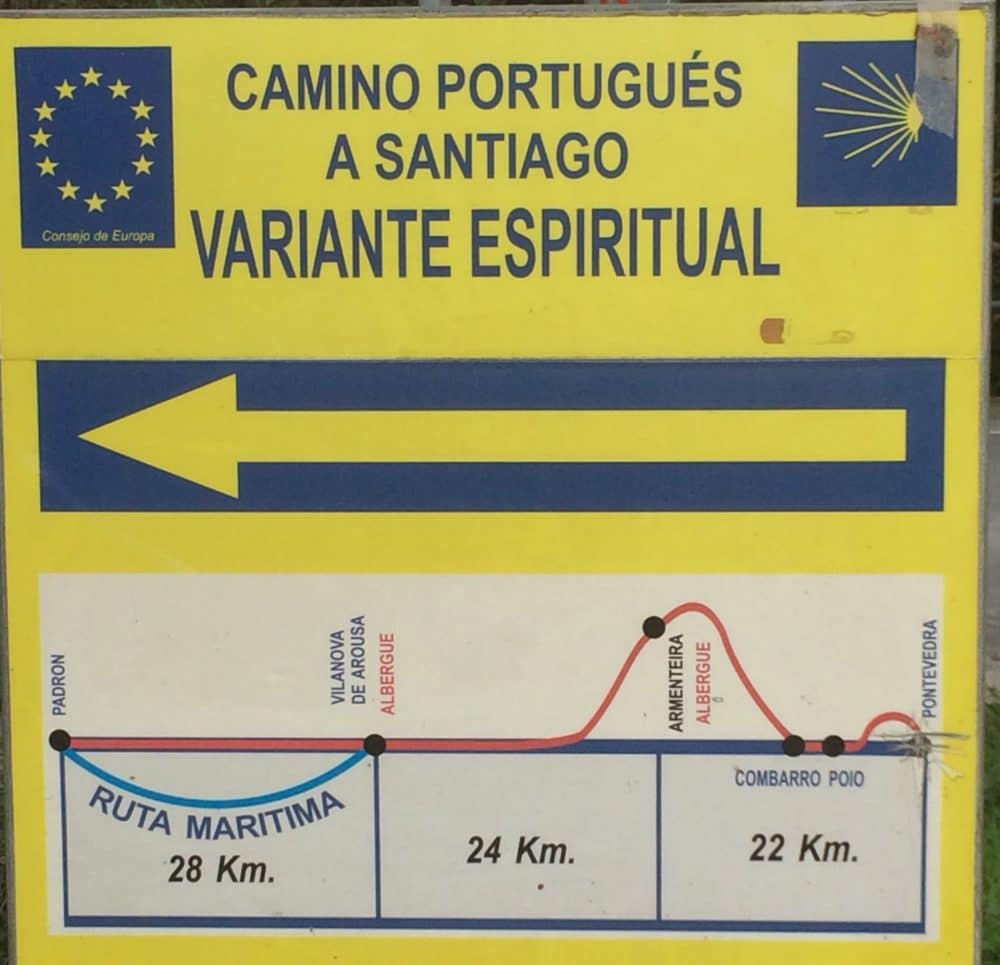
The starting point for the Variante Espiritual is clearly marked with two big signs.

Variante Espiritual

At this point, you can decide to go right under the bridge and follow the traditional Camino Portugués. Or you can go left and follow the Variante Espiritual.

Variante espiritual sign outside Pontevedra

The old signs

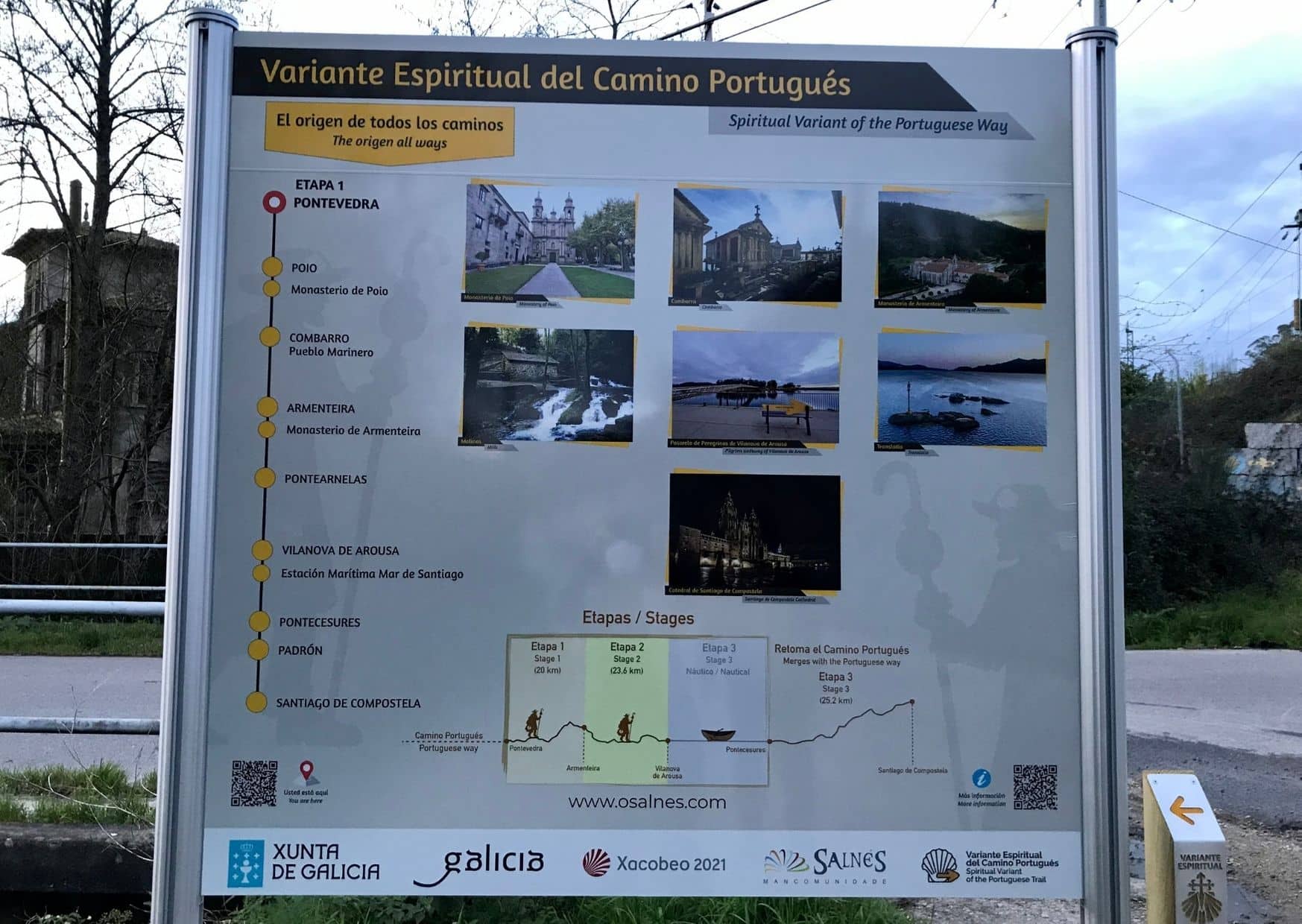
Variante espiritual new sign

New sign (2021)

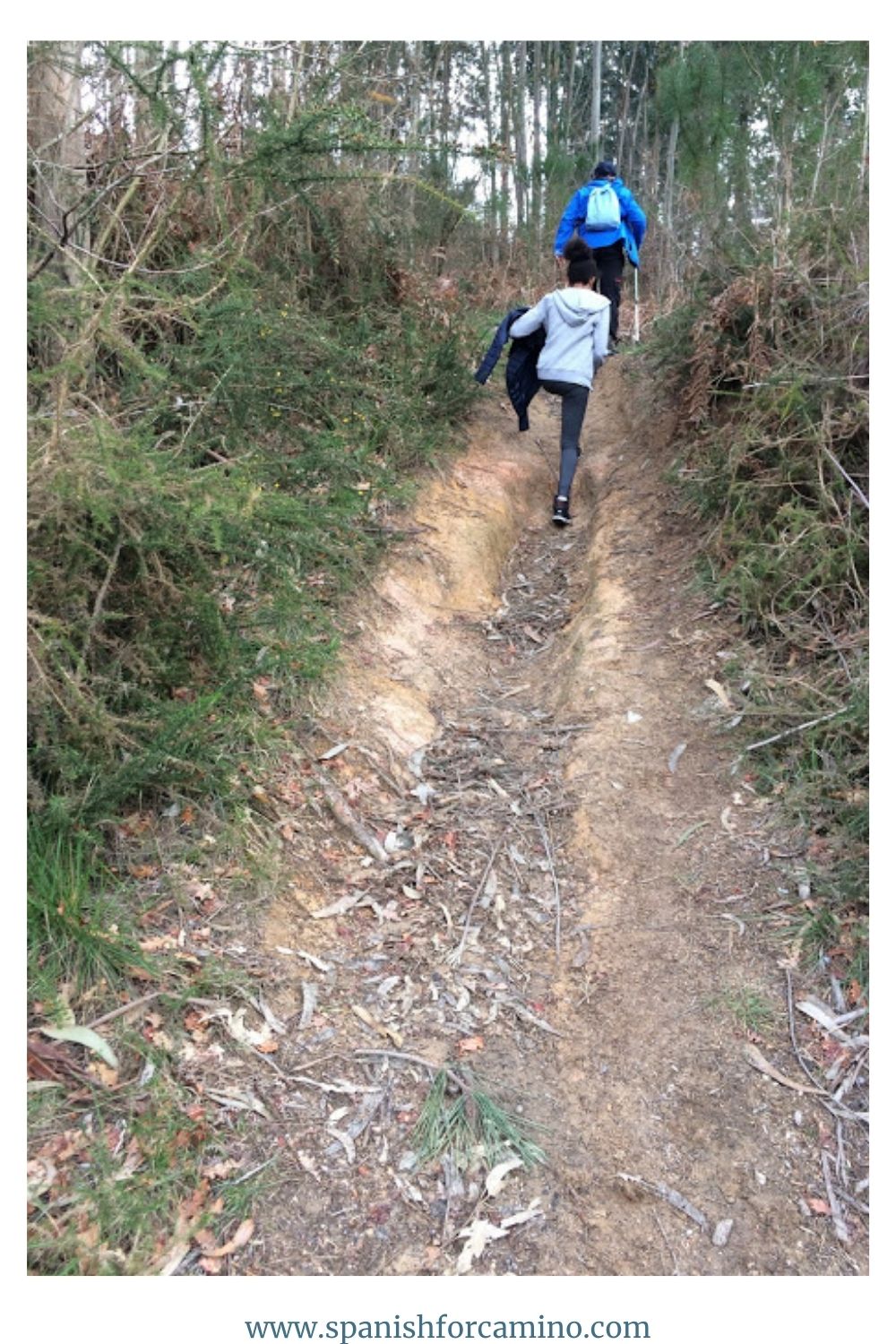
A few days ago I walked more or less half of the first stage (from Pontevedra to Combarro), with my marido (husband) and our two hijas (daughters), aged doce (12) and diez (10). Have you done it with family, or are you planning to? With children? I’d love to hear your experiences!


The reason why we chose to walk this part is mainly that it is very convenient for us. We packed some agua (water) and snacks in a mochila and we started walking. Once we reached our destination, we simply took an autobús back home. Also, the climb up to Armenteira is hard and we didn’t want to get the kids too tired and/or bored.


Leaving Pontevedra 

After we left Pontevedra, we walked through rural areas until we reached the monasterio (monastery) in Poio. You can actually spend the night there, since they have an area for guests. For more info, you can check their website: http://monasteriodepoio.es


Variante Espiritual
On the Variante Espiritual

After Poio, you go down to sea level and walk a stretch along the coast of the Ría de Pontevedra before you reach Combarro.


There is also a couple of small sections on the main road, but there is plenty of space to walk. It might not be so good during the summer, since this is a touristic area, the road gets very busy and there are cars parked everywhere. But it was fine the other day. 


Combarro

Combarro is a beautiful fishing town, famous for its hórreos (granary), a typical Galician construction. Hórreos are used to store grain; they are raised from the ground by pillars ended in flat stones that prevent access by rodents. They are made of stone or a combination of stone and wood.

You enter Combarro through the beach

Combarro, on the Variante Espiritual

One of the many hórreos you will see

And that’s where we finished our walk this time. Maybe next time we will start here and walk up to Armenteira. The climb is hard, but the views of the Ría are amazing.


Armenteira

There’s another monasterio in Armenteira, where you can also spend the night. More info on their website: https://www.monasteriodearmenteira.es/ There’s an albergue too.

View of the Ría

View of the ría

Armenteira, on the Variante Espiritual

Monasterio de Armenteira

See inside book of Camino Portugues legends
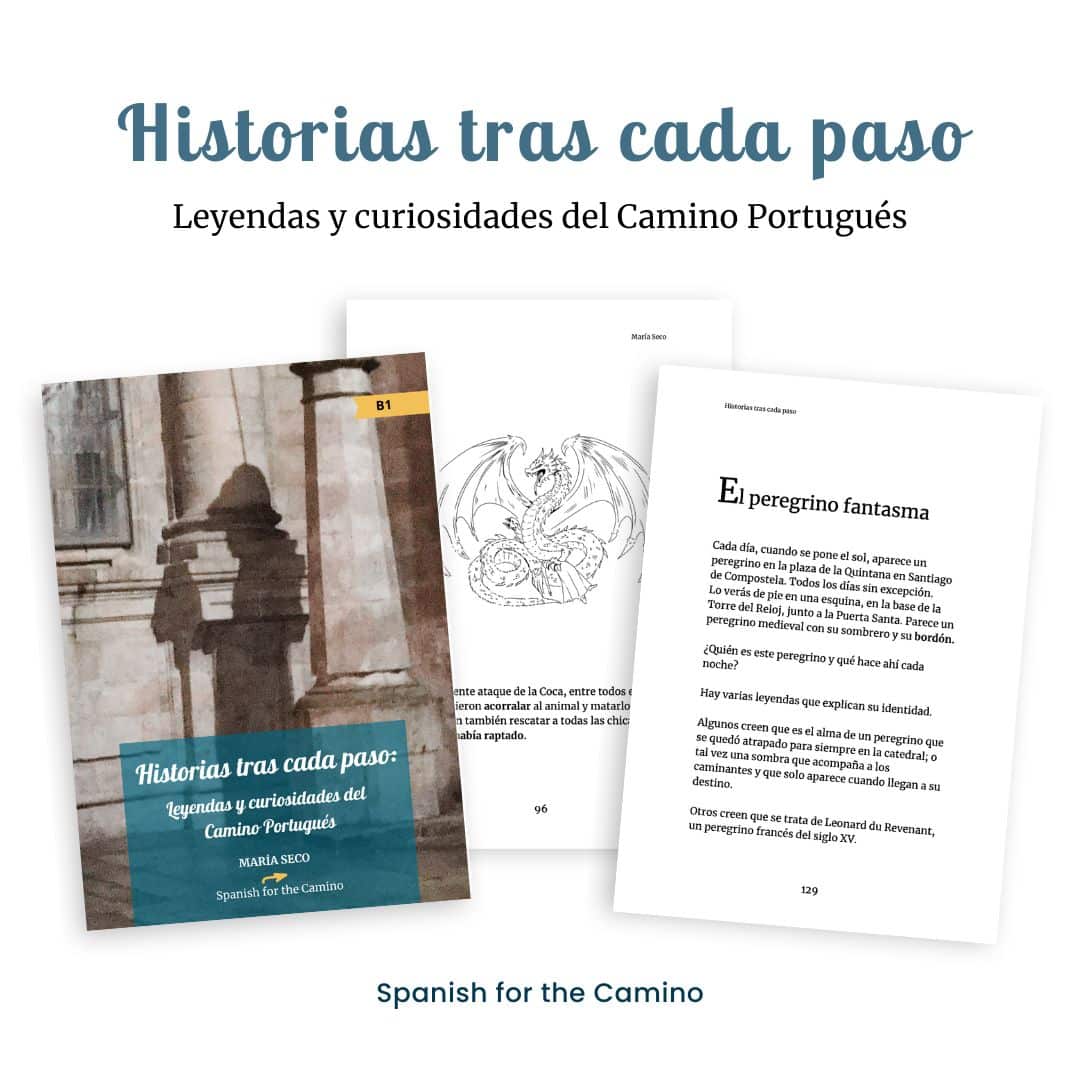
Would you like to know about the miracle that happened in Armenteira centuries ago? Check my book Historias tras cada paso. Leyendas y curiosidades del Camino Portugués, a collection of legends and historical tidbits about places along the Camino Portugués; many of them are directly related to the Camino or St. James.
The book is in Spanish, for intermediate learners, and includes a vocabulary guide with English translation.

Ruta da Pedra e da Auga

The section after Armenteira is one of great natural beauty. It’s called Ruta da Pedra e da Auga (route of stone and water) and it goes along a river where you can see the remains of many old water mills.

This second stage ends in Vilanova de Arousa, from where you will take a boat to Pontecesures, right beside Padrón. Alternatively, you can walk for 28km.


The boat trip takes about an hour and you need to arrange it in advance. The boat departures depend on the tides, so there are no fixed times. If you decide to take the boat, you will see the only maritime Via Crucis in the world, 17 stone crosses identifying the way followed by St. James’s remains.


After this third stage, you just join the traditional Camino Portugués in Padrón.


I found the section we did was very well signed. We didn’t have any maps with us, but we didn’t miss them. We had our phones, which we could have used if we got lost, but that was not necessary either.


It’s a very quiet route, even during busier times of the year. The day we walked, we didn’t meet anybody walking. We saw a couple of young men leaving Pontevedra, but they took the Portuguese route. That was it.

Today’s Spanish words


If you want to know more about hórreos, check Walking through Galicia.

Want more?

Make sure you don’t miss any posts or announcements by subscribing for free here. You’ll receive a free Spanish vocabulary guide with your first Spanish words + cultural tips. And… you’ll get access to exclusive content too.


¡Buen Camino!

El Camino Portugués

El Camino Portugués

For the second Camino in this series I’ve chosen el Camino Portugués (Portuguese Way). It’s the second most popular route to Santiago de Compostela, after the Camino Francés. And also, it is where I live.

As the name suggests, the Camino Portugués goes to Santiago de Compostela from Portugal, but there are a couple of route variations to choose from:

  • The best known one is the central route. The most popular starting point for the Camino Central Portugués is Porto (Oporto in Spanish), which is 240 km from Santiago. If you walk 25 km per day on average, you will need around 10 days to complete it.


 Some people start their pilgrimage from the Portuguese capital, Lisbon (Lisboa in Spanish), which is further south. In this case, you will have to cover a distance of around 600 km. You will need approximately 25 days to complete it.


  • If you decide to start from Lisboa, you could also take el Camino Portugués interior once you reach Coimbra. This route will take you through the Portuguese towns of Viseu, Vila Real and Chaves. Once you enter Galicia the Camino Portugués interior joins the Vía de la Plata.


  • After Oporto, you have two options too: you can continue on the central route through Barcelos, Ponte de Lima and Valença. Or you can take the Camino Portugués por la costa (coastal route).


The Camino Portugués in Spain


If you follow the central route, Tui will be the first Spanish town you will encounter after crossing the bridge over the river Miño, which serves as a natural border between both countries.

  • Tui was a very important town in medieval times and you can still see many buildings dating back to 15-16th centuries, including its cathedral.


  • Porriño is at the centre of an important industrial area. It is one of the world’s biggest granite producers. More on the Porriño-Redondela stage here.


  • Redondela. This is where the central and coastal routes meet.


  • Arcade is a small coastal town famous for its oysters. Every year, at the beginning of April, Arcade celebrates an oyster festival.


  • Pontevedra has one of the most important historical centres in Galicia, after Santiago de Compostela. Most of the city centre has been pedestrianised and Pontevedra has become an internationally acclaimed city, winning awards such as the UN Habitat Award and the Active Design Award.

Pontevedra is also the starting point of the last of the route variations on el Camino Portugués: variante espiritual, which includes a boat ride and joins the central route in Padrón.


  • Caldas de Reis is well-known for its thermal waters.


  • Padrón is the home of the famous Padrón peppers. If you haven’t heard about them yet, don’t worry! I’m sure you will get the chance to taste them when you do your Camino.

Coastal route of the Camino Portugués


If you follow the coastal route, you will have to take a boat from Caminha to A Guarda. From A Guarda, you will continue along the coast towards Vigo, which is the biggest Spanish town on this Camino. After Vigo, the coastal route joins the central route in Redondela.

There is also a variation of this coastal route, going from Caminha to Valença, along the river Minho. After Valença you then continue on to Tui.

If you don’t have enough time, you can do the Spanish section of this Camino, from Tui. It’s 119 km, enough to get a compostela and easily done in less than a week.

**Update: Regardless of the route you choose, you should know that Spain and Portugal are on different time zones. Once you cross over to Spain, you will be one hour ahead.

This document lists all available accommodations along this route. It’s a great resource.

In a previous post, I shared pilgrims recommendations about accommodation on the Camino Portugués. You can read it here. And if you would like to add any further recommendations (accommodation, food…), I’d love to hear your suggestions. 

For more details on some of the stages of the Camino Portugués in Spain:


Today’s Spanish words 

See inside book of Camino Portugues legends
For a collection of legends and historical tidbits, check my book Historias tras cada paso. Leyendas y curiosidades del Camino Portugués.
All the stories are about places along the Camino Portugués; many of them are directly related to the Camino or St. James.
The book is in Spanish, for intermediate learners, and includes a vocabulary guide with English translation.

Want more?

Make sure you don’t miss any posts or announcements by subscribing for free here. You’ll receive a free Spanish vocabulary guide with your first Spanish words + cultural tips. And… you’ll get access to exclusive content too.


¡Buen Camino!