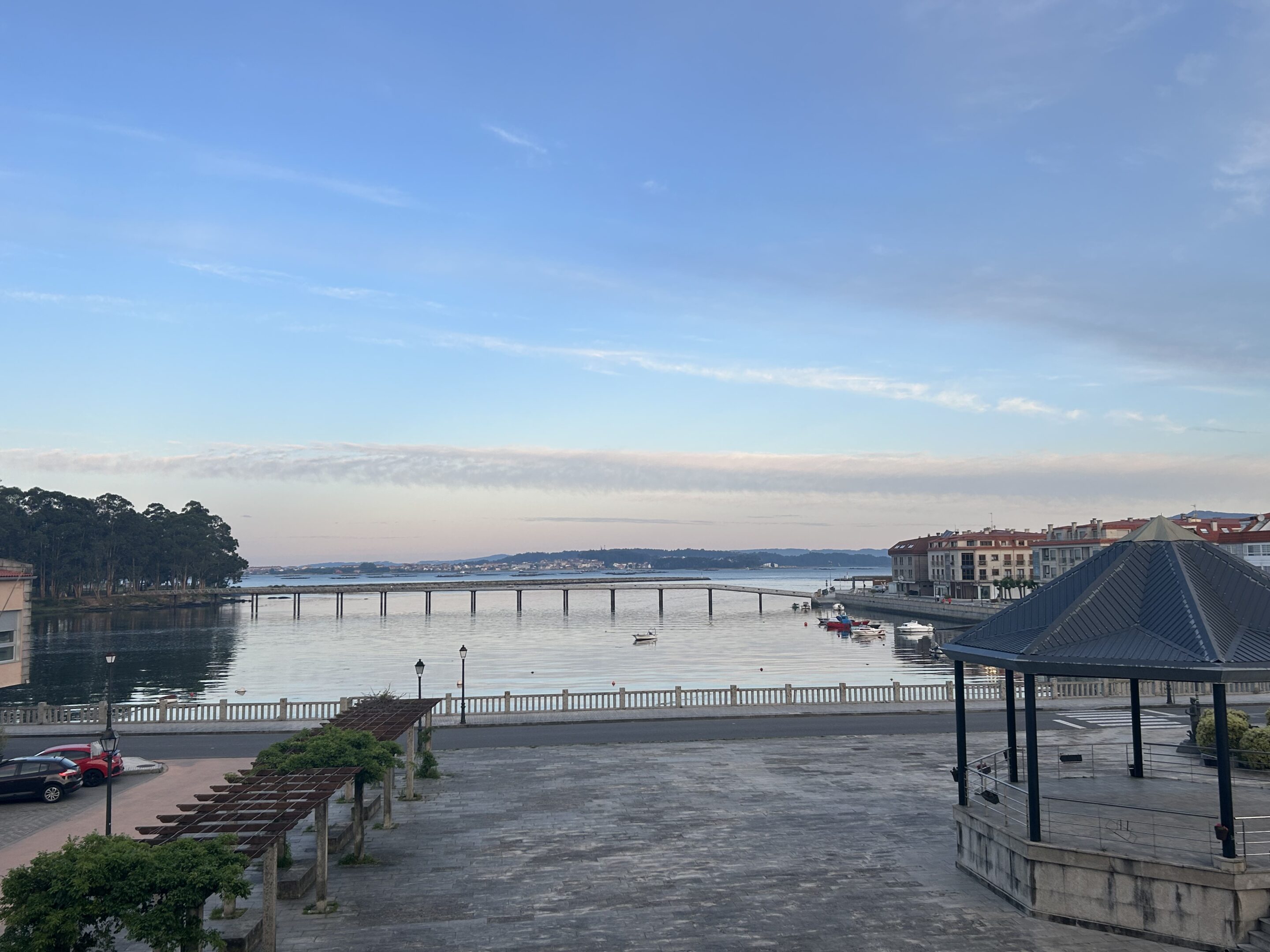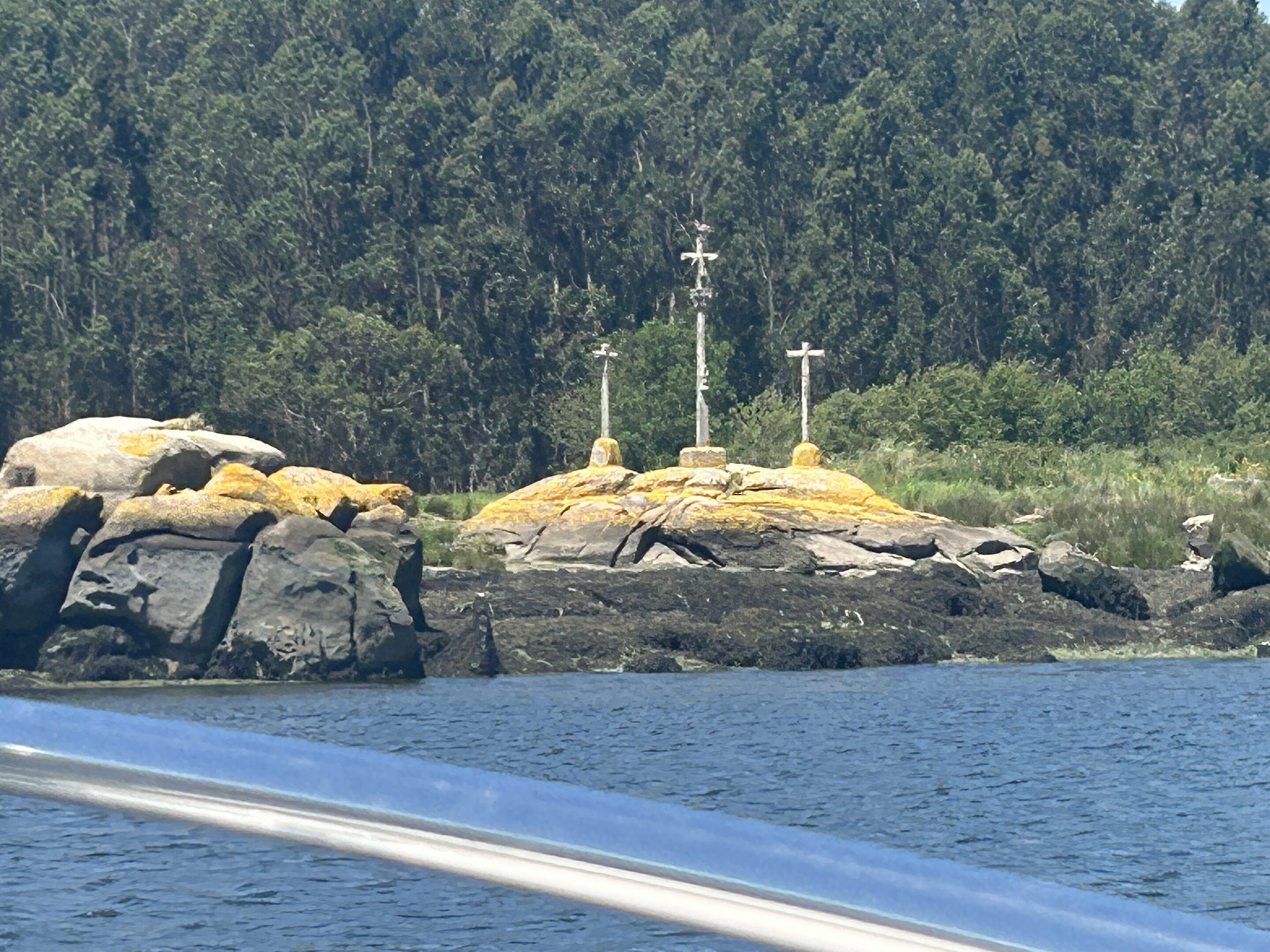

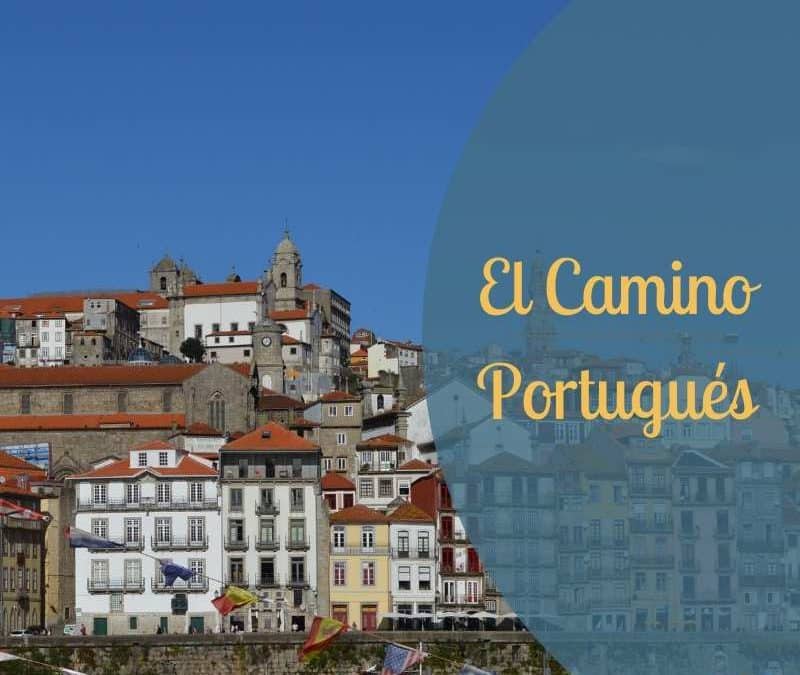
El Camino Portugués

El Camino Portugués

Updated: January 2026

Portuguese Caminos: routes, variations and what to expect

For the second Camino in this series I’ve chosen el Camino Portugués (Portuguese Way). It’s the second most popular route to Santiago de Compostela, after the Camino Francés. It also happens to pass through the area where I live.

As the name suggests, the Camino Portugués starts in Portugal and leads pilgrims north towards Santiago de Compostela. But there isn’t just one route from Portugal to Santiago.


Main routes in Portugal

  • The best known, more traditional one is the central route. The most popular starting point for the Camino Central Portugués is Porto (Oporto in Spanish), which is 240 km from Santiago. You will need around 10-12 days to complete it, walking about 25 km per day.


 You can also start your pilgrimage from the Portuguese capital, Lisbon (Lisboa in Spanish), which is further south. In this case, you will have to cover a distance of around 600 km. You will need approximately 25 days to complete it.

The pilgrim infrastructure from Lisbon is not as good as from Porto, so you may need to plan a bit more and possible have some longer days.


  • If you decide to start from Lisboa, you could also take el Camino Portugués interior once you reach Coimbra. This route will take you through the Portuguese towns of Viseu, Vila Real and Chaves. Once you enter Galicia the Camino Portugués interior joins the Vía de la Plata.


  • After Oporto, you have two options too: you can continue on the central route through Barcelos, Ponte de Lima and Valença. Or you can take the Camino Portugués por la costa (coastal route). The coastal route is becoming more and more popular in recent years.


Because Portugal and Spain belong to the European Union and the Schengen Area, there is free movement of people between the two countries. In practice, this means there are no border checkpoints or passport controls when you cross from Portugal into Spain on the Camino.

Central Camino Portugués in Spain


If you follow the central route, these are some of the most important towns you’ll pass through in Galicia:

Tui will be the first Spanish town you will encounter after crossing the bridge over the river Miño, which serves as a natural border between both countries.

  • Tui. The first Spanish town after crossing the bridge over the river Miño, which form the natural border between Spain and Portugal. Tui was a key town in medieval times and its historic centre still has many buildings dating back to 15-16th centuries, including its cathedral. More info on Tui here.


  • O Porriño. Located at the centre of an important industrial area and known internationally as one of the world’s biggest granite producers. 


  • Redondela. This is where the central and coastal routes converge. 


  • Arcade. A small coastal town famous for its oysters. Every year, at the beginning of April, Arcade celebrates a popular oyster festival.


  • Pontevedra. One of the most important historical centres in Galicia, after Santiago de Compostela. Most of the city centre has been pedestrianised and Pontevedra has received international recognition, including the UN Habitat Award and the Active Design Award.

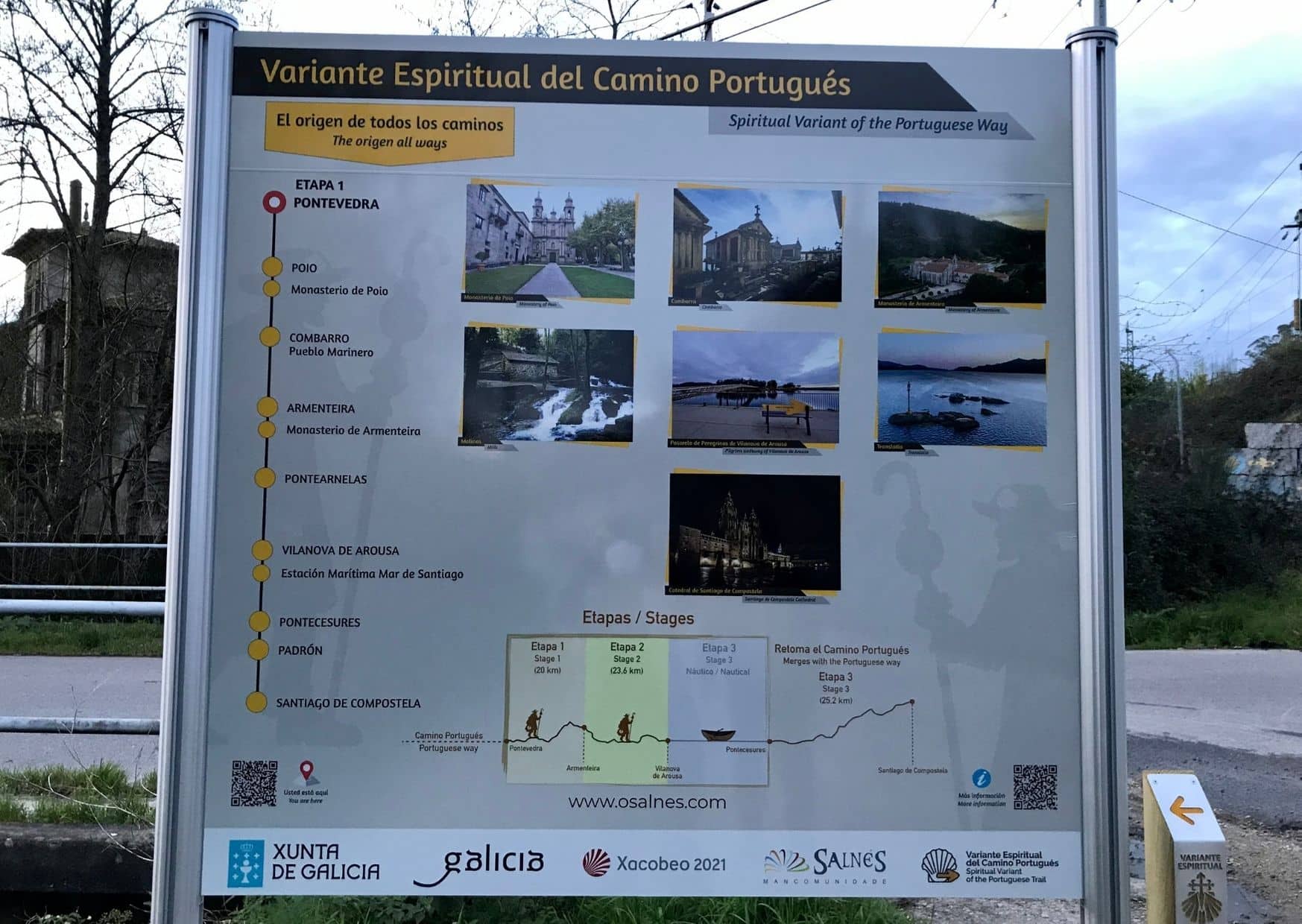
Pontevedra is also the starting point of the last of the route variations on el Camino Portugués: the Spiritual Variant or  Variante Espiritual, which includes a boat ride and rejoins the central route in Padrón.


  • Caldas de Reis. Well-known for its thermal waters. Your legs will feel like new after soaking in them for a while.


  • Padrón. Famous for the Padrón peppers. If you haven’t heard about them yet, don’t worry! I’m sure you will get the chance to try them on your Camino.


For more details on these stages of the Camino Portugués in Spain:

Coastal route of the Camino Portugués


There’s no bridge on the coastal route to cross from Portugal to Spain. You’ll have to take a boat from Caminha to A Guarda.


A Guarda is a fishing town with lots to see and do… and amazing seafood! More info in this other post.


From A Guarda, you will continue along the coast through Oia and Baiona towards Vigo, which is the biggest Spanish town on this Camino. After Vigo, the coastal route joins the central route in Redondela.

There is also a variation of this coastal route, going from Caminha to Valença, along the river Minho. After Valença you then continue on to Tui, on the central route.


Tui is a very popular starting point if you don’t have so muh time. It’s about 119 km from Santiago, enough to get a Compostela and easily done in less than a week.

On the coastal route, Vigo and Baiona are both quite popular too. 


**Heads up: Regardless of the route you choose, you should know that Spain and Portugal are on different time zones. Once you cross over to Spain, you will be one hour ahead.


Today’s Spanish words

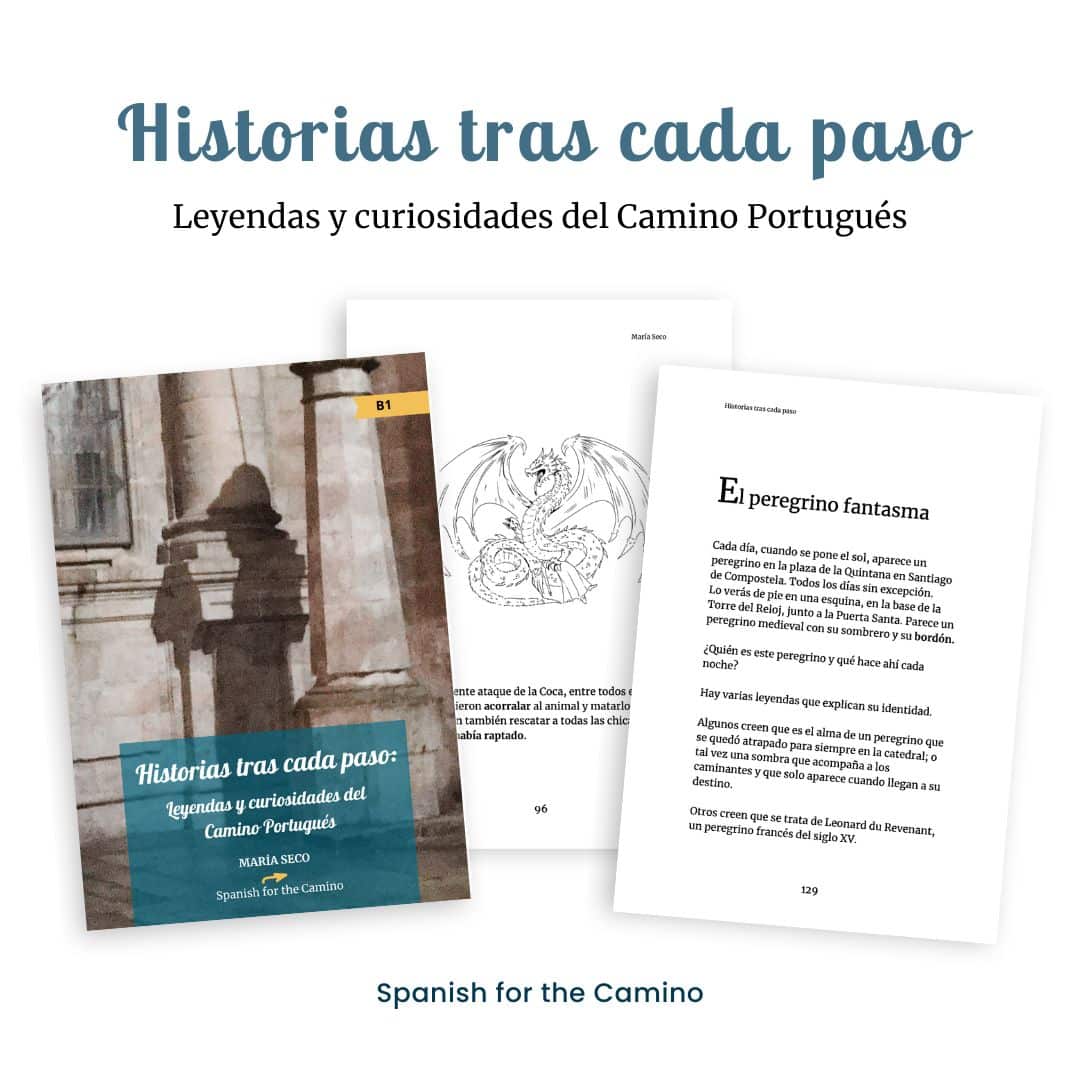
See inside book of Camino Portugues legends
For a collection of legends and historical tidbits, check my book Historias tras cada paso. Leyendas y curiosidades del Camino Portugués.
All the stories are about places along the Camino Portugués; many of them are directly related to the Camino or St. James.
The book is in Spanish, for intermediate learners, and includes a vocabulary guide with English translation.

Want more?

Make sure you don’t miss any posts or announcements by subscribing for free here. You’ll receive a free Spanish vocabulary guide with your first Spanish words + cultural tips. And… you’ll get access to exclusive content too.
 

¡Buen Camino!

El Camino Francés

El Camino Francés

We always talk about el Camino de Santiago or The Way as if there was one Camino only, when in reality, there are many -although not all of them are equally known. Some people are not even aware that there are so many Caminos. Anyway, when we hear el Camino (de Santiago), what most of us think of is actually el Camino Francés (French Way), so called because it comes from France.  


In the past, pilgrims used to start their journey from their doorstep. Nowadays, we tend to follow established routes. The French one starts from Roncesvalles on the Spanish side. However, a large number of people these days start their pilgrimage in Saint Jean au Pied du Port in France. That means you have to cross the Pirineos (Pyrenees).


If that is your case, you need to keep in mind that there are two routes: Napoleón and Valcarlos. Napoleón route closes for the winter months, generally from the first of noviembre (November) till the thirty first of marzo (March). However, these dates can vary depending on weather conditions, so if you are planning to cross the Pirineos, make sure you know which route to take and you are well prepared. And always follow recommendations.  


The Regions along the Camino Francés

El Camino Francés goes across most of Spain, from east to west, covering a distance of around 800km (500 miles). It takes between 4 and 6 weeks to complete, depending on your daily mileage and the rest days you take. As it covers such a long distance, the terrain and landscapes are varied: mountains, plains, forests, the Meseta (plateau)…   It also goes through four different regions: Navarra, La Rioja, Castilla y León and Galicia.

  • Navarra: el Camino Francés enters Spain through the region of Navarra. As I mentioned earlier, Roncesvalles is the start of this Camino in Spain. Other important towns in Navarra are Pamplona (the capital), Puente la Reina and Estella. Pamplona is famous worldwide for the bull running festival that takes place in July.
  • La Rioja: this region is very well-known for its red wines. The Camino goes through its capital: Logroño. Enjoy its food and wines!
  • Castilla y León: this is where the Meseta is. But what is the Meseta? It’s just a plateau or high plain. So why does everybody talk about it? Well, some people love it and some don’t. It can be a tough part of the Camino, since there are along stretches without any towns (no café con leche stops!) or shade.

But there are also towns along the Camino in Castilla y León: the main ones are Burgos, León, Astorga and Ponferrada. Both Burgos and León have very important cathedrals; Ponferrada is best known for its templar castle and Astorga has an important museum devoted to… chocolate!

 Getting closer to Santiago de Compostela

  • Galicia: you are getting closer to your destination. This section of the Camino is usually busier than the rest; Sarria is a very popular starting point for many: it marks the last 100km, the distance required to get a Compostela certificate.

For the types of accommodation that are available along the Camino, you can check Where to sleep on the Camino.

If you have already done the Camino Francés (or part of it), I’d love to hear your experience: best accommodation? favourite town? most delicious food you tasted? Anything you can think of! 

For a detailed guide of Pamplona, check Pamplona with Jose Mari Ardanaz.

For more on Castilla y León, check A walk through Castilla y León with Sara Castro.


Camino journals


Improve your Spanish while you walk the Camino with one of my journals.

You can actually start using them before you even travel, since they include a section to help you plan your Camino (stages, packing list, etc.). 2 versions available: with with space to record up to 40 days and another one, for shorter Caminos, with space for up to 15 days.

Basic Spanish Camino vocabulary

Want more?

Make sure you don’t miss any posts or announcements by subscribing for free here. You’ll receive a free Spanish vocabulary guide with your first Spanish words + cultural tips. And… you’ll get access to exclusive content too.


¡Buen Camino!

Necesito un médico

Necesito un médico

Necesito un médico (I need a doctor) is probably something you don’t want to say while on the Camino, right? And hopefully you won’t need it but… you never know.


  • You are an EU citizen and you got your  Tarjeta Sanitaria Europea (European Health Insurance Card). And if you are from outside the EU, you got seguro.


  • Farmacias and parafarmacias can help with many of the most common problems. But you need to let them know of any relevant alergias (allergies) or conditions you may have, so they can give you the right remedy.


If you are allergic to something, you can just say Tengo alergia a… and complete the sentence with whatever causes your allergy: Tengo alergia a la penicilina or la aspirina, to name a couple.

*Note that you can use this expression in bars and restaurants too when ordering food, if you have any food allergies. Here’s a little test for you:

How would you say “I’m allergic to eggs” in Spanish?

(leave a comment with your answer!)


Sometimes the pharmacist can’t help or you already know you need medical attention. Then you may say… Necesito un médico (I need a doctor). As I explained a couple of weeks ago, you can go to the local centro de salud.


The médico will ask ¿Qué le pasa? (What is wrong?) and you can then explain. You can check last week’s lesson to revise how to talk about pains and other common ailments. Let’s add está hinchado (it’s swollen) and diarrea (diarrhea) to the list.


As with the pharmacist, you need to inform the médico of any medical history that may be relevant. I’ll give you a couple of examples: soy diabético (I’m a diabetic; replace the final -o in diabético with an -a if you are female) or tengo la tensión alta (I have high blood pressure).


Today’s Spanish words & phrases


¡Buen Camino!

Want more?

Make sure you don’t miss any posts or announcements by subscribing for free here. You’ll receive a free Spanish vocabulary guide with your first Spanish words + cultural tips. And… you’ll get access to exclusive content too.
I’m not feeling well

I’m not feeling well

I’m not feeling well |

As I promised last week, here is the second part of the body series. In today’s lesson you can learn a few more body parts and a couple of expressions you can use if you are not feeling well.

For the parts of the body, I’ll leave you again with an image (check the pronunciation below).

For the expressions, scroll down a bit.

I'm not feeling well

I’m not feeling well

OK. So you’ve learned a few new parts of the body. But they are not enough. Keep reading if you want to learn how you can use them to let someone else know that you are not well. We just need to add a couple more words.


  • Tos (cough) and fiebre (fever, temperature) are two common ailments you can suffer while doing the Camino de Santiago. If you want to say that you have a cough or a fever, all you have to say is Tengo (I have) tos or tengo fiebre.

  • Another common problem you can have is a pain somewhere in your body. If that is the case, you can say Me duele + body part; e.g. me duele la cabeza (I have a headache).


So how do you say “I have blisters” in Spanish? And “my shoulder hurts”?

Leave your answers in a comment.


And remember that a pharmacy is always a good starting point is you’re not feeling well. Pharmacists are quite knowledgeable and they might be able to help. If they can’t, they will tell you where to find help.


Today’s Spanish words

Want more?

Make sure you don’t miss any posts or announcements by subscribing for free here. You’ll receive a free Spanish vocabulary guide with your first Spanish words + cultural tips. And… you’ll get access to exclusive content too.

¡Buen Camino!


Your health on the Camino

Your health on the Camino

Since I started this blog I’ve discussed different topics such as accommodation or food, but I only briefly touched on a very important one: your health during the Camino. So let me correct that.


Do you need any vaccines to walk the Camino de Santiago?

First, I’d like to clarify something: every now and then people ask on forums what vacunas (vaccinations) they need in order to enter Spain. The answer is NONE! You don’t need any vacunas to enter Spain or any other European country.

You can find that information, as well as other practical travel info in the following link: https://www.spain.info/en/how-to-get-there/

In case of emergency…

Secondly, the number to contact emergency services in Spain and the rest of Europe is 112. It’s a free number. And they speak English. Make sure you know this number or keep it handy at all times. It would be a good idea to store it in your phone.


A few weeks ago I wrote a short post, El botiquín, about first-aid items to carry in your mochila. Hopefully, that’s all you will need: a couple of tiritas and an ibuprofeno or two.

But some things are beyond our control: You could get sick or even have an accident. That’s why it’s a good idea to be prepared.


  • If you are an EU citizen, don’t forget your Tarjeta Sanitaria Europea (European Health Insurance Card). The Tarjeta Sanitaria Europea entitles you to state-provided healthcare during a temporary stay under the same conditions and at the same cost (free in some countries) as people insured in that country.

The following link has contact information for every country where you can apply: http://ec.europa.eu/social/main.jsp?catId=563&langId=en#nationalinfo


Where should you go?

If you need medical attention while in Spain, you can go to the local centro de salud with your Tarjeta Sanitaria Europea. 

On the other hand, when the centro de salud is closed (or your problem can’t wait) you can go to urgencias (A&E or ER, depending where you are from) to be seen by a doctor.

If you can’t get yourself to the centro de salud or urgencias, call 112 for assistance. Don’t worry if your Spanish is limited. As I mentioned, they have English-speaking operators to help you. They will assess the situation and dispatch an ambulancia or any other emergency services they deem necessary.


  • If you are coming from outside the European Union, then you should consider getting seguro (insurance).

And even if you are coming from within the EU, getting some seguro is not something you should dismiss, since the Tarjeta Sanitaria Europea is not an alternative to travel insurance. It does not cover any private healthcare or costs such as a return flight to your home country.


If you are not convinced, read Nidarosa’s story:

My Scouse Spouse and I have walked together several times – Astorga to Santiago for our honeymoon, Hadrian’s Wall, then Astorga to Santiago again earlier this year. I knew he enjoyed it and he sometimes mentioned wanting to walk the Francés from St Jean Pied de Port to Astorga to see what I have seen, […]

via Accidents and Emergencies — Somewhere Slowly


You can find more health-related info and Spanish in Necesito un médico. Ideally, you won’t need any of this, but you know what they say: Better safe than sorry or Más vale prevenir que curar, if you would like to say it in Spanish!


Today’s Spanish words & phrases


¡Buen Camino!

Want more?

Make sure you don’t miss any posts or announcements by subscribing for free here. You’ll receive a free Spanish vocabulary guide with your first Spanish words + cultural tips. And… you’ll get access to exclusive content too.

Vegan or vegetarian on the Camino

Vegan or vegetarian on the Camino

Updated February 2026

Vegan or vegetarian on the Camino de Santiago: how to find food

Future pilgrims ask all the time about the availability of vegetarian or vegan dishes along the Camino de Santiago. They worry that it will be hard for them to find suitable food. And it’s understandable.

Obviously, you need adequate nourishment.

Although the Mediterranean diet includes many vegetables and legumes, Spain is not always the most vegetarian-friendly country. It’s common for a salad to have tuna; and a “vegetable sandwich” with either tuna or a slice of ham is a classic (and nobody thinks it’s odd!).

Things are changing and it’s becoming easier to find vegan or vegetarian restaurants, especially in the bigger cities. But the Camino goes through a lot of smaller towns and rural areas.

So, is it possible to walk the Camino as a vegetariano/a or vegano/a?

The short answer is: YES! It’s possible, with some planning.


Food options for vegetarians and vegans on the Camino


You have two main choices for your meals:

1. Buy and prepare your own food.

  • You can buy food and snacks from the local fruterías and supermercados (see Shopping on the Camino for the pronunciation of these words).
  • Some albergues have kitchens where you can prepare your own meal. You just need to find out if the place where you are staying has such facilities.


2. Eat out and enjoy the local cuisine.

This is possible even in the smaller towns. 

There are many Spanish dishes that are naturally vegan or vegetarian, like the popular tortilla or gazpacho. Some can be easily adapted (In this article you can find a long list of Spanish dishes that are suitable for vegans: https://www.thenomadicvegan.com/the-ultimate-vegan-guide-to-spain/).


You just need to know a few Spanish words and phrases to make sure you get the right food:

  •  Soy vegetariano / Soy vegetariana or Soy vegano / Soy vegana (I’m a vegetarian or I’m a vegan)

 If you are a male, you will refer to yourself as vegetariano/vegano. If you are a female, you will use vegetariana/vegana instead. If you’re non-binary, the most common way to express this in Spain right now would be vegetariane/vegane.


  • You can also specify the foods you don’t eat by saying No como… (I don’t eat…) + anything you need to mention, such as carne (meat), pescado (fish), huevos (eggs), lácteos (dairy) or queso (cheese). Check this other article on food allergies for more useful Spanish and tips.


  • If you’re not sure about the ingredients of any particular dish: you can ask ¿Lleva carne, huevo…? (Does it have… meat, egg…?).


  • If a dish is mostly vegan, but it has some egg or cheese, for instance, you can still order it and ask them to serve it sin huevo (without egg) or sin queso (without cheese).


  • You could even take advantage of the menú del día. The second course tends to include fish or meat, but you can explain that you are vegan or vegetarian and ask if you could take 2 first courses instead of a first and a second. Most places wouldn’t have a problem with that.


  • You can still enjoy café con leche as a vegan. Many cafés have some vegetable alternative to dairy milk. Soya is the most common, but oat milk is becoming increasingly popular too.


Practical tips

  • Learn the names of basic foods in Spanish, as well as the phrases above.
  • Carry snacks for those times where options are limited.

  • Be clear with restaurant staff about what you can and cannot eat.

  • Don’t be afraid to ask them to adapt dishes. Spanish restaurants are generally flexible.


Today’s Spanish vocabulary

Want more?

Make sure you don’t miss any posts or announcements by subscribing for free here. You’ll receive a free Camino food guide. And… you’ll get access to exclusive content too.


¡Buen Camino!