Games and the Camino

Games and the Camino

Have you ever played any games on the Camino? Have you even considered it?

I had a lovely evening on the Camino Inglés last year, playing cards. It was fun, but it was also an opportunity to bond and, of course, to learn about Spanish culture and language.

So, if you hadn’t thought about it, please think again and keep reading.

In this guest post, Vickie Kelty tells us about the benefits of games and how you can incorporate them in your Camino… and in your life after the Camino.

Over to Vickie!Flecha azul

 

I know you have a lot of things to pack for the Camino and you want to keep it as light as possible, but I have one request: please don’t forget to pack a game (juego).

Now, obviously you aren’t going to put a big board game like Clue or Monopoly in your backpack! I’ll bet a deck of cards (baraja), some dice (dados), or a tiny travel size game would fit though, wouldn’t it?


First, why you’ll wish you brought a game on the Camino

  1. Relaxation! After a long day walking the Camino playing a game is just one way to chill out and start getting to know other pilgrims. Read about what it’s like walking with strangers in this post
  2. You can play them anywhere! It isn’t necessary to wait for a table to play a round of cards, just sit right down on the ground and play.
  3. No time limit. You decide how long to play, so don’t worry about time. It’s not necessary to keep score or finish the entire game. Sometimes just one hand of cards is a nice way to unwind after a long day of walking or travel.
  4. Forget language barriers. Playing a game is a great way to take the Spanish you know and the English or other language the other person knows and use it to play a game together. Be prepared for laughter and fun to ensue! 


What Spanish games can I learn before I do the Camino?

Keep in mind, the games I’m about to mention are suggested based only on my own personal experiences living in Spain and in the U.S. So, please take that into account if there’s a game mentioned that you’ve never heard of or isn’t popular where you’re from.

I also invite you to research any games you don’t know, perhaps they’ll become your next favorite game!

Let’s start with board games. 

Games and the Camino Parchís
If you know the game Sorry!, which I grew up playing in Nebraska, then Parchís will look familiar to you. I found a cool magnetic travel size version called Ludo (this game goes by many names!) at a dollar store and I often bring it with me on vacation. In fact, it proved entertaining while on a road trip with my parents one summer, even though my mom always beat me.

Perhaps you’ve heard of this next game too, The Game of the Goose or La Oca. This one I hadn’t played before coming to Spain and I can’t wait to play it with my family the next time they visit. Even though I don’t have the travel size version I did see one available online. It’s like a game I grew up playing called Chutes and Ladders in that you never know if you’re going to land on a good or bad square next!

Games and the Camino La Oca

By the way, both of these board games have special Camino versions available – though perhaps not in the travel size – and they could make for nice souvenirs! So even if you don’t play them on the Camino you can play them when you get home and share your experience with others.


Although board games are nice, nothing beats a good old-fashioned card game.

While there are many popular Spanish card games, I suggest checking out Brisca, which can be played in pairs, and another game called Chinchón, which is similar to Rummy.

It might also be fun to buy a Spanish deck of cards to play with! Another nice souvenir – and this one will easily fit in your backpack.

Obviously, there are many more Spanish card and board games, but these are the ones I’ve played the most and found easiest to learn.


If you’re like me, you want to share your culture too!

Think about some easy games you can share with other pilgrims. I’ll share two of my examples. A couple easy to teach card games that I played growing up are now my favorite games to teach others when I travel. They’re Old Maid and Go Fish.

Although I have special cards (cartas) for them, I don’t travel with those. I just carry a standard 52-card deck that I can play both games with. A little secret for Old Maid, I simply leave one joker in the deck and call that the Old Maid. (I know some people will remove three Queens so there’s only one Queen. Do what works for you).

Another card game I’m obsessed with is UNO! I’ve been delighted to find out that it was recognized by most of my Spanish friends when I’ve brought it out to play. Although I was surprised to find out that their rules are slightly different than the ones we played with in my family. Sometimes we play with my rules, sometimes with theirs. It’s fun to change it up!

Honestly, for me, UNO is one of the best games to travel with because the rules are easy to follow (even if they differ slightly from country to country) and the vocabulary you need to play is quite basic. Besides, when you don’t know the words gestures go a long way! 

By the way, if you don’t want to play cards, even carrying five dice and playing a version of Yahtzee can easily be done. The game options are endless!


Just remember, whatever game you choose to bring, it’s worth it for the memories you’ll make.

What game will you bring on the Camino?


Today’s Spanish words


Vicky Kelty

Vickie Kelty is an English speaking skills teacher originally from Nebraska, USA. She specializes in using games to help English language learners speak with ease and enjoyment. You can find her at vickiekelty.com or follow her @vickiekelty on IG where she posts regularly.


Want more?

Make sure you don’t miss any posts or announcements by subscribing for free here. You’ll receive a free Spanish vocabulary guide with your first Spanish words + cultural tips. And… you’ll get access to exclusive content too.


¡Buen Camino!

La Luz del Camino

La Luz del Camino

A month ago I had the opportunity to take part in La Luz del Camino initiative.


But what is La Luz del Camino?

After the confinamiento (lockdown), some peregrinos (pilgrims) decided to start a Camino from Roncesvalles, on the Camino Francés, carrying a special mochila (backpack) with a light on. The purpose of this pilgrimage was to remember all those people who have died of covid-19. The idea was for the backpack to be carried in relays, by different pilgrims, all the way to Santiago.


Once that backpack was on its way to Santiago, the question was “why not do the same on a different Camino? And that’s how La Luz del Camino Portugués originated. Plans were made to start a pilgrimage from Porto, in Portugal, along the central route of the   Camino Portugués. Also, both pilgrimages were coordinated so that the 2 mochilas would enter Santiago on the same day, July 24, the day before the festivity of st. James.

Oihana, someone I’ve met online and hope to meet in person soon, was one of the people involved in the organisation of La Luz del Camino Portugués. She invited me to participate and I immediately said yes!

First, because it was a very thoughtful project in general. But also because it gave me the chance to do something meaningful for my friend and fellow Spanish teacher Inés, who lost both her parents to coronavirus.

Inés is from Madrid but lives in the US with her American husband. Her parents died in April and, 5 months later, she still hasn’t been able to travel to Spain, which is making her grieving process harder. Her parents, Vicente and Carmen, were deeply religious and also had a strong interest in art and history. They never walked the Camino, but they did visit the cathedral in Santiago, as well as many other places along the Caminos.

So, going back to the light of the Camino, our special mochila left Porto on July 11, after a blessing at the cathedral. It made its way to Spain on the central route and reached Tui a few days later. You can follow the journey on this Facebook group, which has plenty of photos and an account of each day’s walk.


From Pontevedra to Caldas

On Tuesday July 21 the backpack travelled from Pontevedra, my home town, to Caldas de Reis. And that’s where I came in. I didn’t know who I was going to walk with or how many people I was going to meet.

Arrangements were made to leave very early, at 6.00am, because the weather had been particularly hot that week; the maximum expected temperature for that day  was around 40ºC (104ºF). ¡Mucho calor!

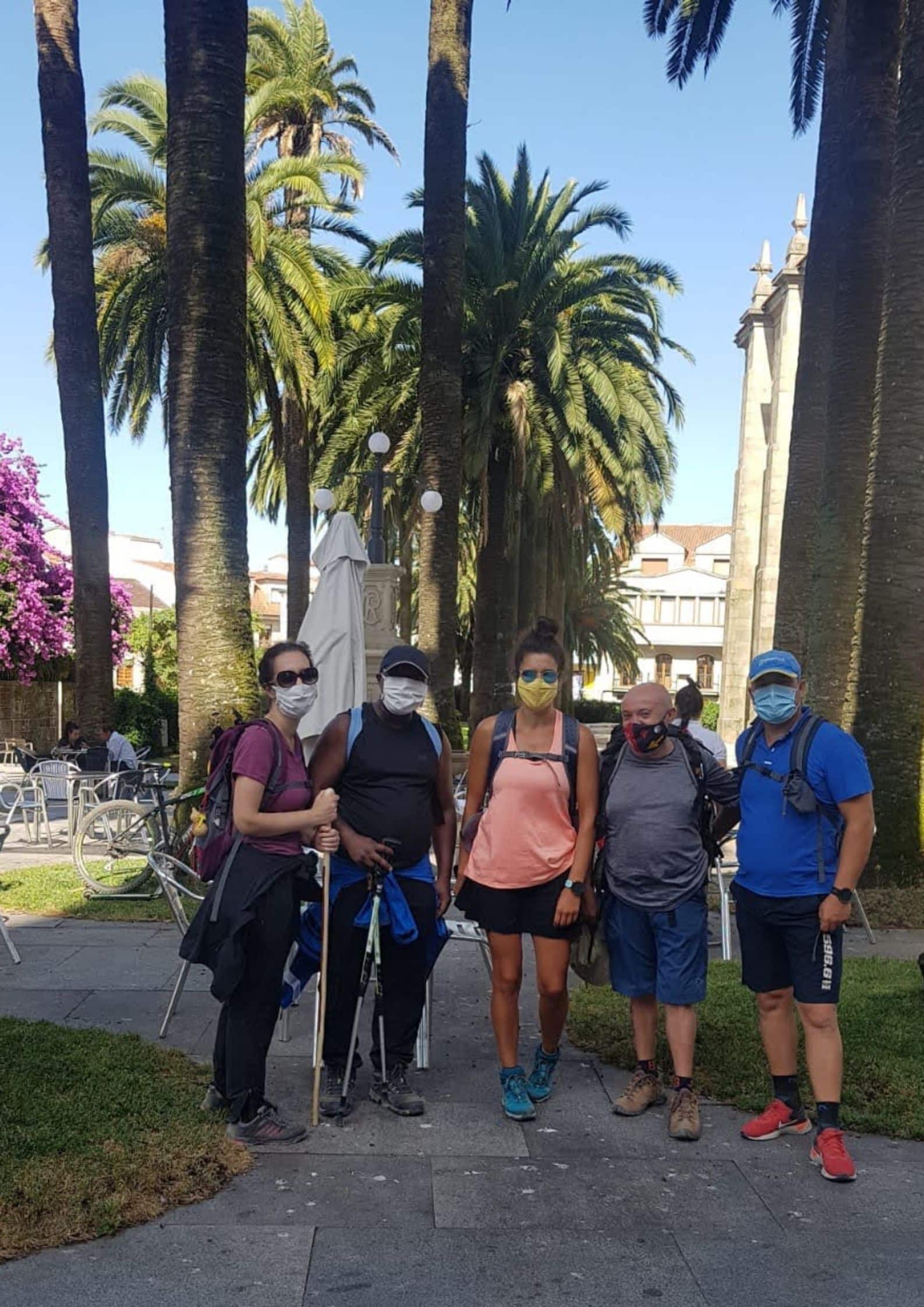
We met outside the Peregrina church, with our mascarillas (facemasks), as the “new normal” requires, and we started walking. It turned out there were 5 of us in total. It was still oscuro (dark) but at least the temperature was nice and fresh.


La Luz del Camino en la Peregrina
La Luz del Camino
Leaving Pontevedra

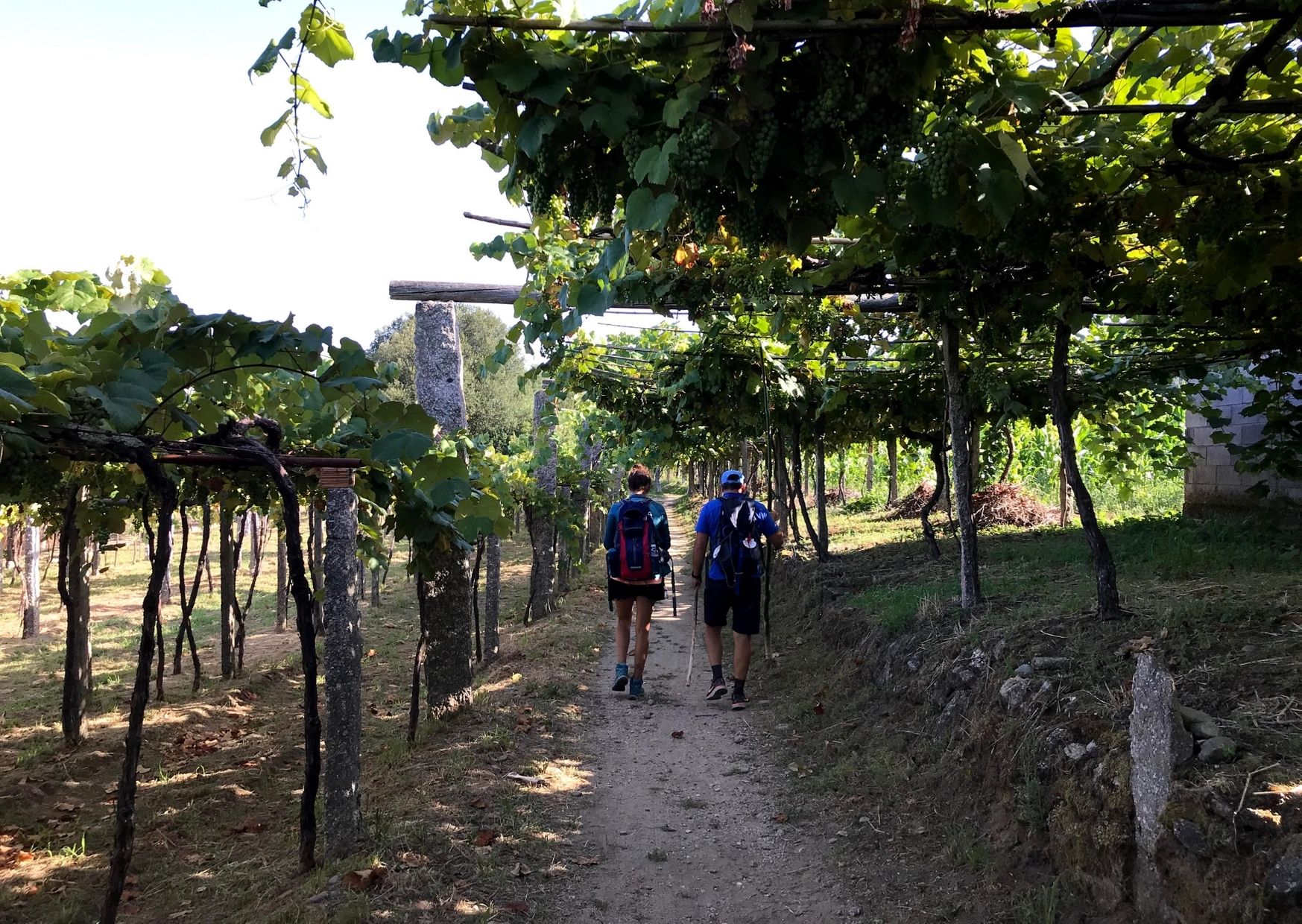
 We left Pontevedra in the dark, making good speed to try and beat the heat, and continued on to Alba, San Amaro and A Portela.  After a while, we started distancing from each other so we could remove our masks. We saw one or 2 pilgrims along the way and a couple of locals too as we passed through villages. But, in general, we were on our own.


The bares and cafeterías we passed were closed. Maybe it was too early, or maybe it was one of the side effects of covid-19. I’d say it was the latter, because we didn’t find anything open until we got to Caldas, which means… we were not able to have café con leche or tortilla! 

Luz del Camino

La mochila

As I mentioned before, the backpack was carrying a light, but that was not the only thing:

There was also una concha de vieira (scallop shell) hand-painted by Julia, the same girl who later carried the backpack into the cathedral in Santiago, as well as different items added by different people at different stages.

I added a yellow knitted shell, for all of those who had plans to walk this year and had to cancel (myself included). 

La mochila de la luz del Camino

There was also un bordón (a staff), that was especially made for the occasion and that you can see in the video.

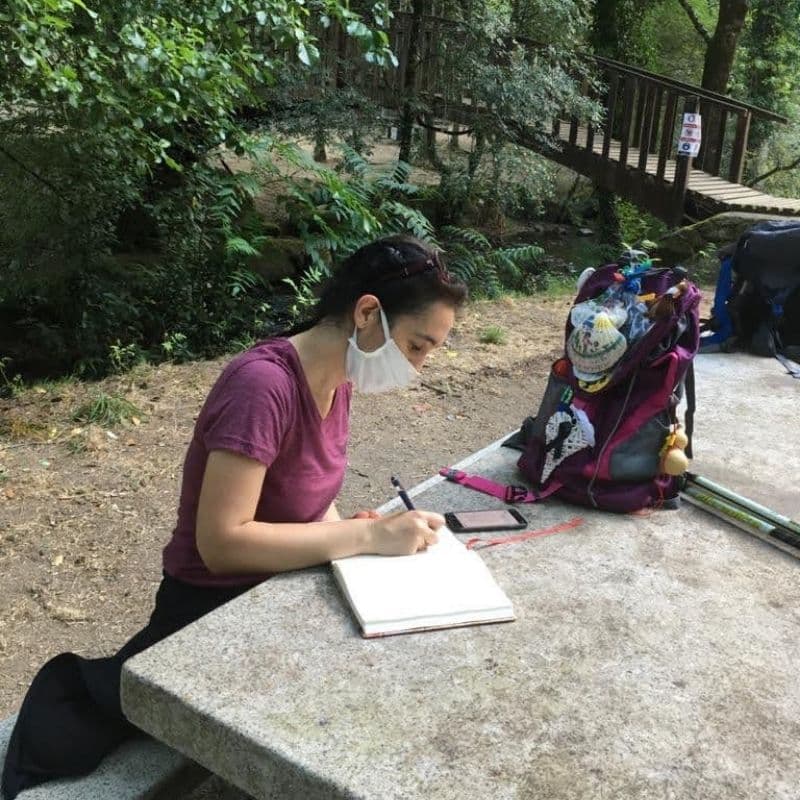
Inside the bag, there was a notebook where anyone could write about their experience accompanying the light of the Camino, a special message for a loved one, etc. So I asked my friend Inés if she would like me to write something on her behalf.


After walking through forests and villages for a while, the Camino joins the busy N-550 road. At this point, if you look across the road, you’ll see a sign saying “Parque Natural Río Barosa”. It’s a beautiful place with waterfalls and old watermills. It’s about 500m off the Camino, but it’s well worth the detour. Whenever you find yourself walking the Camino Portugués, if you have the time, please stop by. You won’t regret it.

We chose this place for a break (sadly, café con leche was not an option, as I mentioned, because everything was closed); we were all carrying snacks, but a colleague of one of the people walking met us there with donuts, cereal bars, nuts and drinks! The Camino provides, right?

I also chose this place to write Inés’ message on the notebook. It’s beautiful, it’s peaceful… I couldn’t think of a better spot to complete my mission.

El cuaderno

The notebook

Mensaje de la luz del Camino

Writing on behalf of my friend

So we had a break, I wrote on the special notebook and we continued our way to Caldas de Reis, which was not too far away.

That meant back to busy N-550. I’ve travelled that stretch of the road on numerous occasions (by car) and I often see pilgrims walking on the side of the road. I wasn’t looking forward to this part of the walk. But I was pleasantly surprised to find out that there’s actually no need to do this. The Camino runs more or less parallel to the road, but you don’t actually have to walk on the hard shoulder.


After Barosa

Not walking on a busy road

Getting close to Caldas

Getting close to Caldas de Reis

There’s around 5-6km between Barosa and Caldas, so most of our walking was done by the time we took our break. We entered Caldas before 11.30am… and before the worst of the heat!

Caldas de Reis is nice little town well known for its hot springs and spa. We had no time to enjoy any of it on this occasion, because we were going back home. But if you’re ever staying in Caldas, make sure you don’t miss it. Your feet will thank you for it.

En Caldas de Reis

Work commitments meant we couldn’t keep on walking to Santiago. It would have been great to see that mochila enter Santiago and the cathedral; but I’m happy and grateful I was able to be a part of this initiative (even if it was a small one).


Today’s Spanish words

The weather on the Camino

The weather on the Camino

The weather on the Camino |

This is a question I see quite frequently in Camino-related groups: “I’m doing (add a Camino of your choice here) in (add any month or season). What will the weather be like?” The only true answer to this is: Who knows?!

There are too many factors at play here.

First of all, different parts of Spain have different types of weather. In el norte (north), for instance, la lluvia (rain) is never too far away. El sur (south), however, is drier and it can be much hotter, especially en verano (in summer). Depending on which Camino you choose, and where you start, you could be walking for just a week … or crossing Spain from este (east) to oeste (west) or from sur to norte!

And then, el tiempo (the weather) can be quite unpredictable. The same month, in different years, can be very wet or dry; cool or hot. It’s a bit of a lottery.


Weather on Camino Francés
Weather on the Camino

I didn’t make these up… and there are many more variations of the same question:

What will the weather be like on the Camino?

I know we want to know what to pack. And, of course, we want to pack as little as possible. But you need to be prepared to carry a few layers and also have some rain gear ready, especially on certain routes.

Just to give you an example: as I’m writing this, the past week has been quite hot in most of Galicia, with maximum temperatures of up to 35ºC (95ºF), even higher in Ourense. While we are roasting here, it has been cloudy and rainy in Asturias. So, you could be walking the Camino del Norte, experiencing rain and not-so-hot temperatures today and, a few days later, you’d be looking for shade and trying not to melt in the sun.

Once you’re closer to your departure time, you can check the weather forecast for the following two weeks in El Tiempo. The home page will give you a general overview, but you can check specific towns by typing the name in the search box on the top left corner.


Talking about the weather

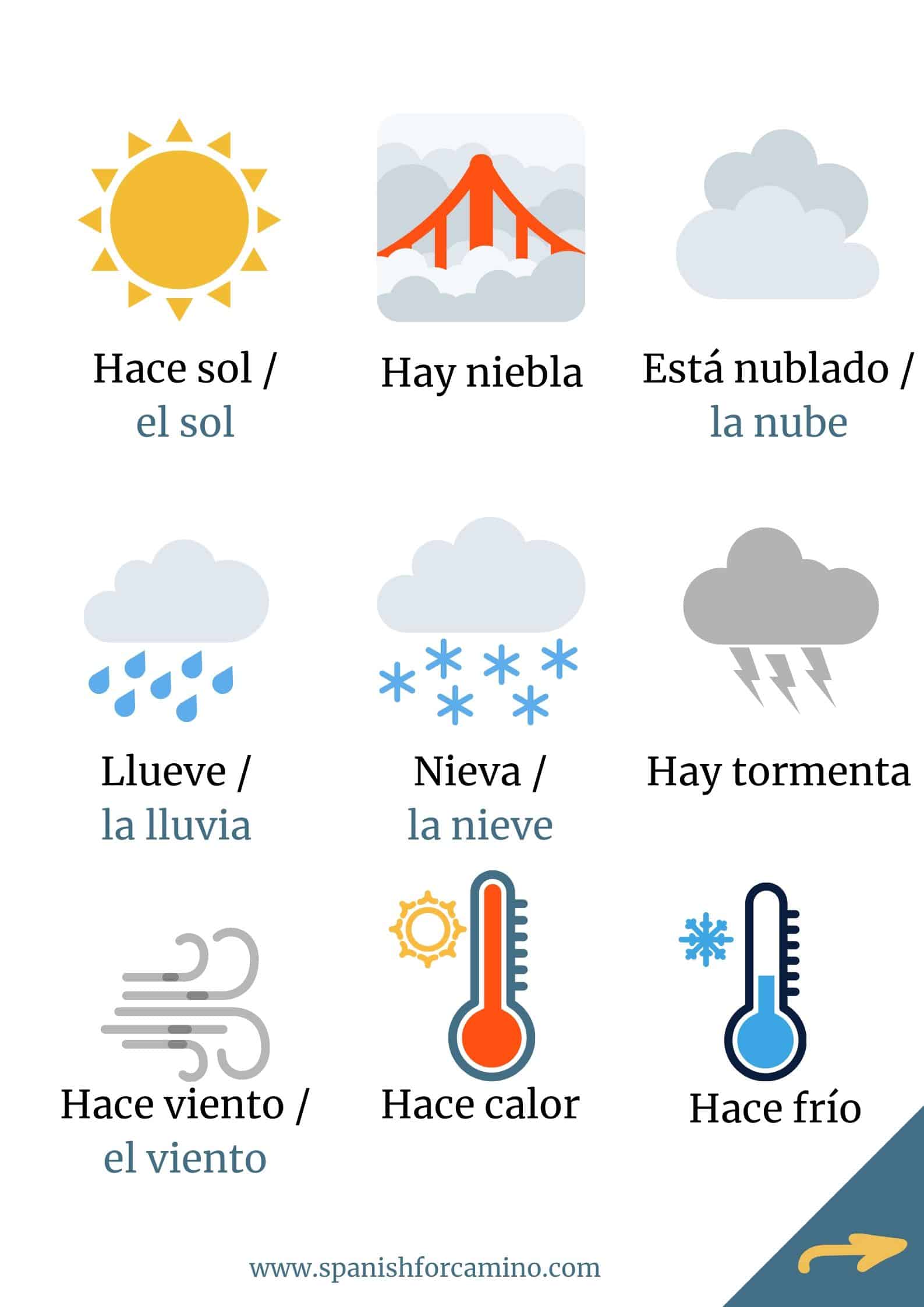
OK. So, we can’t predict next year’s weather on the Camino. But we can still learn a few useful Spanish expressions to talk about it.

In the image below you have the most common phrases. Have a look at them.

Weather on the Camino

You have all the main vocabulary there, but let me give you an extra tip before I go.

If you are hot, please say tengo calor and not what many English-speakers say: estoy caliente. While it is a perfectly correct sentence in Spanish, it doesn’t mean what you think. What you are actually saying is that you are sexually aroused. So, if you’re trying to talk about the temperature… tengo calor is the right phrase!

You could use caliente to talk about the temperature of other things, like a hot shower or a hot drink. But, if you’re talking about yourself (or any other person, for that matter), be aware that caliente has that added extra meaning…

For advice on walking in hot weather, check It’s hot on the Camino.

*one final note: tiempo means weather, but it also means time.


Today’s Spanish words & phrases

Want more?

Make sure you don’t miss any posts or announcements by subscribing for free here. You’ll receive a free Spanish vocabulary guide with your first Spanish words + cultural tips. And… you’ll get access to exclusive content too.
 

¡Buen Camino!

The Camino and the new normal

The Camino and the new normal

The Camino and the new normal |

In the last few months, many have had to postpone or cancel their Camino plans due to the coronavirus pandemic. Spain shut down and we were in strict lockdown for 2 months.

When is the Camino reopening?

That has been one of the most frequently asked questions during this period. For those of us lucky to live in Galicia, walking the last 100km of any Camino has been possible for a couple of weeks already. For the rest… you’ll have to wait a bit longer.

The state of emergency that we’ve been in since March ended on June 15 in Galicia and it will end on June 21 in the rest of Spain. On that day, most restrictions will be lifted and we’ll enter in what the Government has called la nueva normalidad (the new normal).


How will the new normal affect the Camino? 

A set of new rules and recommendations has been approved and they will remain in place until there is an effective treatment or vacuna (vaccine).


  • Airlines and other transport companies are required to hold all passengers’ details for a month, so they can be easily traced in case of a positive case being confirmed.
new normal
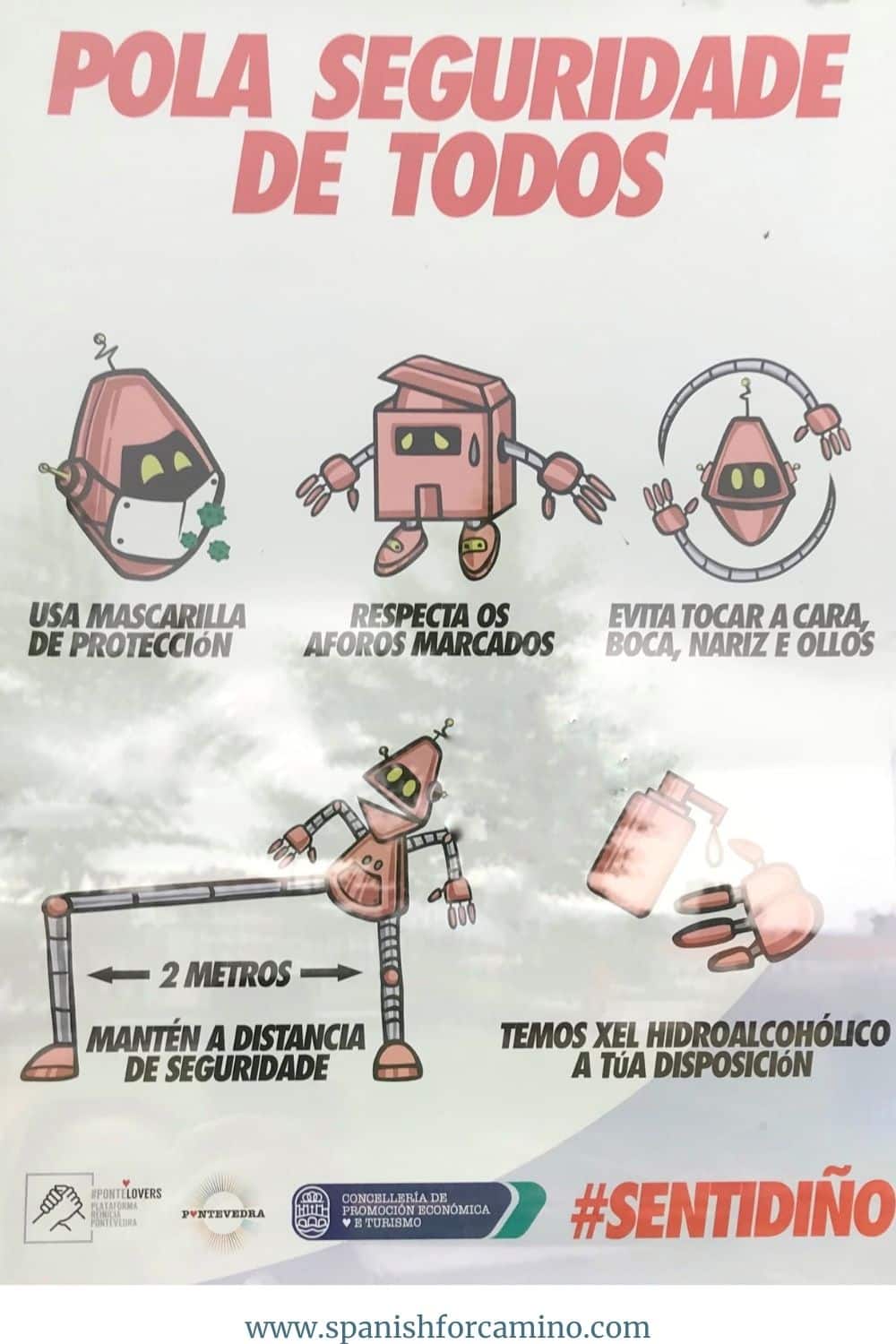
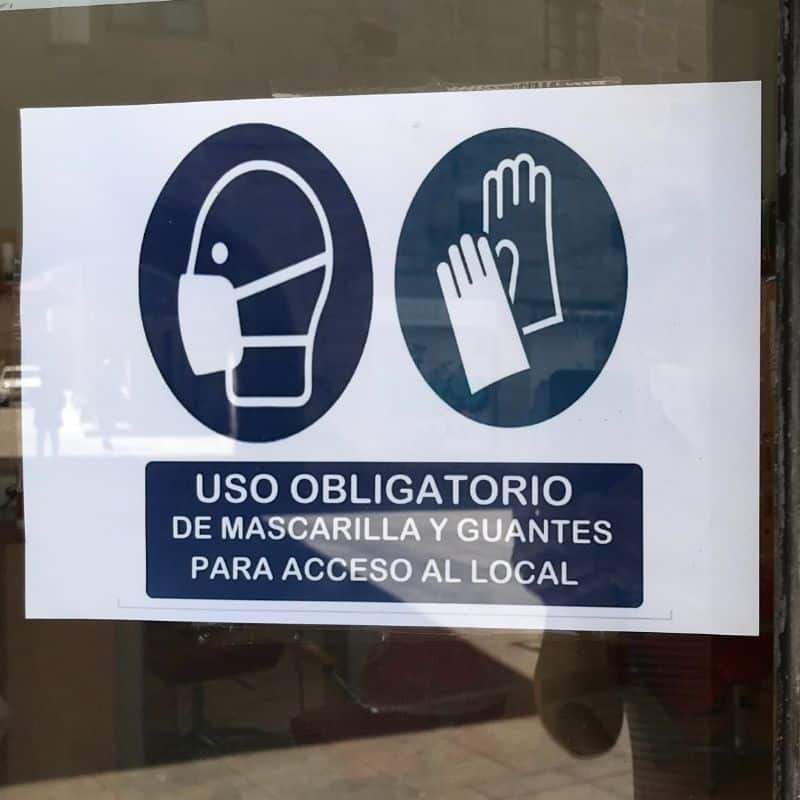
  •  The use of mascarillas (face masks) is compulsory in closed public spaces where a 1.5m safety distance cannot be observed. You can be fined with up to €100 for not complying. So, be ready to wear a mask when you enter tiendas (shops), accommodations and public transport.


  • Don’t be surprised either if you are required to use gel desinfectante (disinfectant gel) on your hands every time you enter a closed space.


But albergues is where we’ll see the biggest change

There are no specific regulations for albergues, but there is a series of recommendations that any type of accommodation should follow.

  • The biggest change for albergues will be in the number of pilgrims they can accommodate, as there has to be a 2m distance between bunkbeds.

Safety measures should be clearly displayed at all times, but these are some of the things you can expect:


You will notice changes from the minute you step inside.

  • Maybe it’s alfombras desinfectantes (disinfecting mats) or gel hidroalcohólico (disinfectant gel) at the entrance.


  • Physical contact is to be avoided, and that includes handshakes.
new normal social distance
new normal mascarillas
  • The use of tarjeta (card) for payment is encouraged. Many albergues didn’t have this option before, so I don’t know whether they’ll make it available. But the recommendation is there.


  • Another change you may encounter could be bolsas de plástico (plastic bags) at the entrance for your backpack, shoes or any other object that could be potentially infected.


  • You can also expect sábanas desechables (disposable bedsheets)… and having to make your own bed. The guidelines say they should give you your bedsheets in a sealed bag, to make sure they are clean and no one else but you can touch them. Also, only bottom bunk beds can be used.


  • Shared toilets should be cleaned and disinfected at least 6 times a day.


  • Communal dinners could become a thing of the past, since shared kitchens can only be used by groups (that travel together) and they have to be disinfected after every use.

What do you think?

Do these measures make you feel safe doing the Camino soon, or would you rather wait?

What do you think will be the biggest change to the Camino experience as we knew it?


Today’s Spanish words

A conversation with Oihana

A conversation with Oihana

A conversation with Oihana |

I met Oihana online. When or how exactly I can’t remember. We both belong to some of the same Camino-related FB groups and we have a couple of things in common: we were both born in towns along one of the Caminos and we have both lived in Ireland (in fact, she still does). So this conversation has been due for a while now.


I wasn’t sure whether to do it in English or Spanish. Finally, I thought that Spanish made more sense, since we’re both from Spain. And… it’s an excellent opportunity for you to practice. But don’t worry if your level of Spanish is not enough to follow our conversation yet! You can find a translation here.


A conversation with Oihana

Conversation with Oihana

Nací en Bilbao, Euskadi, en el Camino Norte a finales del año 75.

Viví y crecí en Venezuela por 27 años, donde realicé mi licenciatura en Administración de Empresas Turísticas y donde trabajé principalmente en el área de eventos, así como en campamentos vacacionales para niños y jóvenes entre 5 y 17 años principalmente en la zona de los Andes venezolanos. 


Actualmente vivo en Irlanda desde hace casi catorce años y trabajo en un colegio de primaria como asistente de educación especial. 


Es tradición de vascos caminar por el monte y recuerdo bien los domingos familiares con el bocadillo de lomo o la tortilla de patatas, así como las excursiones que hacía mi aitite (abuelo en vasco) paterno con los nietos en verano. Asistí a muchos campamentos vacacionales en Euskadi, mi primero con ocho años, una mochila al hombro con ropa y utensilios para dos semanas que recuerdo me pesaba muchísimo mientras caminamos hasta llegar al área final de acampada. Son experiencias que marcan.


En Caracas (Venezuela) existe el maravilloso Parque Nacional “El Ávila” y subir de excursión era algo habitual los fines de semana, unos días rutas cortas y otras durmiendo literalmente sobre las nubes a 2765m de altura en el pico Naiguatá.


En Irlanda las montañas son diferentes, más rocosas de lo que era habitual para mí y de menor altura pero algunas más difíciles de recorrer; son estas junto a las de la zona vasca del Camino Norte, las que me han hecho las piernas más fuertes para el Camino.


¿Cuándo oíste hablar del Camino por primera vez? ¿Cuándo decidiste hacerlo?
 

Santiago es el Patrón de Bilbao y tenemos también Catedral de Santiago, así que el Camino del Norte lo he conocido desde pequeña y caminaba por él sin saberlo porque en ese entonces no había flechas amarillas y no recuerdo ver peregrinos.


En el año Jacobeo de 1993, una de mis guías del movimiento juvenil concepcionista, Magdalena Hung, contaba su experiencia del Camino. No recuerdo detalles pero fue la chispa que encendió la llama del Camino y busqué más información, aunque no fue hasta que dejé Venezuela en 2003 que me decidí a investigar. Fue en el 2005 que tomé la decisión de hacerlo con otra amiga vasco-venezolana de la infancia que vivía en Pamplona en aquel entonces. 


¿Cómo fue tu primer Camino?

Mi amiga Leire y yo queríamos celebrar nuestro 30 cumpleaños de una manera especial y no encontramos mejor manera que pasar tiempo juntas peregrinando a Santiago por el Camino del Norte. Por temas laborales y de logística empezamos en junio de 2006 con unas mochilas de 60 litros y durmiendo en la tienda de campaña que llevábamos por si no encontrábamos albergues disponibles ya que en un principio hacíamos Camino los sábados y domingos. De Vilalba hasta Santiago no llevamos la tienda y dormimos entre albergues y algún hotel.


El Camino del Norte fue duro pero muy bonito, el ver el mar desde la montaña es algo que nos encantaba disfrutar. En agosto de 2006 me trasladé a Irlanda, así que el continuar Camino se complicó un poco más ya que debíamos coordinar nuestras vacaciones y llegamos a Santiago tres años después el 7 de Agosto de 2009. Allí dentro de la Catedral, en el Pórtico de la Gloria, mirando a Santiago y con nuestras Compostelas en mano, nos prometimos celebrar los 40 haciendo el Camino Portugués por la Costa desde Baiona.


Oihana and her friend Leire
On the Camino del Norte

Después has hecho otros Caminos…

He hecho varios Caminos con familia, amigas del colegio y sola. Recorro etapas del Camino Norte muy a menudo sola o con amistades cuando estoy de vacaciones por Bilbao, principalmente la zona vasca, cantabria y asturias porque puedo acceder fácilmente.

El año pasado volví a recorrer sola el Camino del Norte (mi madre, un par de tíos y una prima se unieron en algunas etapas) para celebrar el décimo aniversario de mi primer Camino y en memoria de mi amiga Leire con quien hice mi primer Camino y falleció en Navidad de 2013. 

Cuando tengo una semana de vacaciones, si puedo me gusta hacer Camino pero para terminar en Santiago, es por ello que también he recorrido el Camino inglés desde Ferrol, el Camino Portugués por la Costa desde Baiona y el Portugués desde Tui en varias ocasiones.

Al vivir en Irlanda, también he recorrido varias rutas de peregrinación irlandesas vinculadas al Camino Inglés por las cuales los irlandeses medievales recorrían antes de navegar hasta Coruña para continuar hasta Santiago.


Camino del Norte

Además, eres voluntaria en varias organizaciones relacionadas con el Camino.

En 2017, David Smith (clearskiescamino) me anima a formar parte del equipo de voluntarios de Camino Society Ireland y me introduce a Bernard Lynch quien me acoge, me entrena y me guía como voluntaria de la asociación para ayudar a los peregrinos con mi experiencia. 

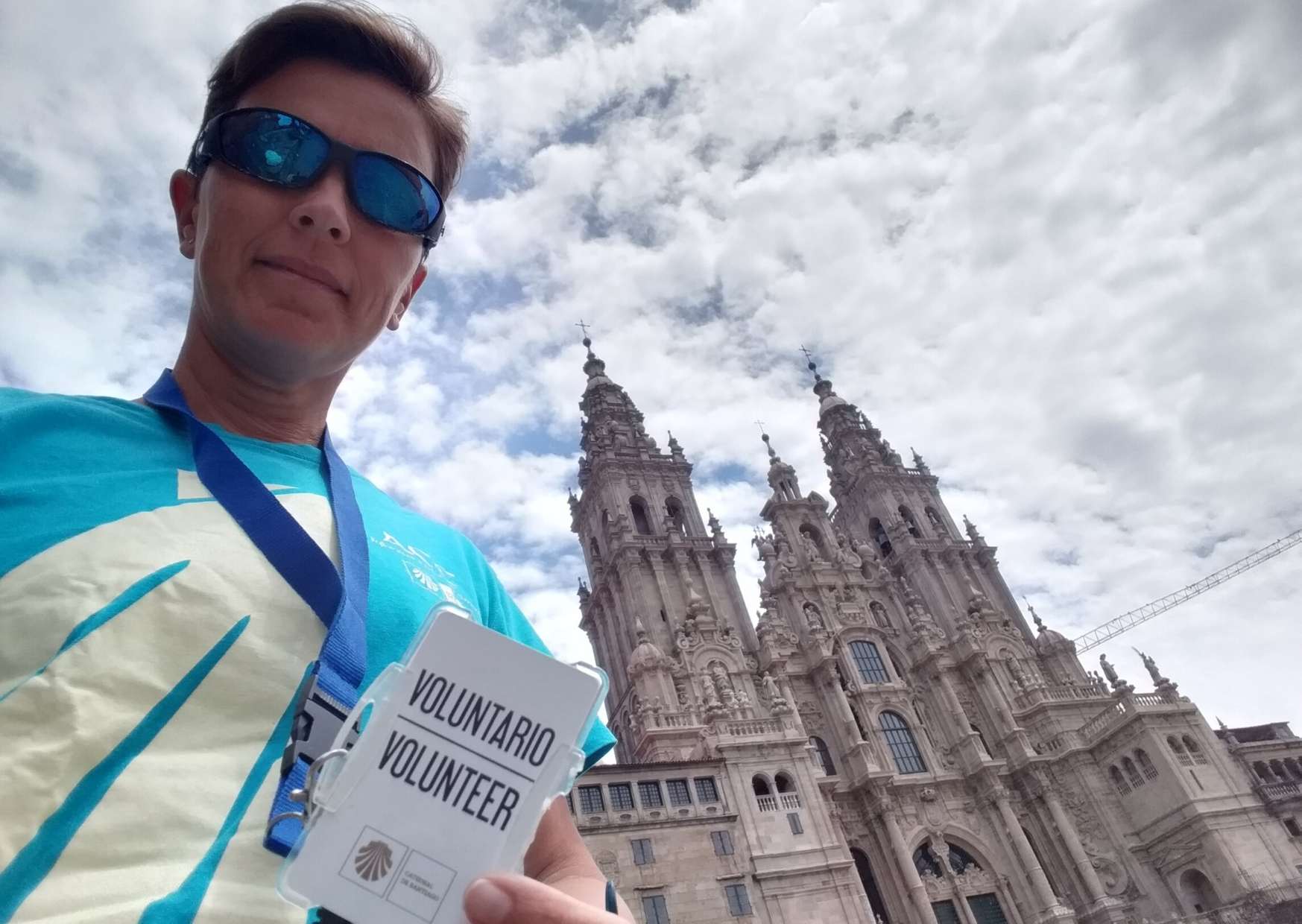
En 2018, Bernard me indica que en la Oficina del Peregrino en Santiago había una plaza para hacer voluntariado con ACC (Acogida Cristiana en los Caminos de Santiago) y que buscaban preferiblemente a una persona con conocimientos y fluidez del español ya que por lo menos un 50% de los peregrinos en verano dominan esta lengua.

Este año también estaba en mis planes pero con las restricciones actuales de viaje por la pandemia, no creo que sea posible. Ser voluntaria para la Oficina del Peregrino es toda una experiencia que hay que vivirla para entenderla. La empatía peregrina para dar acogida es muy importante, es por ello que es requisito para ser voluntario el haber realizado el Camino. La mayoría de las vivencias son muy gratificantes y emotivas aunque algunas veces, el trato recibido por parte de una minoría de peregrinos deja mucho que desear.

Como voluntario te comprometes a dos semanas, trabajando seis horas diarias (muchas veces más por el tema de ayudar lo más que puedes) por seis días a la semana librando uno. Recibes alojamiento, que compartes con más voluntarios que se convierten en tu familia por catorce días. El resto va por cuenta del voluntario (traslado y manutención). 


Conversation with Oihana pilgrims office

Los voluntarios son fáciles de identificar: siempre o casi siempre llevan la camiseta azul del uniforme de ACC que tiene media concha blanca. 


Puedes…

  • ayudar en los mostradores dando acogida y escribiendo Compostelas,
  • dar la bienvenida y acoger en la fila,
  • ayudar en Monte de Gozo ofreciendo información de la oficina del peregrino o de Santiago y revisando las credenciales al poner el sello para recordar de completar la información personal. Este detalle agiliza el proceso y el tiempo de espera para solicitar la Compostela cuando el peregrino llega cansado y el cuerpo no aguanta más,

… entre muchas otras cosas que según las habilidades de cada voluntario. 


¿Crees que tus Caminos habrían sido diferentes si no supieses hablar nada de español?

Por supuesto, el dominar el idioma mayoritario del país es una gran ventaja, sobre todo cuando pasas por poblaciones o caseríos donde no saben otro. 


En las grandes ciudades quizás es más fácil conseguir entenderse en inglés, francés o italiano pero por experiencia propia, muchas veces las traducciones no son correctas o hablando se mal interpretan y provocan confusión y enfados. Por ejemplo no es lo mismo decir “estoy cansada” que “casada”; son un par de palabras típicas que escucho a menudo y según el contexto puedo sacar la conclusión pero a veces vuelve loco a quien recibe para dar alojamiento y te ofrece un tipo de habitación o de cama disponible. 


Yo he ayudado a muchos peregrinos o gente local haciendo de intérprete si me doy cuenta que no se están entendiendo o me piden ayuda . El domino del idioma facilita a aprender más de la cultura a lo largo del Camino y a crear nuevas amistades. 


You can follow Oihana’s Caminos on Instagram and she has a blog too.


Today’s words and phrases

As you’re probably already aware of, Spanish is not the only language that is spoken in Spain. It is the common language, but several regions have their own language too. In Galicia, where Santiago is located, we have galego. You can read more about it (and learn a few phrases) in this previous post.


Oihana is from Bilbao, in the Basque Country, where they have their own language too, euskera. So, I thought it was the perfect occasion to learn some of the Basque language. She has kindly selected the following words for us and recorded the audio too.