
Menú del día

Menú del día

Menú del día |

What is a menú del día? When can you have it? And when can you find comida (food) in Spanish?

Before I answer those questions, let me clarify that the word comida is also what we call the most important meal of the day: lunch. You can refer to lunch as almuerzo, but comida is used more frequently -and it’s easier to pronounce! So I’ll use comida.

If you have been to Spain before you will know this. But if you haven’t, you should be warned: mealtimes in Spain are late compared to other countries. The reason for this is that we are living in the wrong time zone (this article explains it in more detail).


Mealtimes in Spain

As I was saying, la comida is the most important meal, but obviously not the only one. We also have:

  • Desayuno (breakfast). Spaniards, in most cases, don’t take desayuno too seriously. Many just drink a cup of coffee before leaving their homes. That’s why it’s common for people to go down to their nearest bar or cafetería during their break, for a mid-morning café con leche and pincho. Despite that, we have a verb meaning “to have breakfast”: desayunar.


  • Cena (dinner). It is usually a light meal. 10:00pm is a perfectly acceptable (and normal) time to have dinner. It’s not common for restaurants to start serving la cena before 8:30pm. We also have a verb meaning “to have dinner”: cenar.


Having lunch in Spain

Since it’s the most important meal, let’s concentrate on la comida. I already said that lunch in Spain is late, compared to other countries: don’t expect restaurants to start serving lunch before 1:30pm. And you normally have a couple of options:

  1. You can choose from the full carta (menu). This option tends to be more expensive, but it gives you the freedom to choose exactly what you want.
  2. You can go for the menú del día. Generally a more economical option. The price is set and you get at least 2 or 3 choices for each course.


El menú del día

Menú del día was introduced by law in the 60’s. Back then it was called menú turístico and, as the name suggests, it was created to cater for all the tourists that started visiting Spain in those days. The government set the prices and what the menu should include. It should be served as fast as possible and it should also try to promote typical Spanish dishes among the tourists.

Things have changed since, and restaurantes don’t have to offer a menú del día, although many do. Needless to say, prices are not set by the government either and they can vary a lot from one place to another.
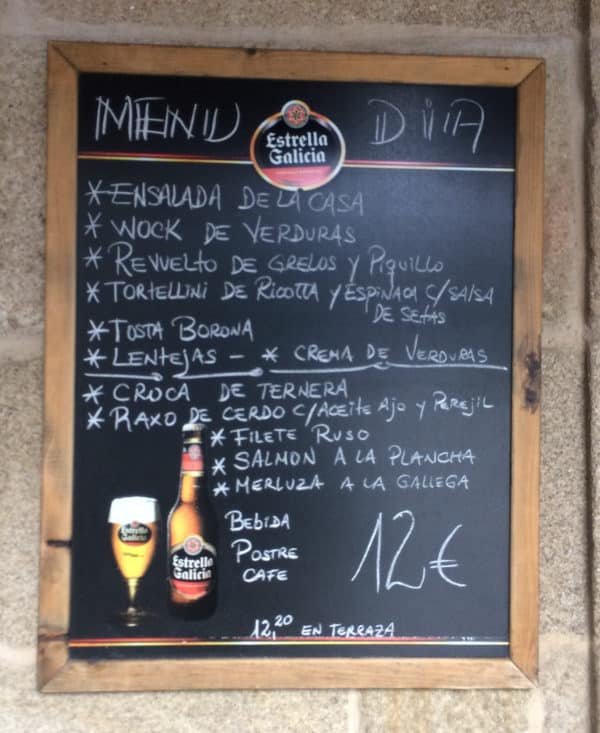
menu del dia

The picture shows a real menú del día from a restaurant along the Camino Portugués.


In this menu, you can see the first and second courses separated by a line. So you have siete  (7) primeros and cinco segundos to choose from. The price is €12.00 (€12.20 if you sit outside) and it also includes a bebida (drink), postre (dessert) and café (coffee).

The primeros usually include vegetables, soups, eggs and/or pasta. All of these are included in this menu:

Vegetables: ensalada (salad) as well as vegetable wok.

Soups: lentejas (lentil soup) and crema de verduras.

Eggs: revuelto (scrambled eggs).

Pasta: tortellini.

The segundos are in most cases either fish or meat dishes.


Some places may offer a vegetarian option among their segundos, but you’re more likely to find one among the primeros. So, if you’re a vegetarian and you still want to avail of the menú del día, you can ask to have 2 primeros, instead of a primero and a segundo. That’s an acceptable practice and most places will be happy to oblige.


What is frowned upon and not allowed in many places is to share a menú del día between 2 people. 

In some places, they have a plato del día (just 1 course instead of 2).


Today’s Spanish words


For the pronunciation of primero and segundo, check Eating on the Camino.


Want more?

Make sure you don’t miss any posts or announcements by subscribing for free here. You’ll receive a free Camino food guide. And… you’ll get access to exclusive content too.


¡Buen Camino!

Shopping on the Camino

Shopping on the Camino

Shopping on the Camino |

Last month I wrote a series of posts about the things you should and should not pack for your Camino de Santiago. In the last one, “Your packing advice“, I tried to summarise all the suggestions I got from experienced pilgrims. One of my favourites was:


No “just in case” stuff. You can buy what you need in Spain.

With that in mind, I thought it would be a good idea to have one of our mini lessons on shopping on the Camino: shops you might need, what to buy in them and how to ask some basic questions… 

Shops and stuff

  • Farmacia (pharmacy) – in a previous post entitled El botiquín I covered the most relevant information about farmacias, as well as the difference between farmacia and parafarmacia and the meaning of farmacia de guardia (you can also listen to the pronunciation of these words there). To sum it up, farmacia is where you can get medicines, with or without prescription, as well as a long list of other items for your personal care.


In a parafarmacia you can find the same stuff as in a farmacia, except for medicines: they sell tiritas and Compeed, creams (sun protection and others), personal hygiene products: from jabón (soap), to shampoo and pasta de dientes (toothpaste)… (check El botiquín for the pronunciation of these words).


Tip: personal care products tend to be cheaper in supermarkets.


  • Frutería (greengrocer’s) – you can buy lots of fruta (fruit) and vegetables here. Loose fruit and veg is sold by weight, so the price you see, unless something else is specified, is the price for a kilo. Let’s say you just want an apple or two; no problem! You pick what you want, they will weigh it for you and you pay for what you take.


  • Panadería (bakery) – you can buy pan (bread) here, obviously. But you can also get empanada (savoury pie) and empanadilla (small version of empanada). Many panaderías are also pastelerías (cake shop), so you can also get all sorts of sweet pies, cakes and pastries.


  • Supermercado (supermarket) – In the bigger supermarkets you can buy all of the above (except for medicines), as well as other things. If you are in a small town with a small supermercado, your options will be more limited but you are still likely to find a bit of everything.


Do you just need a snack? A panadería or frutería  might be all you need. But if you are planning to cook your meals at the albergue or need non-food items, you might want to visit the supermercado.


You should be aware of shops’ opening times. If you are starting your walking day very early in the morning, as most people do, you will find that pretty much everything is closed. So, if you need something for the early morning, your safest bet is to buy it the previous evening.


Also, almost everything is closed on Sundays (not bakeries and cafés) and festivos (public holidays). And during “lunch time”, which is roughly between 13:30-16:30, although it can vary depending on the shop. Again, try to plan your shopping ahead.


And finally, some useful phrases you can use when shopping


  • If you can’t find what you need and want to ask if they have it, you can simply say ¿Tienen…? (do you have?) and add the name of the item you are looking for. For instance, you go into a supermercado looking for tiritas, but you can’t find them. You can ask a member of staff ¿Tienen tiritas?


  • If you need to ask for something, quería (I’d like) followed by the name of the item you want is what you say. Let’s say you go into a farmacia looking for ibuprofeno. What do you say? Quería ibuprofeno. Easy, right?


  • If you want to know the price of an item, you can ask ¿Cuánto cuesta esto? (how much is this?) while pointing at it. You can drop esto if you think it’s not necessary because it’s obvious enough what item you are asking about.


  • ¿Cuánto es? (how much is it?) is similar to ¿Cuánto cuesta?, but they are used differently. As I just said, we use ¿cuánto cuesta? to ask about the price of a specific item. However, we use ¿cuánto es? when we finish our shopping, to find out how much the total is.

Are you ready to go shopping on the Camino de Santiago?


Today’s Spanish words


​ 

¡Buen Camino!


Want more?

Make sure you don’t miss any posts or announcements by subscribing for free here. You’ll receive a free Spanish vocabulary guide with your first Spanish words + cultural tips. And… you’ll get access to exclusive content too.

En el aeropuerto

En el aeropuerto

En el aeropuerto |

And finally… we take a trip to el aeropuerto (airport).

You are very likely to travel by avión (plane) either to get to Spain and start your Camino or to go back home after you have finished your pilgrimage.

So, what do you need to know about airports and air travel in Spanish? If you have been following my weekly posts, I’m sure you already know a few words, those we can also use when travelling by tren or autobús (in case you missed them, here are the links: En la estación de tren, En autobús).

In those two posts you can find words like billete -de ida, de vuelta or de ida y vuelta; asiento, pasillo and ventanilla, which are common to all three means of transport. There are some other common words, but there are also words that are specific to air travel.


En el aeropuerto

  • When you land on a Spanish aeropuerto, you will be in the llegadas (arrivals) area. You should easily find your way out. The good thing about aeropuertos is that all the signage is in English too.


  • If you are starting your journey from a Spanish aeropuerto, you should go to the salidas (departures) area first. You can find both words, salidas and llegadas, in train and bus stations also, on the screens listing all the departures and arrivals.


  • Once in the salidas area, you might need to go to the facturación (check-in) counters, but only if you have luggage to check-in or if you need a tarjeta de embarque (boarding pass).


  • You have your tarjeta de embarque and your luggage has been checked-in (or you have equipaje de mano (hand luggage) only). Then you can go through security and look for your puerta de embarque (boarding gate).


Are you ready to fly?


Today’s Spanish words

Want more?

Make sure you don’t miss any posts or announcements by subscribing for free here. You’ll receive a free Spanish vocabulary guide with your first Spanish words + cultural tips. And… you’ll get access to exclusive content too.
 

¡Buen Camino!

En autobús

En autobús

En el autobús |

Last week we travelled by tren. This week we’re going en autobús or bus. You can use both words: the full name is autobús, but we call it bus for short.

The good news is that a lot of the vocabulary is the same, but not all. So let’s have a look at the differences and similarities:

  • The estación de tren becomes estación de autobuses. However, buses don’t stop at estaciones only. In fact, there are no estaciones in most villages and smaller towns. In those cases, buses stop at paradas (de autobús), also known as bus stops in English.


  • You won’t need andén, vía and vagón when talking about buses. These words refer to trains specifically. If you are in a estación de autobuses and you are trying to find your bus, you need to look for the right dársena (dock).


  • If you go to an estación, you can get your billete from the taquilla, just like when we visited the estación de tren. Your billete can be de ida (one way), de vuelta (return only) or de ida y vuelta (return). Same words apply to billetes de tren, by the way.


  • If there is no estación, or the taquilla is closed, you can buy your billete directly from the conductor (false friend alert! conductor is the driver, not the English conductor).


  • If you need to check the bus or tren schedule, you will ask for the horario.


  • And once you get on the bus, the seats are also called asientos, just like the ones in trains. Asientos can be by the ventanilla (window) or the pasillo (aisle). Which one do you prefer?

Today’s Spanish words 

En la estación de tren

En la estación de tren

En la estación de tren |

You’re probably wondering… what are we doing en la estación de tren? When we think about the Camino de Santiago we think walking, maybe cycling or even horse-riding. Trains, buses and planes do not come to mind. But we will need them…


Why are we discussing transport?

  • First, you have to get in and out of Spain and that will most likely happen by plane.


  • Once you are in Spain, you need to get to your starting point, the town where you will start your pilgrimage. And you have to get out of Santiago, once your Camino is done.


  • Even after you have started your Camino, you might sometimes skip a stage or two, for a number of reasons such as time constraints or health issues.


In the latter cases, you will probably use tren (train) or bus (or the occasional taxi, which is also conveniently called taxi in Spanish!).


En la estación de tren

Some of you suggested that I should cover this topic in my mini lessons, so that is the plan for the next couple of weeks. This week we’ll navigate our way around the estación de tren (you might find it also referred to as estación de ferrocarril, but estación de tren is more common).

  • Whether you are travelling by tren, bus or plane, your ticket is called billete (by the way, we use the same word for banknotes, so you get two Spanish words for the price of one!).


  • Where do you buy your billetes de tren (train tickets)? En la taquilla (in the ticket office). Well, you can also buy them online, but if you are already at the station and you don’t have your billetes yet, then you should look for the taquilla.


  • On the information screens you will see in which vía (platform), your train can be found.


  • Vía can be translated as platform, but it literally means track. La vía is for the tren, but people stand on the andén (platform). So, let’s say that your tren is leaving from vía 3: you wait for it on the andén (waiting on the vía would be illegal, not to mention too dangerous!). Does that make sense? Please, let me know if it’s not clear enough.


  • Before you get on the tren, you need to look for some information on your billete: first of all, the number of your vagón (your billete will say coche, but we don’t call it like that when we are talking).


  • And finally, you’ve made it to your vagón. Your billete will also tell you what number your asiento (seat) is. You can now get comfortable and enjoy!


  • Oh! I almost forgot! The person who walks up and down the tren checking that we all have billetes is the revisor.

Are you over 60?

If you are travelling by train and you are over 60, you can get a Tarjeta Dorada (golden card). You can buy it (€6) at the taquilla and it will entitle you to discounts of up to 40% on the price of your billetes. You will need to show your passport in order to purchase it. Here’s the link to RENFE’s website with all the information about it (it’s in Spanish): http://www.renfe.com/viajeros/tarifas/tarjeta_dorada.html


Today’s Spanish words

Where did you stay?

Where did you stay?

Where did you stay?


In the past few weeks I wrote about the different types of accommodation where you can stay along the Camino (¿Dónde vas a dormir?, El albergue and ¿Dónde vas a dormir? (II)). And for this post I wanted to get the stories of people who have already done the Camino about places where they stayed. So I asked the question: where did you stay?


Which Camino?


Although we talk about the Camino de Santiago or the Way of Saint James as if there is just one Camino, the truth is that there are many routes leading to Santiago. There’s the very popular Camino francés, but you could also decide to do the Camino primitivo, Camino del norte, Camino inglés or Camino portugués, to mention just a few.


Let’s just look at the Camino portugués today. As the name suggests, it goes from Portugal to Santiago de Compostela. If you start your pilgrimage from the Portuguese capital, Lisbon (Lisboa in Spanish), you will have to cover a distance of around 600 km. If you walk 25 km per day on average, you will need 25 days to complete it.


Many people start from Porto; in that case, you will need around diez (10) days to walk the 240 km to Santiago. If you don’t have so much time, you can do the Spanish section of this Camino, from Tui. It’s 119 km (enough to get a compostela) and you can do it in cinco (5) or seis (6) days.


In Padrón


All the places these pilgrims tell us about are along the Camino portugués. Scott Prunty has a recommendation for you:

You must visit the monastery (monasterio) in Padrón before pushing on to Santiago. It was the highlight of my walk. We were given a tour by the friars that still study there. Then we were joined by local villagers for a beautiful mass (misa) together.

After a communal dinner (cena) with other pilgrims, we slept in the original cells that friars have lived in for centuries. The whole experience just made a connection to the Camino spirit.


According to the information in the following link, http://www.alberguescaminosantiago.com/albergues-camino-portugues/hospital-de-peregrinos-san-antonio-de-herbon-herbon-la-coruna/ there are 30 beds in this albergue. You cannot book in advance and you must produce your stamped credencial if you wish to spend the night. Apart from la cena that Scott mentioned, you can also have your desayuno (breakfast) here. They take donativo (voluntary donation).


Two places on the coast


Vera Wallström would like to recommend two places:

Pazo Pías in Ramallosa was a great place to sleep at! Single room (habitación individual).

And Camping Mougás, after Mougás. They have a saltwater swimming pool (piscina) with a view, lovely after walking 30km!


In this link you can find pictures and more information about Pazo Pías: http://pazopias.org/contenidos/peregrino 

Vera’s picture of the pool.

In Porriño

And Tess Bouds had a nice experience at the albergue municipal in Porriño:

It is clean & quiet, even though it’s right next to a very large road. I forgot my glasses when I left and had to visit the policía, who called the cleaning lady. Twenty minutes later, I had them and was off. FYI amazing kitchen which you can use if you carry pots, plates, & utensils.

Do you have an “accommodation story” that you would like to share? Just leave a comment!


Basic Spanish Camino vocabulary

Want more?

Make sure you don’t miss any posts or announcements by subscribing for free here. You’ll receive a free Spanish vocabulary guide with your first Spanish words + cultural tips. And… you’ll get access to exclusive content too.


¡Buen Camino!